Clear Sky Science · en
All pure multipartite entangled states of qubits can be self-tested
Seeing quantum secrets without opening the box
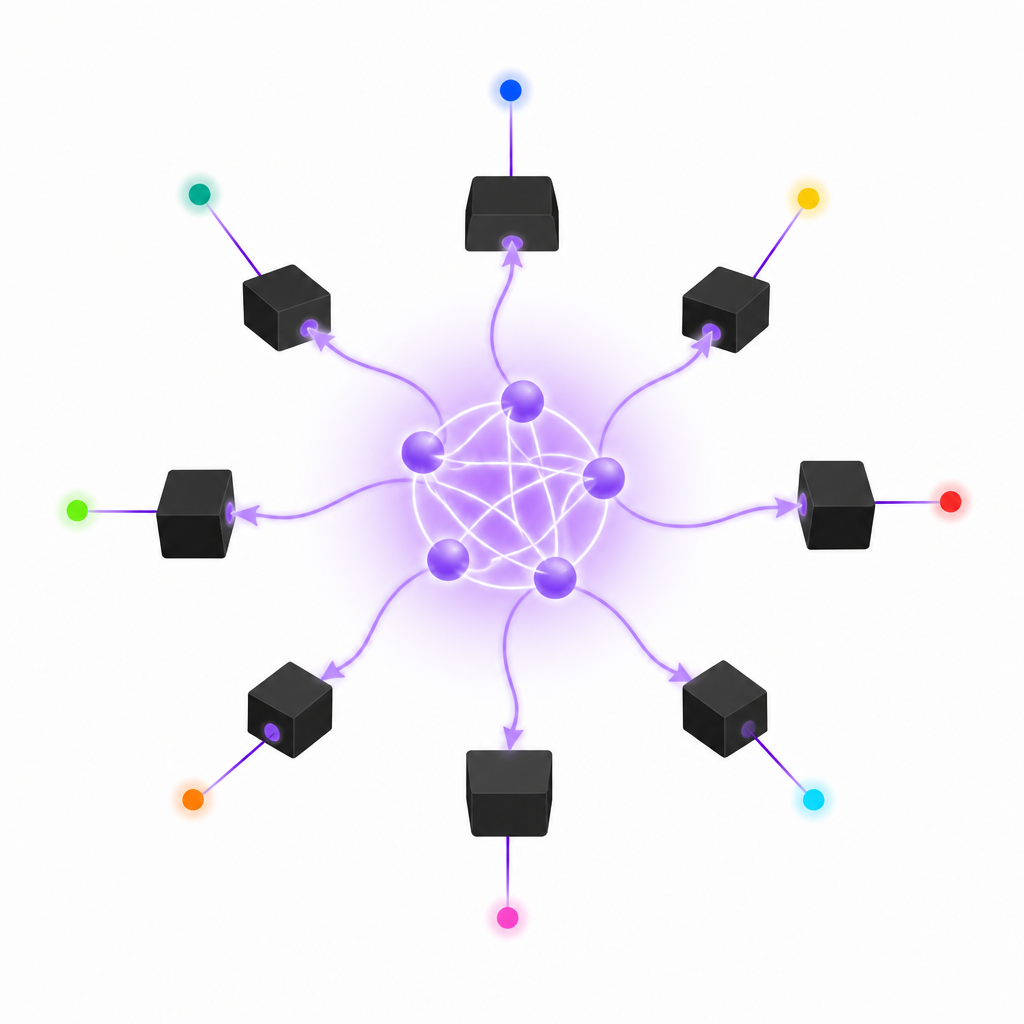
Quantum technologies rely on delicate links between tiny particles, yet real devices are often opaque black boxes that scientists cannot peer inside. This work shows that, for a very broad class of quantum systems made of two-level particles called qubits, it is still possible to figure out exactly what shared quantum state is present, using only the patterns of answers that come out of measurements on separated devices. This offers a powerful way to check and certify complex quantum hardware without having to trust how it was built.
From spooky correlations to reliable certification
The study builds on the idea of Bell nonlocality, where measurements on distant quantum systems yield correlations that no classical hidden mechanism can explain. These correlations violate mathematical constraints known as Bell inequalities. Because any such violation can only arise from entanglement, researchers can use it to certify quantum behavior in a device-independent way, without assuming anything about the internal workings of the measuring devices. Earlier work had already shown that any entangled pair of qubits can be certified in this way, but whether the same was possible for larger entangled systems involving many parties remained unsettled.
Giving every many-qubit state a unique fingerprint
The authors prove that every pure entangled state made of any number of qubits admits a unique “classical fingerprint” in a standard Bell test setting. In practice, this means they design, for each target state, a precise pattern of measurement choices and outcomes on spatially separated devices such that only that state, up to some unavoidable symmetries, can generate the observed correlations. Each party in the test chooses among several yes or no measurements, and the joint statistics across all parties are enough to pin down which many-qubit state must have been shared.
Breaking the many-body problem into simpler pieces
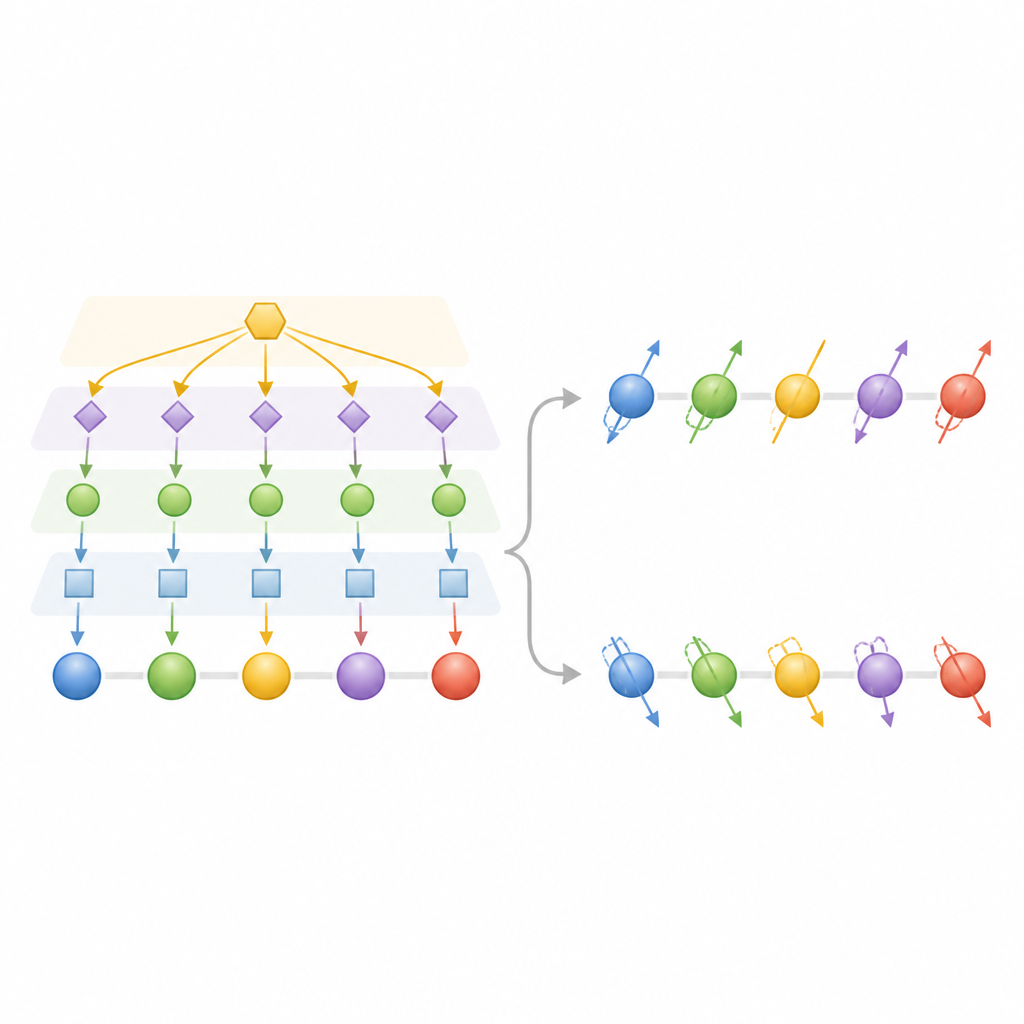
To tackle the daunting complexity of many entangled qubits, the researchers first solve key building blocks. They use refined versions of Bell inequalities to certify not only certain two-qubit states, but also the full set of basic measurements on one of the qubits. With this toolbox, they introduce a measurement lemma that lets them characterise any additional yes or no measurement by studying how it correlates with the already certified ones. They then apply a modular strategy: by asking one party to measure first, the remaining parties are projected into simpler two-party states that can be certified using known methods, and this is repeated while cycling the role of the first party.
Scaling up to many parties with a coherent extraction trick
For three-party systems, the team shows that a carefully chosen combination of such sub-tests is enough to determine any genuinely tripartite entangled state, again allowing for certain harmless transformations such as local changes of basis or taking the complex conjugate. To extend the result to an arbitrary number of qubits, they organise the parties into a sequence of sub-tests where some parties act as “projectors” and others as “tested” pairs. A special circuit called a SWAP isometry uses the certified two-setting measurements to coherently transfer the unknown global state onto clean auxiliary qubits, revealing two distinct branches related by complex conjugation and fixing their relative weight via the observed statistics.
What this means for future quantum devices
The main conclusion is that any pure entangled state of qubits, no matter how many particles are involved, can be fully certified using only measurement outcomes from separated black-box devices, within the usual quantum symmetries. In principle, this enables experimentalists to verify the creation of large, intricate entangled states in a completely device-independent manner, an important goal for secure communication, randomness generation, and delegated quantum computing. The work also highlights open challenges, such as making these tests more tolerant to noise, reducing the number of measurement settings, and extending the approach beyond qubits to systems with more than two levels.
Citation: Balanzó-Juandó, M., Coladangelo, A., Augusiak, R. et al. All pure multipartite entangled states of qubits can be self-tested. Nat Commun 17, 4463 (2026). https://doi.org/10.1038/s41467-026-70829-x
Keywords: quantum self-testing, multipartite entanglement, Bell nonlocality, device-independent certification, qubits