Clear Sky Science · en
Additive-mediated interfacial engineering of H2SO4-catalyzed isobutane alkylation from molecular design to industrial process intensification
Turning Everyday Fuel into a Cleaner Product
Modern cars and planes rely on high quality gasoline made from complex refinery processes. One important step combines light gases into a dense, high octane liquid fuel called alkylate, prized for making engines run smoothly and with fewer tailpipe pollutants. This study explores how tiny amounts of special additives can reshape the boundary between liquids inside a refinery reactor so that more of this desirable fuel is produced using the same equipment and conditions.
Why the Liquid Boundary Matters
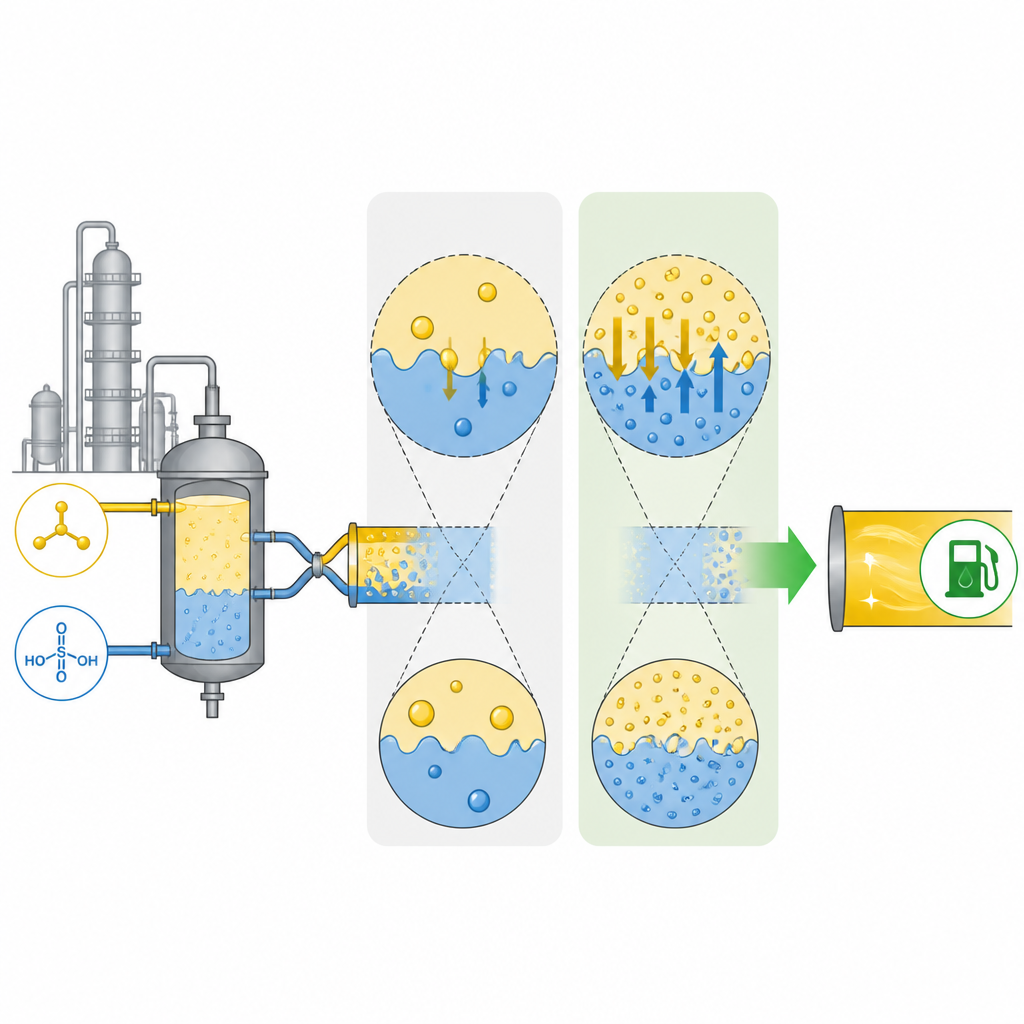
Inside an alkylation reactor, two liquids that do not mix well need to react: a strong sulfuric acid phase and a hydrocarbon phase made mostly of isobutane and butenes. Where these liquids touch, at the interface, is where most of the chemistry happens. But isobutane moves across this boundary more slowly than butenes, so the overall reaction is held back by how fast isobutane can cross. The authors show that by adding a small amount of a surfactant like PPG400, the liquid boundary can be reshaped to speed up this crossing without changing the basic chemistry.
Watching Molecules at the Border
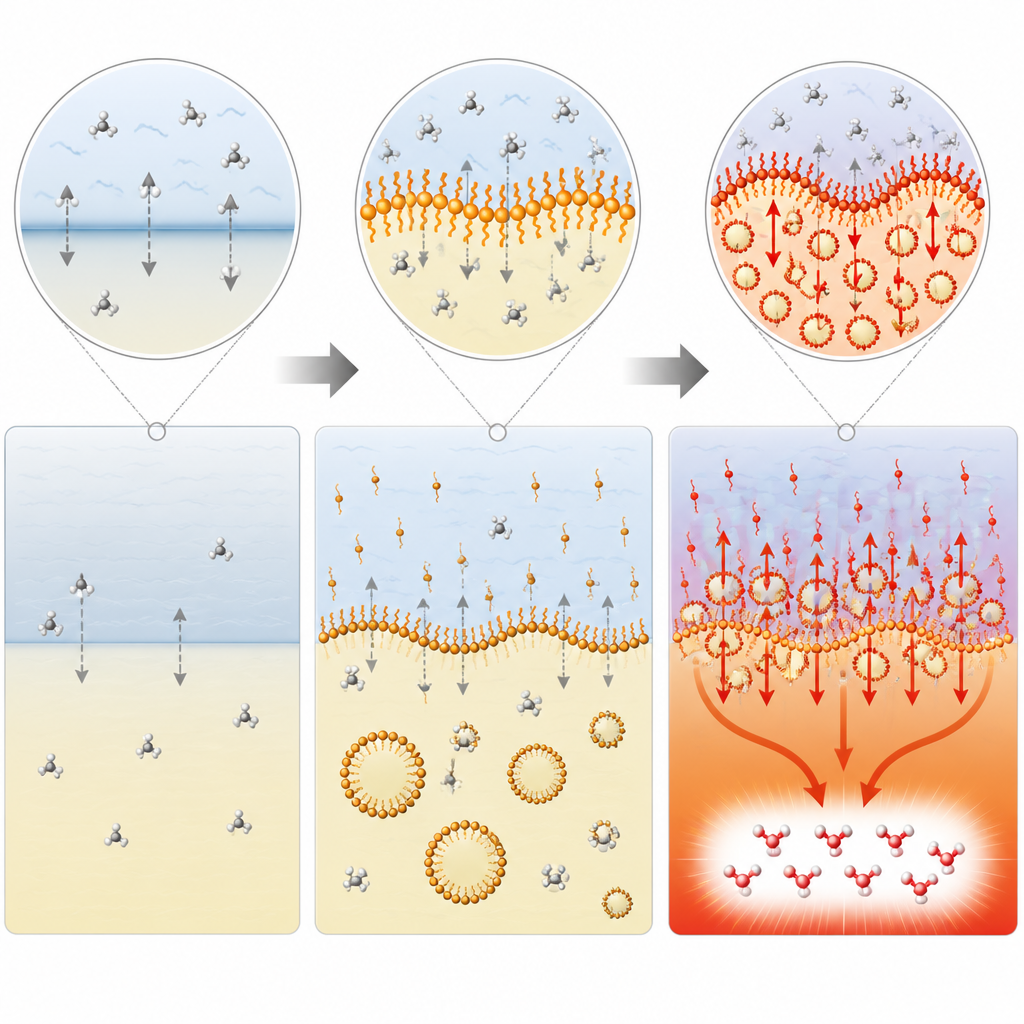
To understand what the additive does on the tiniest scales, the team used molecular dynamics simulations, a kind of computer microscope that follows individual molecules over time. They found that PPG400 molecules gather at the acid and hydrocarbon boundary, forming a thin, organized layer. This layer slightly lowers the tension between the liquids and thickens the interfacial zone. As a result, more isobutane accumulates at the boundary and the energy barrier for it to enter the acid becomes smaller, even though its movement through the boundary becomes a bit slower due to crowding.
From Droplets to Reactor Performance
The researchers then connected these molecular insights to what happens at the scale of droplets swirling in a stirred tank. Using a combined fluid dynamics and population balance model, they predicted how the additive changes droplet size and mixing. Lower interfacial tension allows the hydrocarbon liquid to break into many smaller droplets, increasing the total contact area between the two liquids. Even though individual molecules move slightly more slowly through the interface, the larger contact area and higher concentration difference drive a bigger overall flux of isobutane into the acid phase. The authors defined a dimensionless “enhancement factor” that compares this mass flux with and without additives and showed it tracks very well with measured fuel quality.
Separating Transport from True Reaction Speed
Because the chemistry itself is extremely fast once isobutane reaches the acid, most past measurements of reaction speed were blurred together with transport limits. Here, the authors built a kinetic model that explicitly separates the true chemical reaction rates from the rate at which isobutane crosses the interface. After mathematically removing the transport effects, they found very large intrinsic rate constants and low activation energies, consistent with nearly instantaneous hydride transfer steps. Importantly, these intrinsic rates stayed the same with or without additive, confirming that the additive works by improving transport rather than by changing the chemistry.
Scaling Up to the Refinery
Armed with this clearer picture, the team used process simulation software to test how such additives would affect a full industrial alkylation unit. They showed that adding a small amount of PPG400 to a realistic, slightly impure sulfuric acid stream can lift alkylate output by about one quarter while maintaining or even slightly improving octane quality. The same additive also allows operators to shorten residence time or lower the isobutane to olefin feed ratio, both of which increase throughput without sacrificing product quality.
What This Means for Future Fuels
For a non-specialist, the key message is that thoughtfully designed additives can act like traffic managers at the invisible border between two liquids, allowing more of the right molecules to get to the reaction zone at the right time. The study offers a recipe for connecting molecular structure, interfacial behavior, and reactor performance, and shows that a simple, low cost additive such as PPG400 can turn an existing process into a more efficient producer of high octane gasoline blendstock without new reactors or harsher conditions.
Citation: Ma, Z., Ding, Y., Sun, W. et al. Additive-mediated interfacial engineering of H2SO4-catalyzed isobutane alkylation from molecular design to industrial process intensification. Nat Commun 17, 4291 (2026). https://doi.org/10.1038/s41467-026-70828-y
Keywords: isobutane alkylation, interfacial mass transfer, sulfuric acid catalysis, surfactant additives, alkylate gasoline