Clear Sky Science · en
Heat-assisted hot-hole transfer increases the surface-enhanced Raman activity of Au-TiO2 nanoarrays
Watching Molecules React in the Heat
Chemical reactions that happen at high temperatures power everything from making clean fuels to destroying pollutants. But actually watching how molecules change under these hot, real-world conditions is hard. Many powerful microscopes only work in a vacuum, while most optical tools lose sensitivity when things heat up. This study reports a new way to turn up the heat and still see molecules clearly, using an upgraded form of a laser-based technique called surface-enhanced Raman spectroscopy (SERS).
Why Heat Usually Silences the Signal
SERS works by placing molecules on tiny metal structures that act like antennas for light. When a laser hits these nanostructures, the local electromagnetic field is amplified, and the molecules scatter light in a way that reveals their chemical fingerprints. In practice, however, SERS substrates tend to lose their strength at high temperatures. Metal nanoparticles can change shape or clump together, and protective coatings that keep them stable can block the flow of electric charges that help boost the signal. Earlier attempts to make temperature-tunable SERS relied on soft polymer layers that change with heat, but these only worked below about 55 °C, far from the conditions of many industrial and catalytic processes.
Building a Heat-Hardy Nano Forest
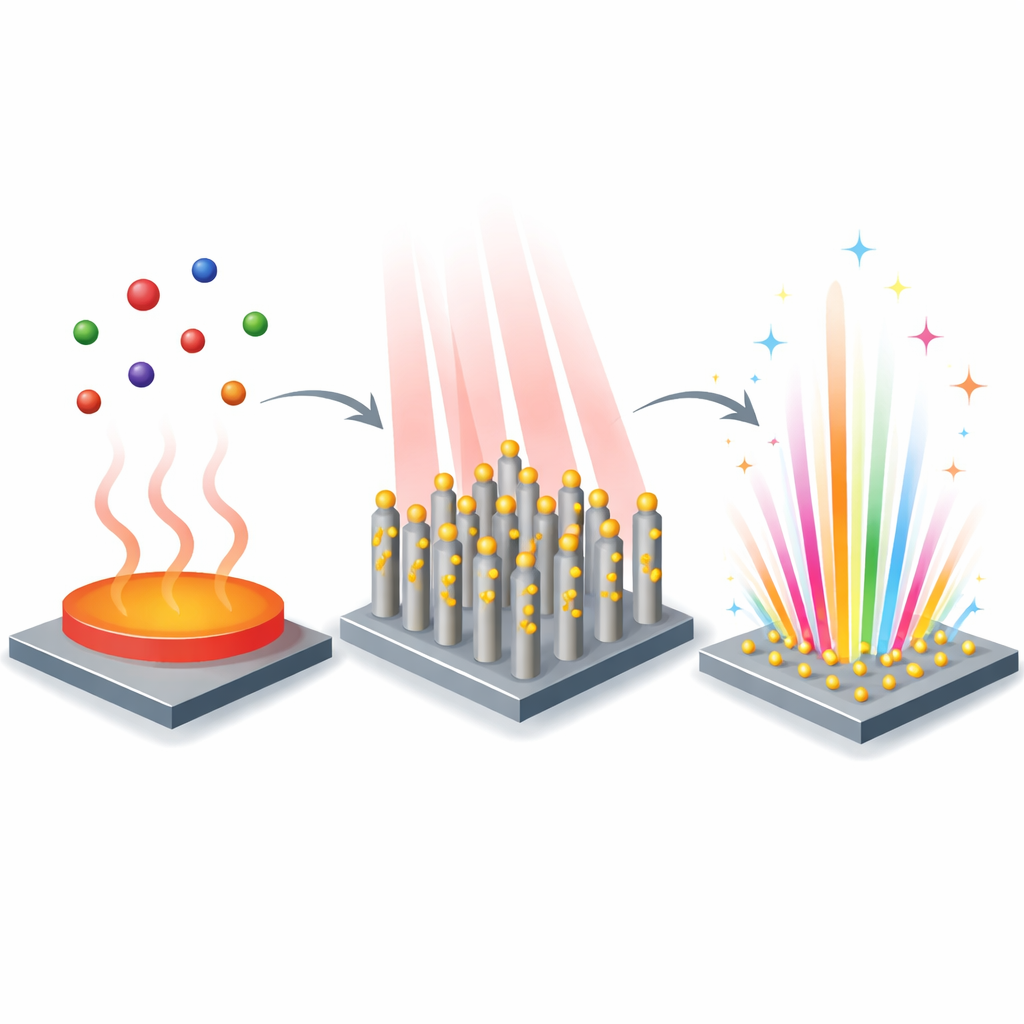
The researchers tackled this limitation by engineering a robust hybrid material made of gold and titanium dioxide, arranged as a dense forest of nano-sized rods. First, they grew upright TiO2 nanoarrays on a conductive glass using a hydrothermal process, giving a large surface area and a stable crystal structure. Then they used light-driven chemistry to coat these rods with tightly packed gold nanoparticles. Electron microscopy and diffraction techniques showed that the gold formed a continuous, well-coupled layer on the rutile TiO2 surface. Optical measurements confirmed that this composite absorbed light from the visible into the near-infrared range, making it an efficient light harvester and an excellent candidate for SERS under different colors of laser light.
Turning Heat into a Signal Booster
When the team tested these gold–TiO2 nanoarrays with a near-infrared laser at 785 nm, they saw something unexpected: as the temperature rose to 180 °C, the Raman signal from test dye molecules became more than eleven times stronger than at room temperature, instead of fading away. This “temperature-induced SERS” not only boosted signal strength but also allowed detection of molecules at extremely low, femtomolar levels. The effect could be precisely tuned by adjusting temperature, was reversible over many heating and cooling cycles, and remained stable at high heat for tens of minutes. Control experiments showed that neither gold nanoparticles alone nor TiO2 alone could produce this behavior; the enhancement came from the intimate cooperation of both materials in the nanoarray.
How Heat Unlocks Hidden Charge Flows
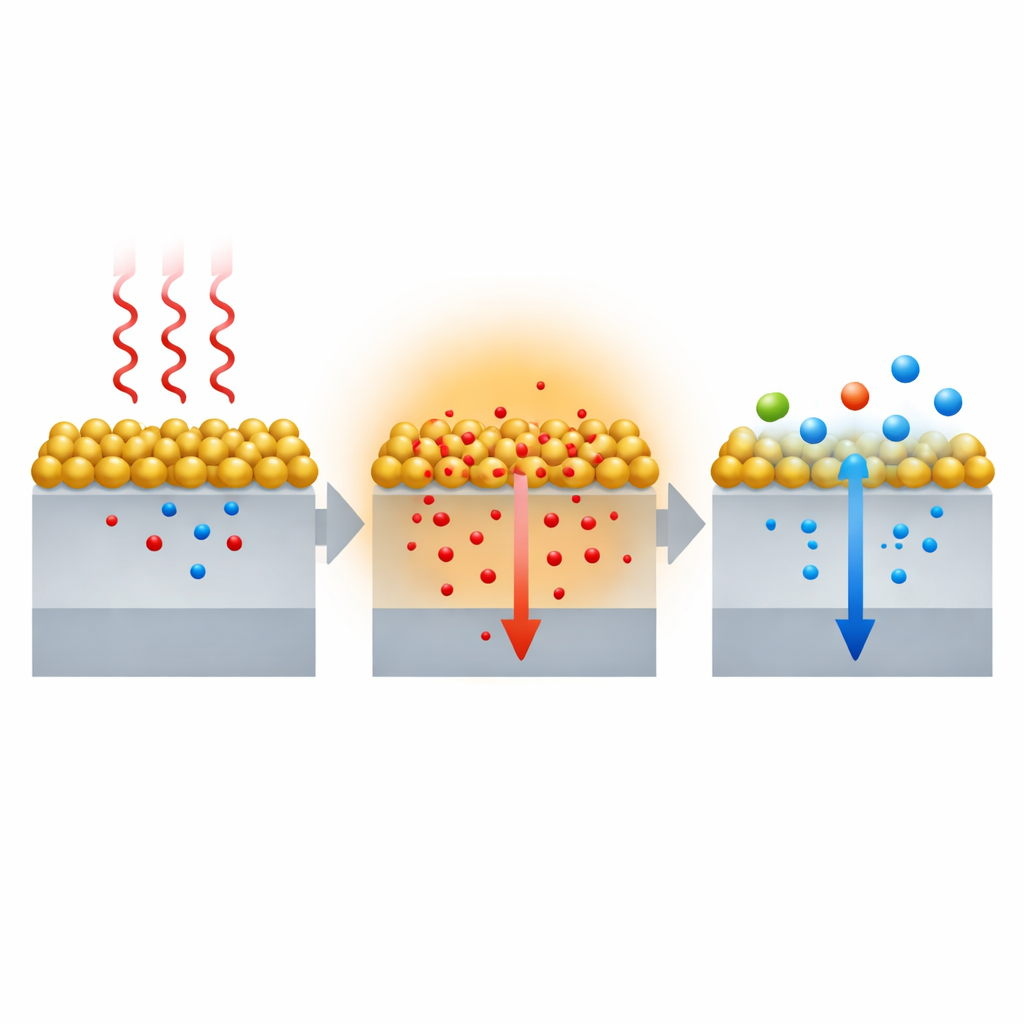
To understand why heating helped rather than hurt, the authors probed the ultrafast motion of electric charges in the material. Using transient absorption spectroscopy, they tracked how excited electrons in the gold relaxed over trillionths of a second, and found that at higher temperatures the relaxation became faster in the gold–TiO2 system, consistent with more efficient transfer of “hot” charge carriers across the interface. Electron paramagnetic resonance experiments revealed that, at room temperature, mainly hot electrons move from gold into TiO2. At elevated temperatures, however, new signatures appeared that signaled the flow of positively charged “hot holes” from gold into oxygen sites in TiO2. Theory calculations supported the idea that removing these hot holes from the metal leaves more energetic electrons available to interact with nearby molecules, strengthening the Raman response in a selective, chemically driven way.
From Harsh Conditions to Practical Uses
Because this heat-assisted process depends on how charges move rather than on a specific test molecule, the same nanoarrays worked for a wide range of dyes, drugs, pesticides, and other small compounds, even those that normally scatter light very weakly. The team further showed that, under combined heat and near-infrared light, the substrate could not only sense molecules but also drive and track a surface chemical reaction in real time, something that neither heat nor light alone could achieve. In simple terms, by cleverly pairing gold with a sturdy semiconductor and exploiting how heat reshapes electronic energies, the researchers turned SERS from a fragile low-temperature tool into a powerful, tunable probe for chemistry happening in the heat.
Citation: Zhang, M., Yu, T., Liu, H. et al. Heat-assisted hot-hole transfer increases the surface-enhanced Raman activity of Au-TiO2 nanoarrays. Nat Commun 17, 4047 (2026). https://doi.org/10.1038/s41467-026-70822-4
Keywords: surface-enhanced Raman spectroscopy, plasmonic photocatalysis, hot carrier transfer, gold–titania nanoarrays, high-temperature sensing