Clear Sky Science · en
Printable Newtonian fluid photocatalysts for scale-up solar CO2 conversion
A new way to paint with sunlight
Turning carbon dioxide into useful fuels using sunlight is an attractive idea for tackling climate change, but most current materials are powders that are hard to spread over large outdoor surfaces. This study introduces a printable liquid-like catalyst that flows like honey yet clings tightly to many surfaces, making it far easier to build large solar reactors that convert carbon dioxide into carbon monoxide, an important feedstock for making fuels and chemicals.
Why powders are a problem
Conventional photocatalysts are tiny solid particles designed to absorb light and drive chemical reactions. While they can be very active, scaling them up is difficult. They must be glued into supporting matrices or sealed inside special devices so the powders do not blow away or wash off. These supports often block the shortest pathways for charges and gas molecules, wasting much of the catalyst surface that should be doing the work. As a result, engineers face a trade-off between keeping catalysts in place and letting them operate efficiently in real outdoor conditions.
A liquid catalyst that still behaves like a solid
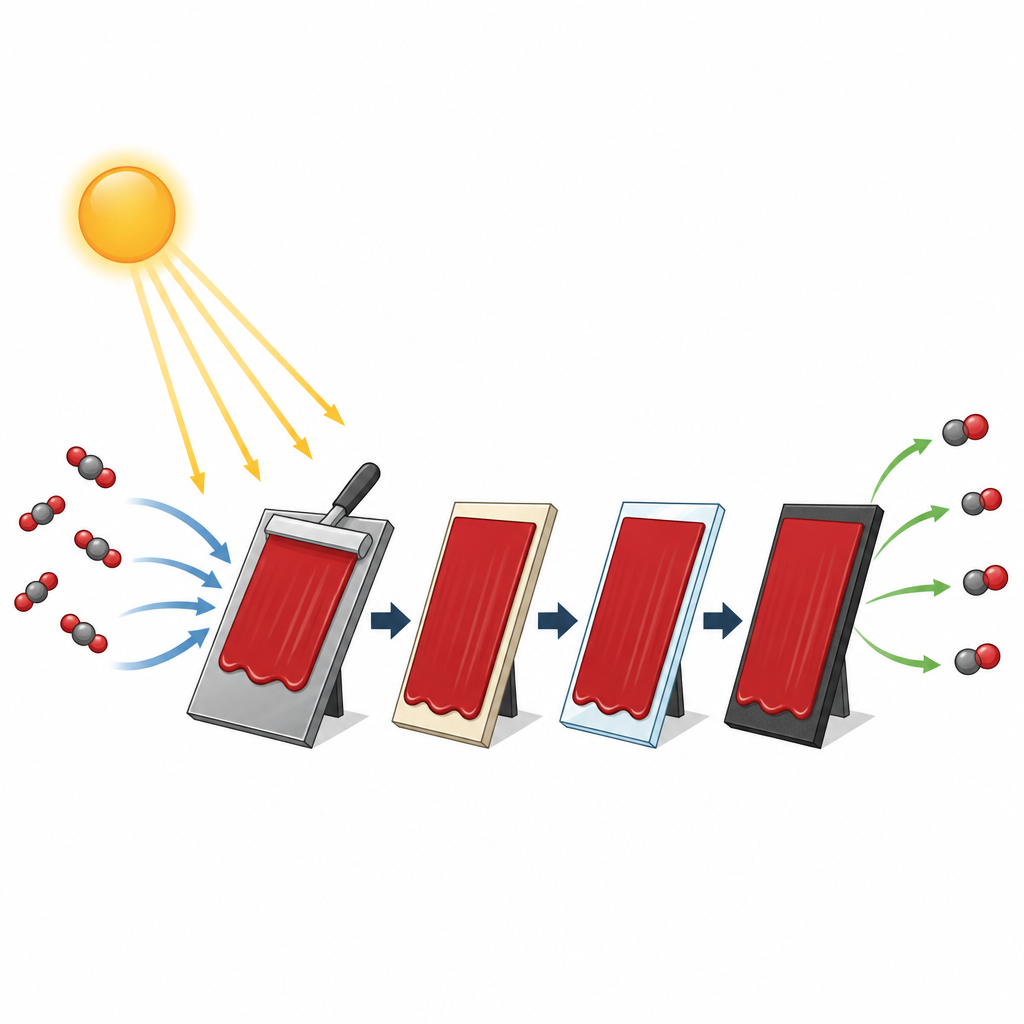
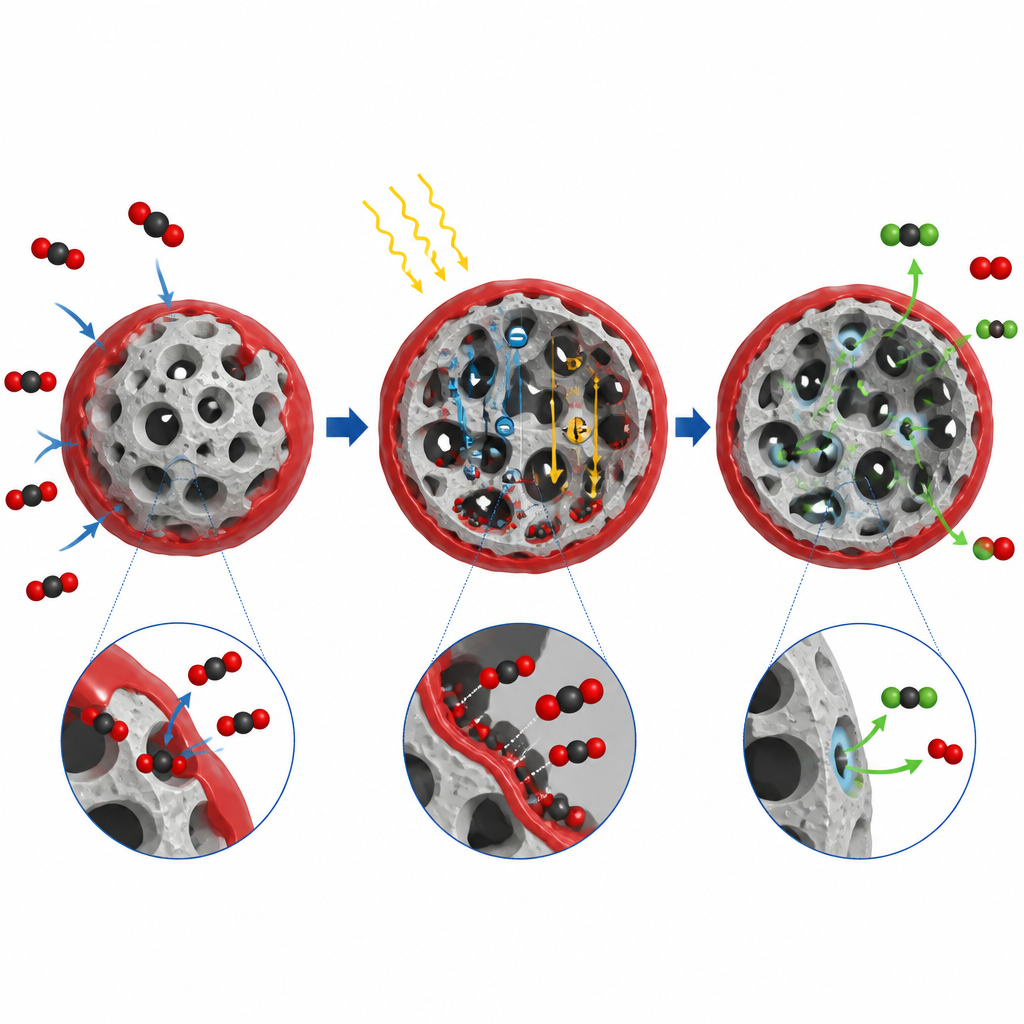
The researchers solved this by building a “Newtonian fluid” photocatalyst that behaves like a thick, stable paint. Inside are hollow nanospheres made from an imidazole-based polymer that carry a positive charge and have many tiny pores. Wrapped around them are long liquid chains based on a light-absorbing dye and a flexible amine. The opposite charges on the solid spheres and liquid chains make them self-assemble into a smooth, cohesive fluid. It flows when pushed yet keeps a constant viscosity, so it can be brushed or printed onto metals, plastics, wood, grids, slopes, and even downward-facing surfaces without dripping off.
How the painted layer speeds up the reaction
Beyond being easy to coat, the new fluid strongly improves how sunlight drives carbon dioxide conversion. The hollow, porous cores act as the main reaction sites, helping gas molecules quickly move in and out. The surrounding liquid chains absorb visible light and donate electrons to the solid cores, where carbon dioxide sticks and is reduced. Experiments and computer simulations show that this solid–liquid partnership separates charges efficiently, pulls in carbon dioxide, and holds key reaction intermediates more stably at the interface. As a result, the painted catalyst produces carbon monoxide at a rate nearly 58 times higher than the solid spheres alone, with 100 percent selectivity for the desired product and stable output over many hours.
From lab vials to outdoor panels
Because the catalyst is a true fluid, it can be loaded into a syringe or brush and spread in seconds over large areas, then withstand strong winds without losing material. The team coated the bottom of a 36-liter glass tank to create a tabletop-scale solar reactor that ran outdoors under changing sunlight. Despite real-world fluctuations in light intensity and sun angle, the painted layer continued to generate carbon monoxide reliably. The same strategy also worked when the researchers replaced the hollow polymer cores with common photocatalysts such as titanium dioxide and carbon nitride, showing that many powder materials can be upgraded into similar printable fluids.
What this means for solar carbon recycling
In plain terms, this work turns a pile of hard-to-handle catalyst powder into a reusable, sticky paint that captures sunlight and carbon dioxide much more effectively. By combining porous solid particles with light-harvesting liquid chains in a single Newtonian fluid, the approach makes it easy to coat complex surfaces, improves how gas and charges move, and greatly boosts the yield of carbon monoxide. While more steps are needed before industrial use, printable fluid photocatalysts provide a practical path toward larger, more efficient solar devices that recycle carbon dioxide into useful building blocks for fuels and chemicals.
Citation: Lu, Z., Cheng, Y., Xu, Y. et al. Printable Newtonian fluid photocatalysts for scale-up solar CO2 conversion. Nat Commun 17, 4277 (2026). https://doi.org/10.1038/s41467-026-70819-z
Keywords: photocatalysis, carbon dioxide conversion, Newtonian fluid catalyst, solar fuels, printed coatings