Clear Sky Science · en
Unlocking the reducing power of metal nitrides by mechanochemical hydrodefluorination of fluorinated compounds
Why tough fluorine chemistry matters
Fluorinated chemicals are everywhere: in medicines, crop-protection agents, non‑stick pans, waterproof jackets and firefighting foams. Their popularity comes from a very strong carbon–fluorine bond that makes these compounds unusually stable. That same stability, however, turns many of them into so‑called “forever chemicals” that resist breakdown in the environment. This study introduces a simple, solvent‑saving way to strip fluorine from a wide range of fluorinated molecules and even from Teflon‑like plastics, turning them back into useful hydrocarbons and inorganic fluoride salts.
Breaking one of chemistry’s toughest bonds
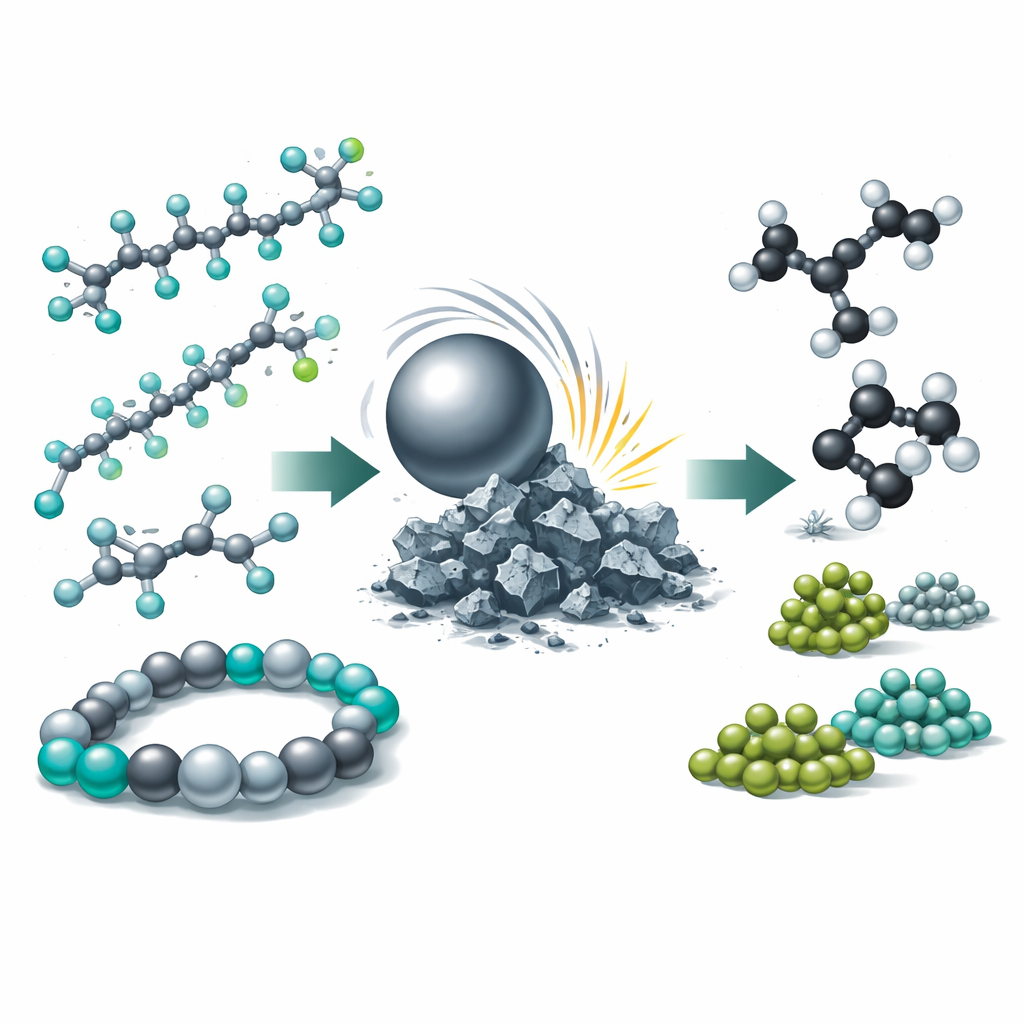
The carbon–fluorine bond is among the strongest single bonds in organic chemistry, which is why fluorinated molecules endure heat, light and chemical attack. Existing methods that do manage to crack these bonds often require electricity, light or harsh reagents, and they frequently shred the entire carbon framework instead of yielding reusable products. The authors set out to find a general strategy that could work on many different fluorinated targets—from simple aromatic rings and alkyl chains to persistent industrial pollutants—while giving back ordinary hydrocarbon molecules rather than chemical rubble.
Using mechanical force and a neglected powder
The key ingredient is magnesium nitride, a cheap gray powder usually treated as a source of ammonia rather than as a reducing agent. Because it does not dissolve in typical liquids, it rarely participates directly in organic reactions. The team overcame this limitation by using a ball mill: a small metal jar loaded with steel balls that rapidly vibrate, grinding and smashing the solid ingredients together. Under air at room temperature, mixtures of fluorinated compounds, magnesium nitride, a little base and a tiny amount of water or dilute solvent are milled. Mechanical impacts activate the nitride and force intimate contact with the fluorinated molecules, enabling the nitride ions to donate electrons and weaken the stubborn carbon–fluorine bonds.
Turning many fluorinated molecules back into hydrocarbons
Once the conditions were tuned, the method worked on an impressively broad set of starting materials. Numerous fluorinated aromatic rings bearing methoxy, amino, alkyl and heterocyclic groups were converted cleanly into their non‑fluorinated counterparts in good to excellent yields. The protocol also handled difluorinated rings, benzylic systems and certain alkyl fluorides, as well as related chlorinated and brominated compounds when the base was adjusted. Importantly, several perfluoroalkyl substances—problematic components of firefighting foams and other products—underwent partial defluorination to give organic products plus inorganic fluoride. Even when complex perfluorinated acids did not yield stable organics, analysis confirmed that carbon–fluorine bonds were being cleaved.
Grinding down “forever” plastics
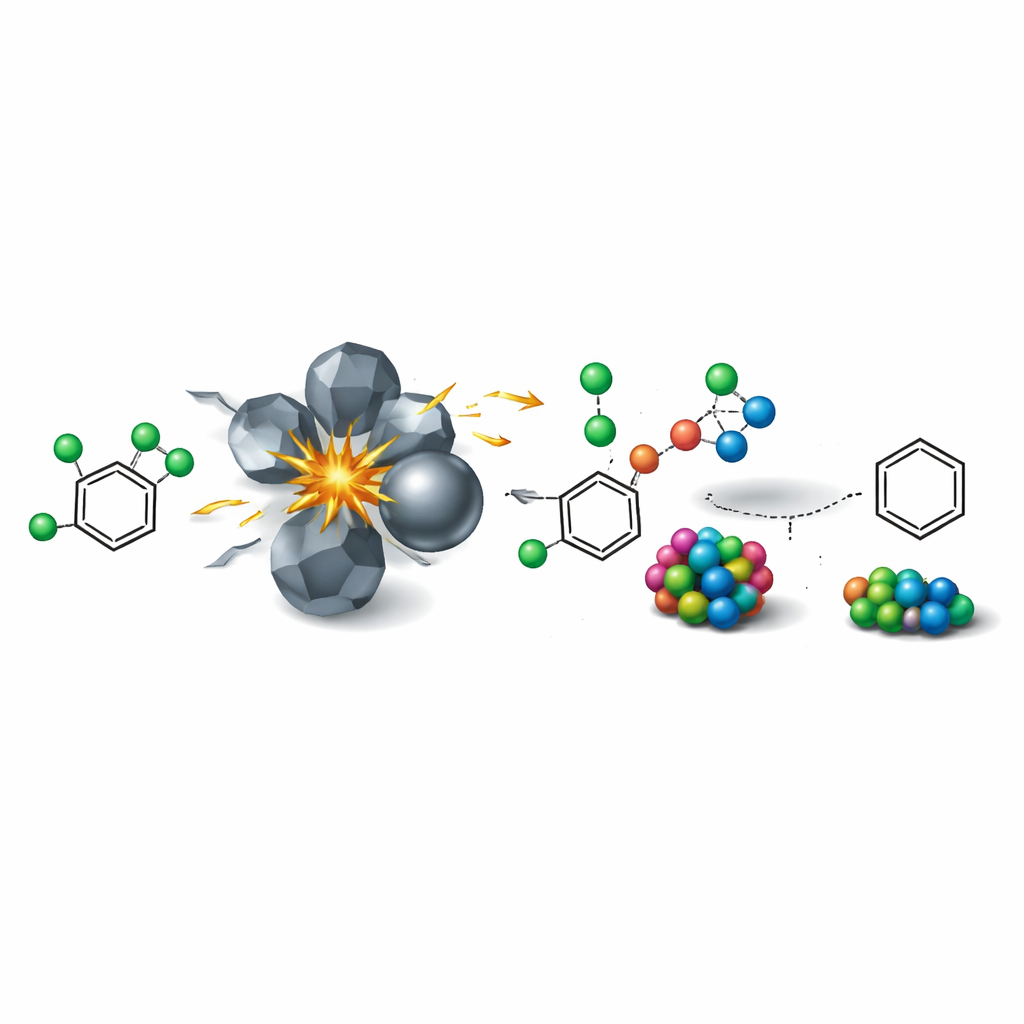
The authors then tested whether fluorinated polymers could be attacked in the same way. When Teflon (polytetrafluoroethylene) powder was milled with magnesium nitride or lithium nitride, signals characteristic of the polymer’s carbon–fluorine bonds disappeared, and inorganic fluoride salts formed. The remaining solid showed spectroscopic signatures of disordered carbon, similar to graphitic material, indicating that the once‑robust plastic had been broken down into a carbon‑rich residue and fluoride. In the lithium nitride system, the fluoride salt produced in the mill could even be reused as a reagent in other reactions, hinting at a circular use of fluorine.
How the grinding‑powered reaction likely works
Mechanistic experiments suggest that mechanical force and base first activate magnesium nitride, which then transfers an electron to a fluorinated aromatic ring to give a short‑lived radical species. The carbon–fluorine bond breaks, generating a radical on the carbon and a free fluoride ion. The radical is quickly reduced further to a charged intermediate that picks up a proton from traces of water to form the defluorinated hydrocarbon. The fluoride binds strongly to magnesium ions, precipitating as magnesium fluoride and helping drive the process forward. Control reactions showed that plain magnesium metal is far less effective, underscoring that the nitride ions themselves provide the crucial reducing power.
A new way to tame persistent fluorinated chemicals
For non‑specialists, the central message is that a simple grinding process using an overlooked inorganic powder can break some of the toughest bonds in common “forever chemicals,” often restoring them to familiar hydrocarbons while trapping fluorine as an innocuous salt. This approach operates without high temperatures, complex catalysts or large volumes of solvent, and it works on everything from fine chemicals to stubborn plastics like Teflon. Although more work is needed to turn it into a practical waste‑treatment technology, the study reveals that metal nitrides can serve as powerful, solid‑state reducing agents and opens a fresh route toward managing and recycling fluorinated materials.
Citation: Chen, JS., Guo, LF., Pan, H. et al. Unlocking the reducing power of metal nitrides by mechanochemical hydrodefluorination of fluorinated compounds. Nat Commun 17, 4131 (2026). https://doi.org/10.1038/s41467-026-70813-5
Keywords: forever chemicals, hydrodefluorination, mechanochemistry, metal nitrides, PFAS degradation