Clear Sky Science · en
A selective enrichment and specific probe terminal mediated strategy for highly sensitive detection of microRNAs
Why tiny blood messages matter
Doctors are eager to use simple blood tests to spot cancer and viral infections early, long before symptoms become severe. One promising approach looks at microRNAs, tiny pieces of genetic material that change when disease is present. But these signals are so short, scarce, and easily drowned out by other molecules in blood that current lab tests often miss them or mistake noise for a real warning sign. This study introduces a new testing platform designed to cleanly pull out the right microRNAs and read them with far greater accuracy, bringing blood based diagnosis a step closer to everyday use. 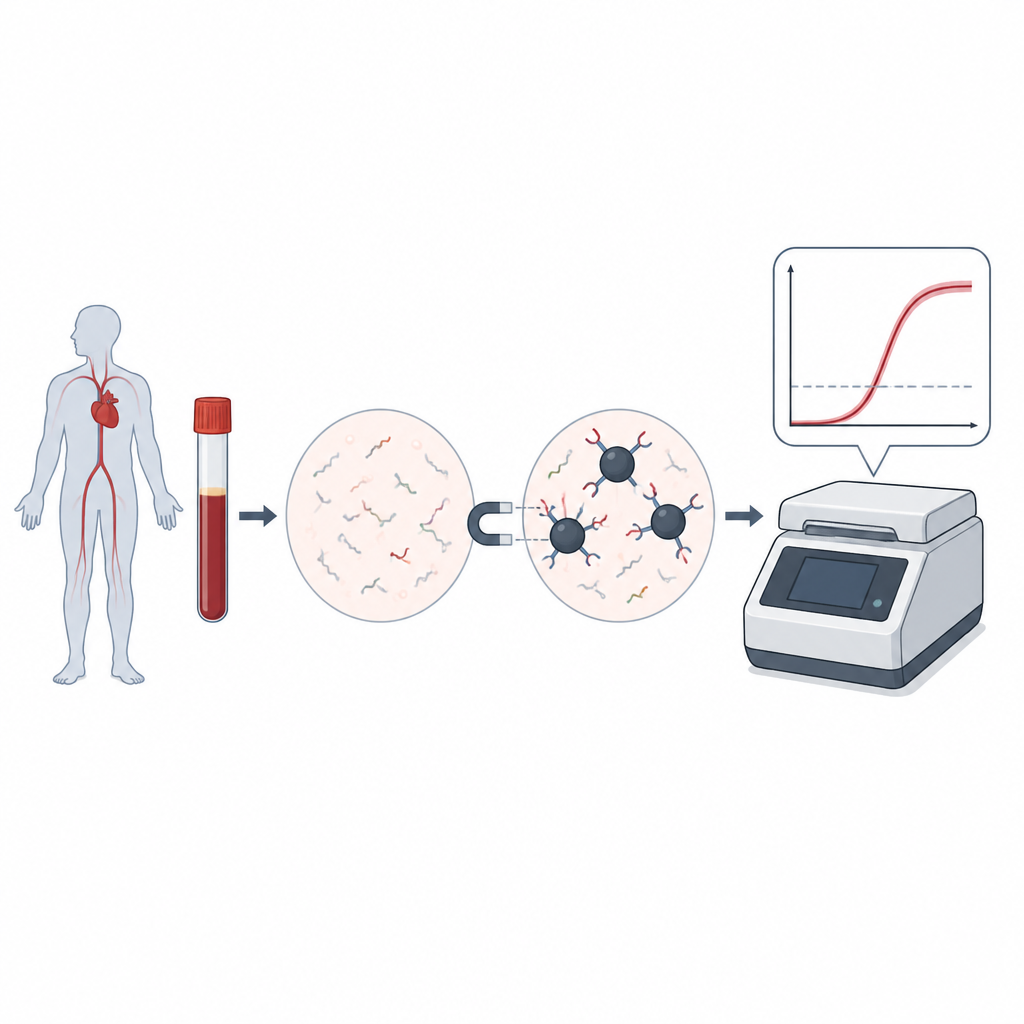
Small signals with big diagnostic promise
MicroRNAs are short strands that help control how our genes are used, and many of them shift in pattern when diseases such as cancer or viral infections take hold. Because they are stable in blood and other body fluids, they are strong candidates for so called liquid biopsies that could replace or reduce invasive tissue sampling. However, microRNAs are present at very low levels and often look almost identical to each other. Standard tests struggle to tell close relatives apart and are easily confused by the crowded mix of DNA and RNA in real patient samples, leading to false alarms and missed cases.
Fishing out the right microRNAs
The researchers first tackled the clutter problem by creating a selective enrichment step that acts like a very picky fishing net. They coated magnetic beads with specially designed DNA probes that include locked nucleic acid building blocks, which bind more tightly and precisely to chosen microRNAs. When these beads are mixed with treated blood samples, the target microRNAs latch on, while most unrelated DNA, RNA, and only loosely matching microRNAs are washed away. Automated handling of the beads improves consistency, cuts processing time, and boosts the yield and purity of the captured microRNAs compared with common column based extraction kits.
A sharper way to read tiny genetic codes
Next, the team improved how the captured microRNAs are measured. Traditional real time PCR tests for microRNAs rely on a loop shaped starter molecule and a fluorescent probe that are not specific enough, so they can even generate signals in pure water. The authors redesigned the test, called Specific Probe Terminal Mediated PCR, so that three separate parts must all match the microRNA sequence: the capture probe on the bead, the looped starter used to copy the microRNA, and a fluorescent probe whose tail is tuned to the exact sequence of interest. This triple check system prevents similar microRNAs from being copied or detected if they differ by even one or two building blocks at either end. 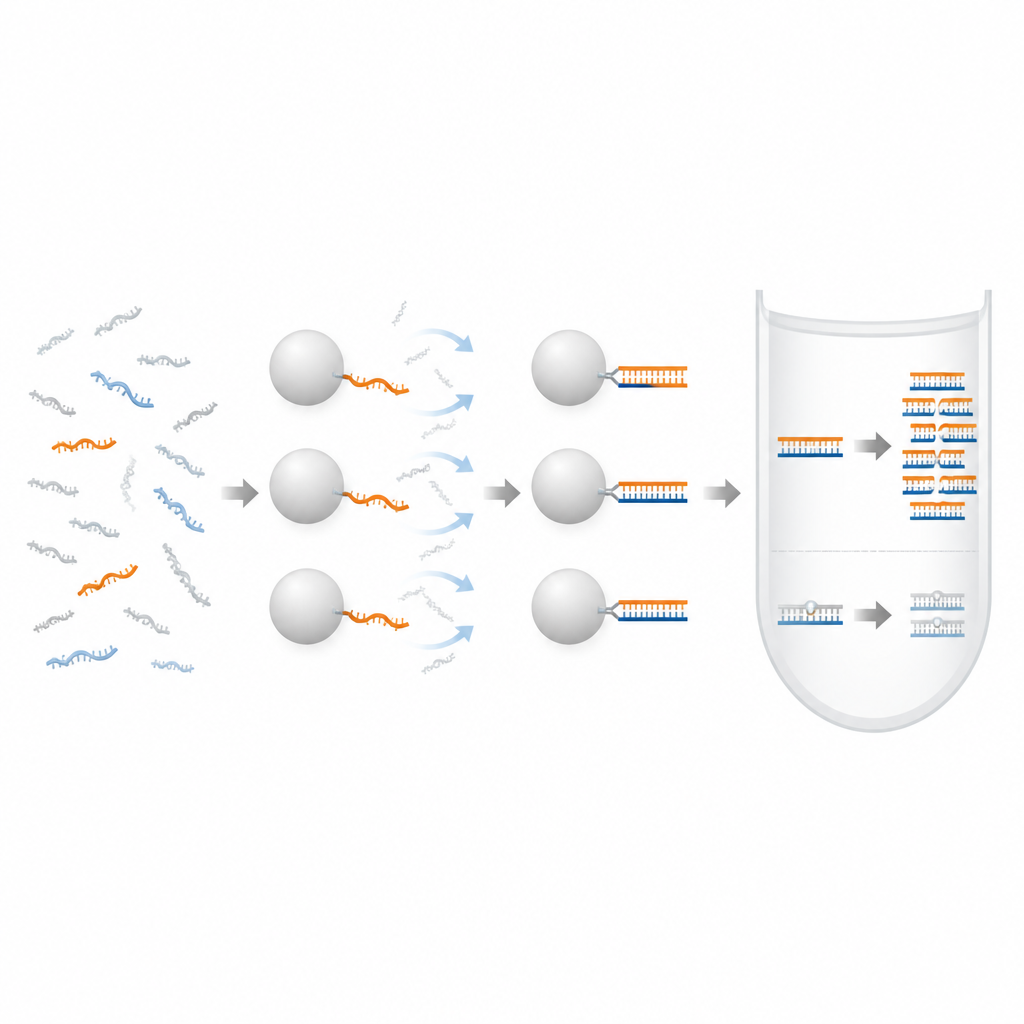
From lab bench to real patient samples
By combining selective enrichment with the new reading method, the full SE-SPTM-PCR platform achieves around 100 times higher sensitivity than standard stem loop PCR assays and virtually eliminates spurious background signals. In plasma from people with colorectal cancer, the platform improved the performance of an existing microRNA marker, hsa-miR-92a-3p, raising its ability to distinguish patients from healthy volunteers. The method also revived two viral microRNA markers that earlier studies had judged unhelpful: an HCMV microRNA became highly informative for monitoring viral reactivation after stem cell transplantation, and an EBV microRNA reached near perfect separation between nasopharyngeal carcinoma patients and controls.
What this means for future blood tests
In plain terms, the study shows that many microRNA based blood tests have been limited more by the tools used to measure them than by the markers themselves. By selectively pulling out the right microRNAs and reading them with a stricter, cleaner assay, SE-SPTM-PCR reveals stronger, clearer disease signals in the same patient samples. While more work is needed to scale and standardize the method and to test it in larger, early stage populations, this strategy could help turn a long list of microRNA candidates into reliable clinical tests for earlier diagnosis, closer treatment monitoring, and more personalized care.
Citation: Zhong, Z., Huang, W., Ren, J. et al. A selective enrichment and specific probe terminal mediated strategy for highly sensitive detection of microRNAs. Nat Commun 17, 4377 (2026). https://doi.org/10.1038/s41467-026-70811-7
Keywords: microRNA detection, liquid biopsy, PCR assay, cancer biomarkers, viral infection monitoring