Clear Sky Science · en
Sulfatase modifying factors control the timing of zebrafish convergence and extension morphogenesis
How early embryos keep their building schedule
When an animal embryo first forms, thousands of cells must move in just the right way and at just the right time to shape a body. This study asks a deceptively simple question: what tells those cells when to start one of the most important sets of movements that stretch the body from head to tail? By watching tiny zebrafish embryos and carefully tweaking specific genes, the researchers uncover a timing system that acts like a molecular clock for these early shape changes.
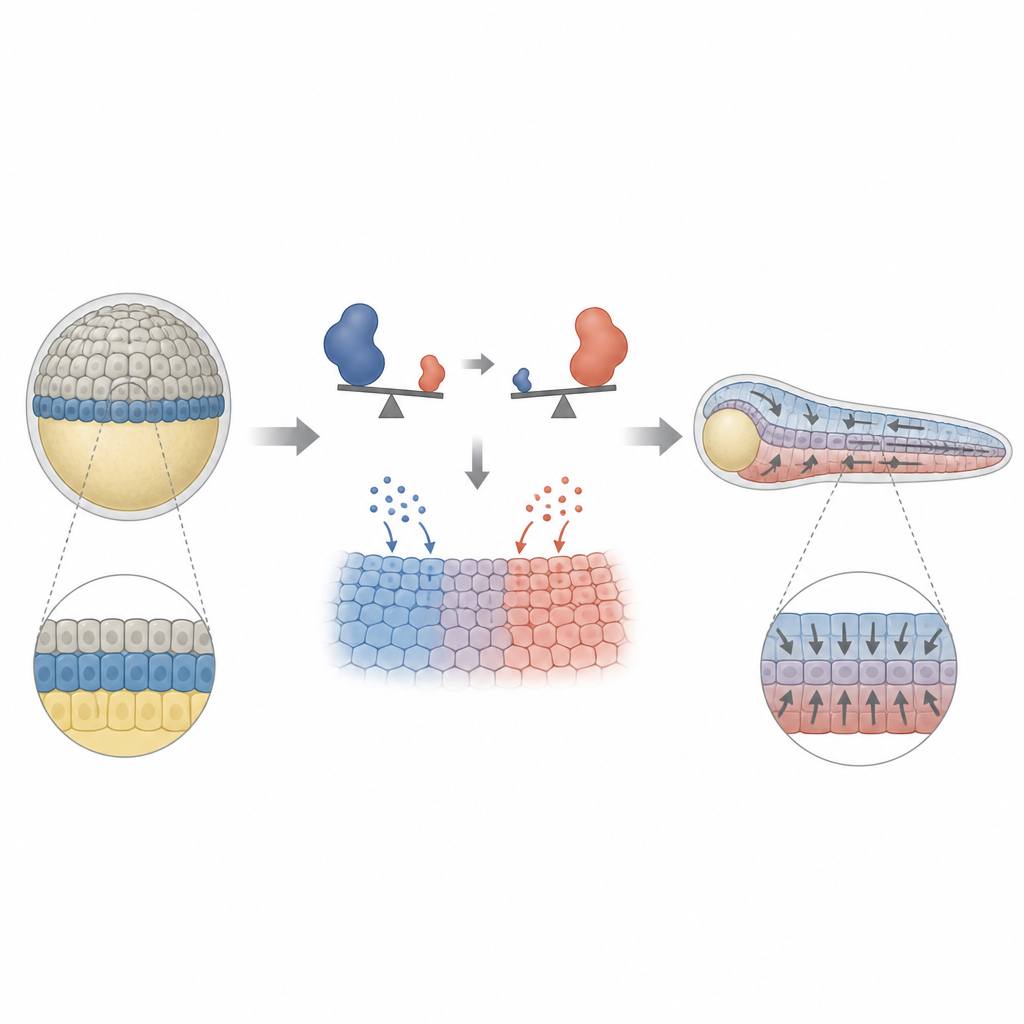
Stretching the early body plan
In many animals, including zebrafish and humans, early cells rearrange in a process called convergence and extension. Cells squeeze toward the future middle of the body and then slide past each other so the embryo lengthens. These motions must start neither too soon nor too late, or the body axis ends up short, wide, or twisted. Previous work showed that certain chemical signals are needed for these movements, but those signals are present long before the cells actually begin to rearrange. That left a puzzle: if the “go” signals are already on, what makes the cells wait until the correct moment to move?
A window when new genes must switch on
The team used a stripped down version of the embryo called an explant, a tiny ball of cells that can be grown in a dish. These explants can still carry out convergence and extension, but are simpler to study. By blocking the ability to turn on new genes at different times, the researchers found that there is a narrow window, right at the start of gastrulation, when fresh gene activity is essential for the later stretching movements to occur. If gene activity was blocked just before this window, the explants never elongated; if it was blocked later, elongation still happened, but less efficiently. This showed that a burst of gene expression at a particular time sets the stage for the coming shape changes.
A balancing act between two partner genes
Among the genes that turned on during this key window, one stood out: sumf2, which works together with an older, already present partner called sumf1. These two genes control a family of enzymes that clip sulfate groups on and off complex sugar chains on the surface of cells. Before gastrulation, sumf1 dominates; as gastrulation begins, sumf2 levels rise while sumf1 falls, flipping their ratio. By either adding extra copies or removing these genes in embryos and explants, the team showed that this balance acts like a dial for timing. More sumf1 delayed the start of convergence and extension, more sumf2 made it start early, and removing each gene produced opposite shifts in timing. Changing both together could reset the schedule back toward normal, highlighting that the relative levels, not just the presence of either gene, are what matter.
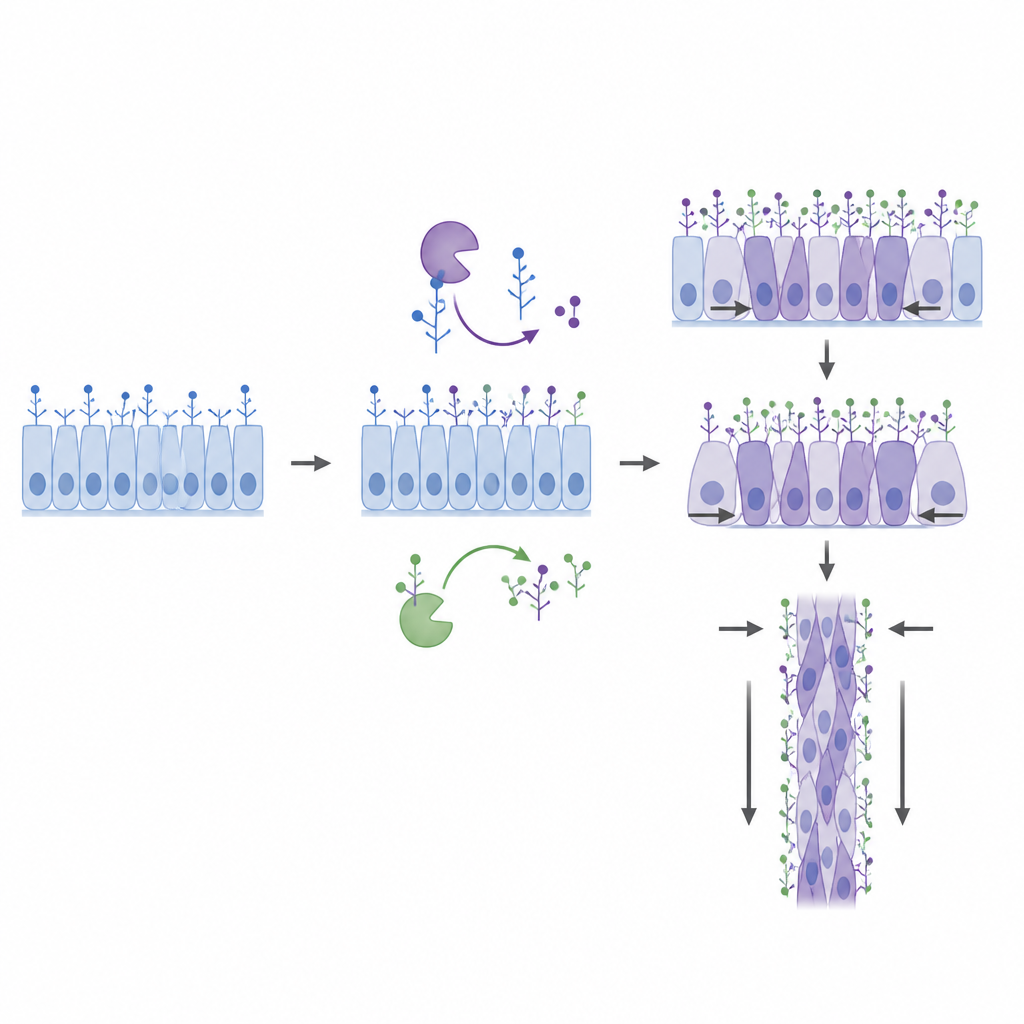
Cell surface sugars as timing tools
Sumf1 and sumf2 do not act alone. Their main influence runs through Sulf1, an enzyme that reshapes sulfate patterns on heparan sulfate proteoglycans, specialized sugar-decorated molecules on and around cells. When Sulf1 activity was increased, embryos showed strong shape defects and their stretching movements started late. When Sulf1 was missing, embryos and explants began their movements early but could not complete them properly. Chemical measurements confirmed that the sulfate patterns on these sugar chains change during gastrulation, and that altering sumf1 or sumf2 levels shifts those patterns in opposite directions. Additional experiments that globally lowered or raised sulfation showed that simply changing how heavily these sugars are sulfated can move the start of convergence and extension earlier or later, and can even cancel out the effects of the gene mutations.
Why this timing system matters
Together, the findings support a model in which the early embryo uses a reversible chemical “tuning” of its cell surfaces to decide when large groups of cells should begin reshaping the body. As gastrulation starts, rising sumf2 counters sumf1, dialing down Sulf1 activity and increasing sulfate decorations on cell surface sugars. This altered surface landscape appears to make the tissue receptive to existing growth and patterning signals, allowing convergence and extension to begin on schedule. If this timing system is disturbed, the body axis still forms but is misshapen, underscoring how important the calendar of events is for normal development.
Citation: Cervino, A.S., Basu, A., Weiss, R.J. et al. Sulfatase modifying factors control the timing of zebrafish convergence and extension morphogenesis. Nat Commun 17, 4632 (2026). https://doi.org/10.1038/s41467-026-70804-6
Keywords: zebrafish development, gastrulation, cell movement, heparan sulfate, embryo patterning