Clear Sky Science · en
Nanoscale exchange-bias magnetic tunnel junctions enabled memristive synapse and leaky-integrate-fire neuron for neuromorphic computing
Why tiny magnetic devices can change computing
Today’s smart devices rely on power-hungry chips that constantly shuttle data back and forth between memory and processors. This paper explores a different path inspired by the brain, where memory and computation happen in the same tiny elements. The researchers show how nanoscale magnetic devices can behave like both brain cells and their connecting links, opening a route to fast, efficient hardware for tasks such as gesture recognition.

From brain signals to spiking circuits
Biological brains process information using spikes, brief electrical pulses passed between neurons through synapses whose strengths are continuously tuned. Artificial versions of these ideas, called spiking neural networks, could in principle work with far less energy than today’s chips. But most current systems still use conventional electronics, which separate memory and logic and need many transistors to mimic even a single neuron or synapse. This mismatch wastes area and power and undermines the promise of brain-inspired computing.
Using magnetism to store and process together
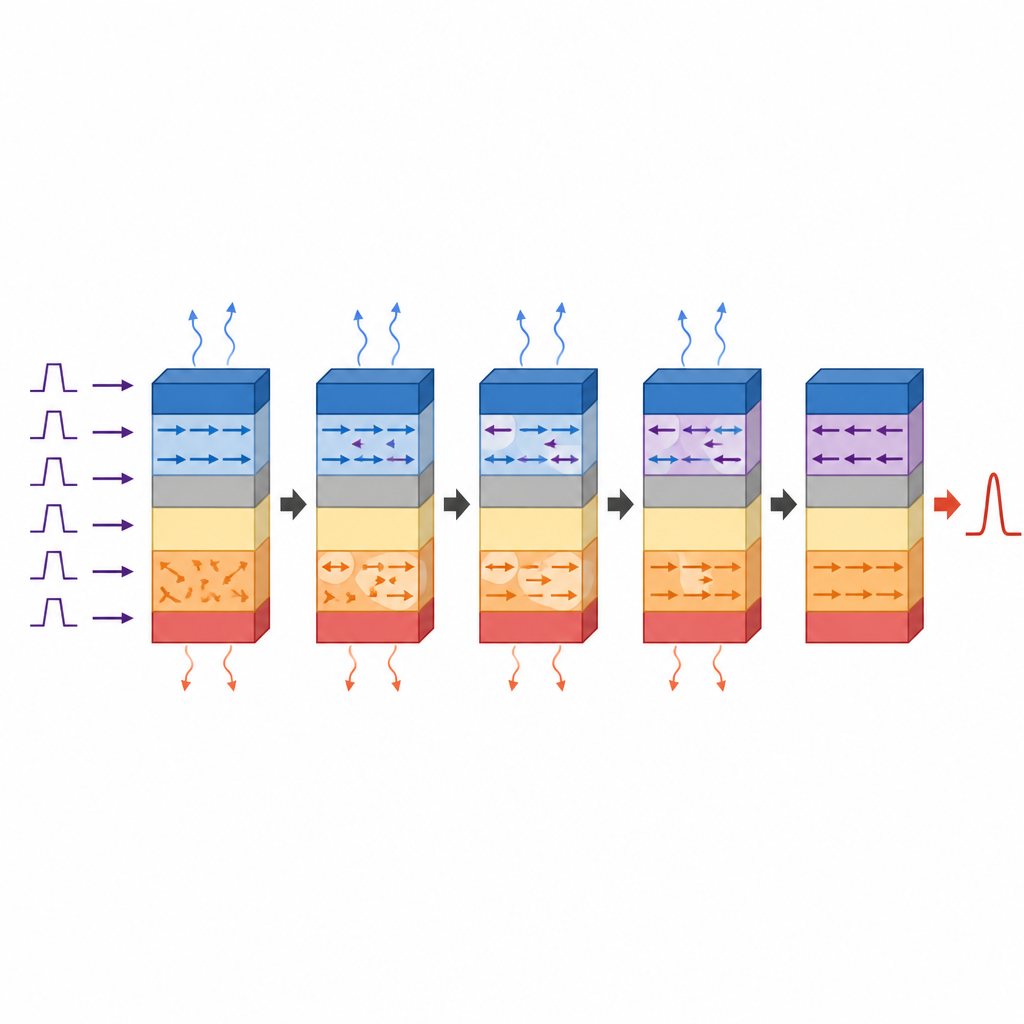
The team turns to a class of memory technology known as magnetic tunnel junctions, where electrical resistance depends on the relative orientation of tiny magnetic layers. By building these junctions with an additional magnetic material that “biases” the free layer, they create exchange-bias MTJs that can be switched by short current pulses. Clever engineering of the device shape and magnetic stack allows one version of the junction to behave like a synapse with many stable resistance levels, while a smaller version acts like a neuron that flips sharply between two states. Both share the same layered structure, simplifying integration on a chip.
Tiny synapses that remember timing
In the synapse-like devices, short current pulses gradually reconfigure microscopic magnetic domains instead of flipping the whole magnet at once. This produces more than 25 distinct resistance levels in a device only about one hundred nanometers across, and these levels remain stable for years and resist strong magnetic fields. By sending pairs of pulses that play the role of pre- and post-neuron spikes with varying time delays, the authors reproduce a key learning rule observed in biology: when spikes arrive close together, the connection strengthens or weakens more than when they are far apart. This timing-based learning, known as spike-timing-dependent plasticity, emerges naturally from the heat and current driven rearrangement of the magnetic grains.
Tiny neurons that integrate and fire
The neuron-like devices respond differently. Individual current pulses are chosen too weak to switch the device alone, but a rapid series of them heats the junction and lowers its internal energy barrier until it suddenly flips state, mimicking a neuron that integrates inputs and then fires. When pulses stop, the device cools and its effective threshold recovers, providing a natural “leak” of accumulated input. Experiments show that these artificial neurons can switch reliably with pulses as short as four tenths of a nanosecond while consuming only a few hundred femtojoules per firing event, far less than typical transistor-based neuron circuits and fast enough for gigahertz operation.
Testing a full magnetic gesture recognizer
To see what such devices could do in a system, the researchers simulate a multilayer spiking network built entirely from these magnetic synapses and neurons. Using real-world gesture data recorded as streams of visual events, the network combines conventional training in earlier layers with timing-based learning in the output layer. With device behavior and imperfections taken from experiments, the model still classifies hand gestures with about ninety six percent accuracy. Because spikes are sparse and neurons fire only when needed, only a small fraction of elements are active at any moment, and the mixed training scheme reduces the number of synaptic updates compared with standard methods.
What this means for future smart hardware
For a non-specialist, the key message is that the same tiny magnetic building block can now act as both a programmable connection and a spiking unit, much like the synapses and neurons in the brain. These exchange-bias magnetic tunnel junctions switch quickly, remember many levels, and can be packed densely, making them strong candidates for compact, low-energy chips that process information in a brain-like way directly in memory rather than shuttling data around.
Citation: Chen, Z., Zhu, D., Du, A. et al. Nanoscale exchange-bias magnetic tunnel junctions enabled memristive synapse and leaky-integrate-fire neuron for neuromorphic computing. Nat Commun 17, 4362 (2026). https://doi.org/10.1038/s41467-026-70802-8
Keywords: neuromorphic computing, spiking neural networks, magnetic tunnel junctions, spintronics, gesture recognition