Clear Sky Science · en
RNA functional modulation by Mitoxantrone via RNA structural ensemble repartitioning
Why this study matters
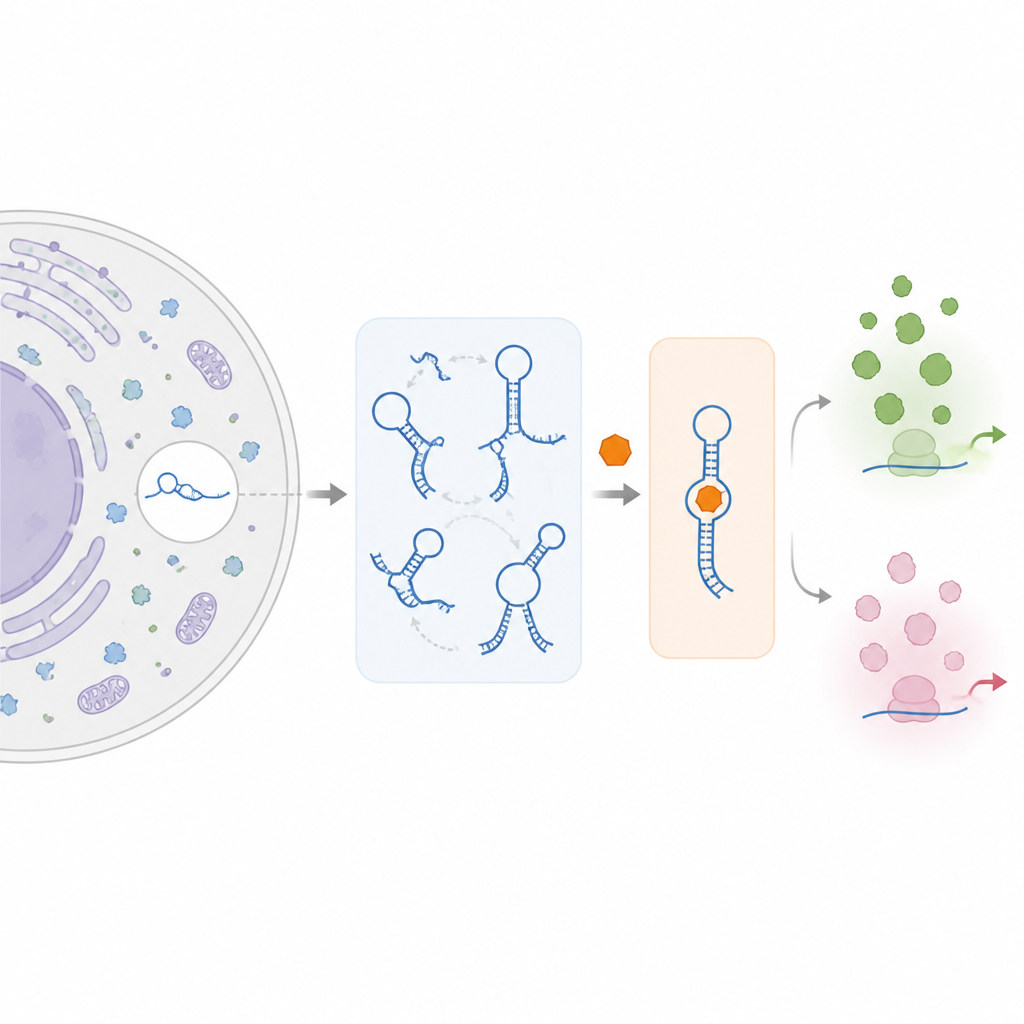
Many modern medicines act on proteins, yet a huge part of our genetic control system is written in RNA. This paper explores how an existing cancer drug, Mitoxantrone, can reshape the folding behavior of RNAs inside cells, subtly shifting how genes are read and turned into proteins. It offers a window into a new class of treatments that work by nudging RNA molecules between different shapes rather than destroying them.
From fixed locks to moving targets
Traditional drug discovery often looks for tidy, rigid pockets on RNA that act like fixed locks for chemical keys. The authors argue that many RNAs in living cells do not behave this way. Instead, they constantly shift among several alternative shapes, forming a bustling "structural crowd" rather than a single, frozen form. Because of this, small molecules may be more useful as traffic directors that redistribute how often each shape is adopted, rather than as simple on off switches that freeze one conformation in place.
Finding a drug that stops RNA self-editing
To test this idea, the team built a sequencing based screen around a self-splicing RNA, a piece of genetic material that can cut itself out of a longer RNA chain. They challenged this system with a library of mostly approved drugs and monitored how efficiently the RNA removed itself. Among 156 compounds, Mitoxantrone stood out as a strong blocker of this self-editing step at micromolar doses. Further tests showed that this effect was not limited to a single RNA: a related self-splicing element from yeast was inhibited with similar potency, and the drug appeared to compete with a natural helper molecule for access to a key pocket in the RNA.
What makes a molecule actually change RNA behavior
Mitoxantrone belongs to a family of flat, ring-shaped chemicals known to slide between the base pairs of DNA and RNA. However, when the researchers compared it with many close chemical cousins, they found that the shared flat core was not enough to interfere with RNA function. Molecules that lacked flexible, basic side chains barely affected splicing, even though they could likely still attach to nucleic acids. By analyzing dozens of variants, the study linked strong activity to side chains rich in amine groups, which can form multiple hydrogen bonds and electrostatic contacts with RNA. In other words, the drug’s add-on arms, not just its central scaffold, give it the ability to reshape RNA behavior.
How the drug reshapes RNA choices
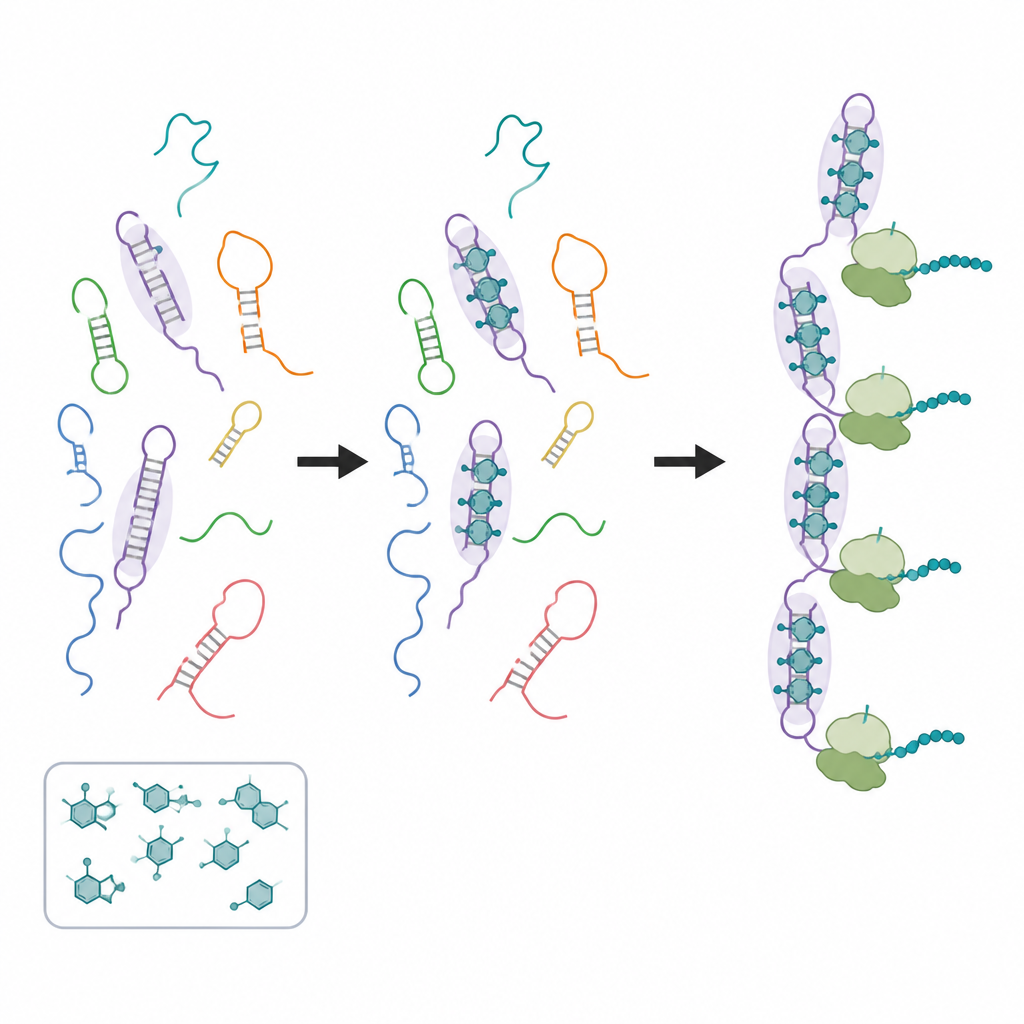
Using chemical probes that report on how exposed each RNA base is, the authors examined a model RNA with and without Mitoxantrone. Instead of loosening the fold, the drug made base-paired regions more clearly protected, and computational analysis revealed that one native, well organized shape became dominant while a more disordered alternative faded away. Extending this approach to human cells, they mapped thousands of RNAs and saw that Mitoxantrone preferentially nestled into short, GC-rich double-stranded segments. Only a fraction of these binding events caused measurable structural shifts, and where shifts occurred they tended to make the local structure more stable and less flexible, consistent with the drug selecting certain shapes from a pre-existing menu.
Linking shape changes to protein output
The team then focused on the front regions of messenger RNAs, the 5′ untranslated segments that can either invite or hinder ribosome binding and thus control how much protein is produced. By deeply probing these regions and mathematically untangling overlapping shapes, they showed that many 5′ leaders normally exist as mixtures of multiple conformations. Mitoxantrone treatment often reduced this diversity, favoring one conformation over others. Ribosome profiling, which reads where ribosomes sit on RNAs, revealed that messages whose front regions became less structurally diverse tended to be translated more efficiently. This links the drug’s effect on the "shape ensemble" of RNA directly to changes in protein production.
What this means for future medicines
This work shows that a small molecule can act as a gentle dial on RNA behavior, stabilizing selected shapes within a shifting crowd and in turn altering how genes are expressed. Rather than viewing binding alone as a sign of success, the study highlights the need to ask whether a compound actually redistributes the structural states that RNA samples and whether that redistribution has functional consequences. In the long run, such an ensemble-aware view of RNA could guide the design of drugs that fine-tune disease-related RNAs by steering, rather than freezing, their natural shape-changing tendencies.
Citation: Zhang, C., Borovská, I., Iobashvili, T. et al. RNA functional modulation by Mitoxantrone via RNA structural ensemble repartitioning. Nat Commun 17, 4315 (2026). https://doi.org/10.1038/s41467-026-70801-9
Keywords: RNA structure, Mitoxantrone, small molecule RNA, translation control, RNA drug discovery