Clear Sky Science · en
Phosphorus-activated carboxyl small molecule positive electrode for high specific capacity and long-life iron-organic batteries
Why better batteries matter
From electric vehicles to backup power for the grid, our modern world increasingly depends on cheap, safe and long‑lasting batteries. Today’s dominant lithium‑ion technology works well but relies on relatively scarce metals and flammable liquids. This study explores an alternative: water‑based batteries that use abundant iron and specially designed organic molecules, aiming to deliver high energy, long life and low cost in a safer package.
A new twist on iron batteries
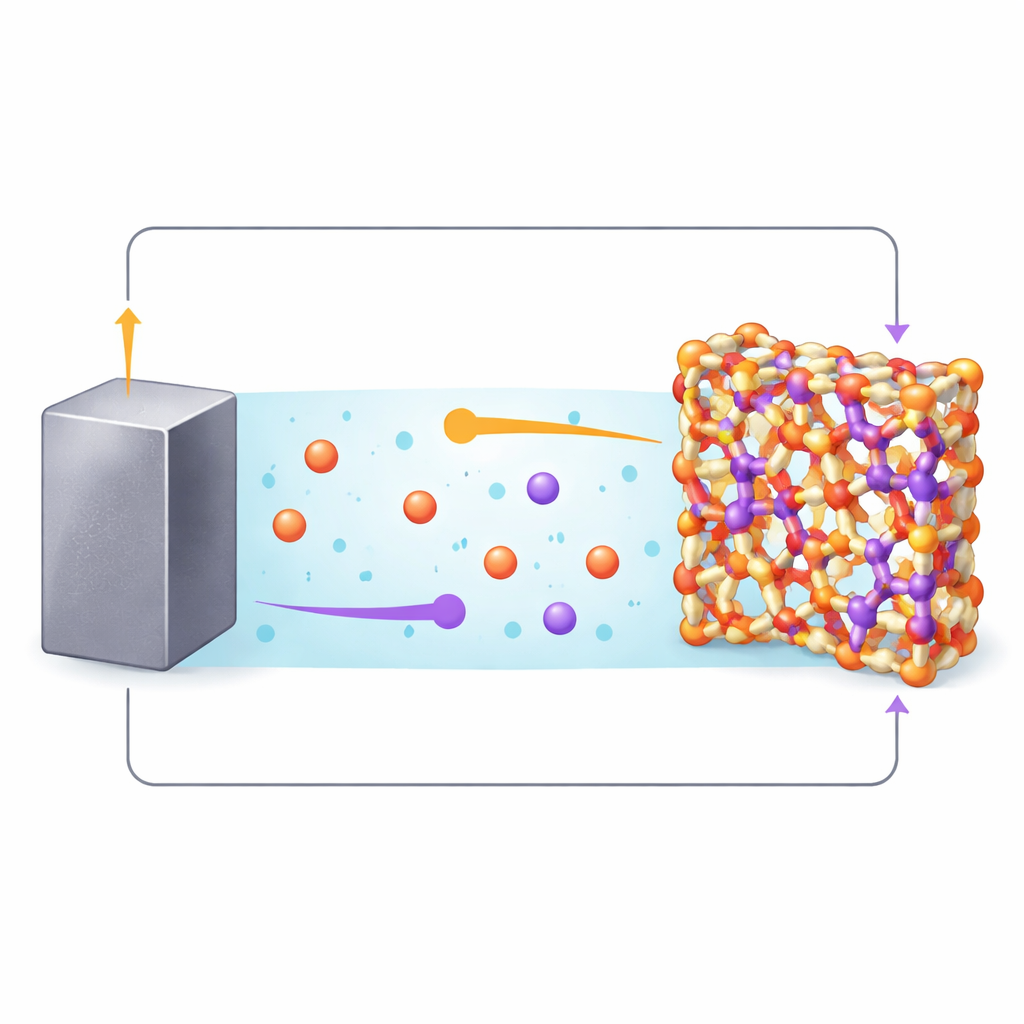
Iron‑ion batteries store energy by moving charged iron atoms between two electrodes immersed in water. Iron metal is an attractive negative electrode because it is cheap, plentiful and can hold a lot of charge. The real challenge has been finding a matching positive electrode that can repeatedly host and release iron ions without falling apart or slowing down. Earlier organic polymers, such as polyaniline, showed promise but suffered from limited active sites and fragile chemical links, which reduced capacity and shortened battery life.
Designing a smarter organic electrode
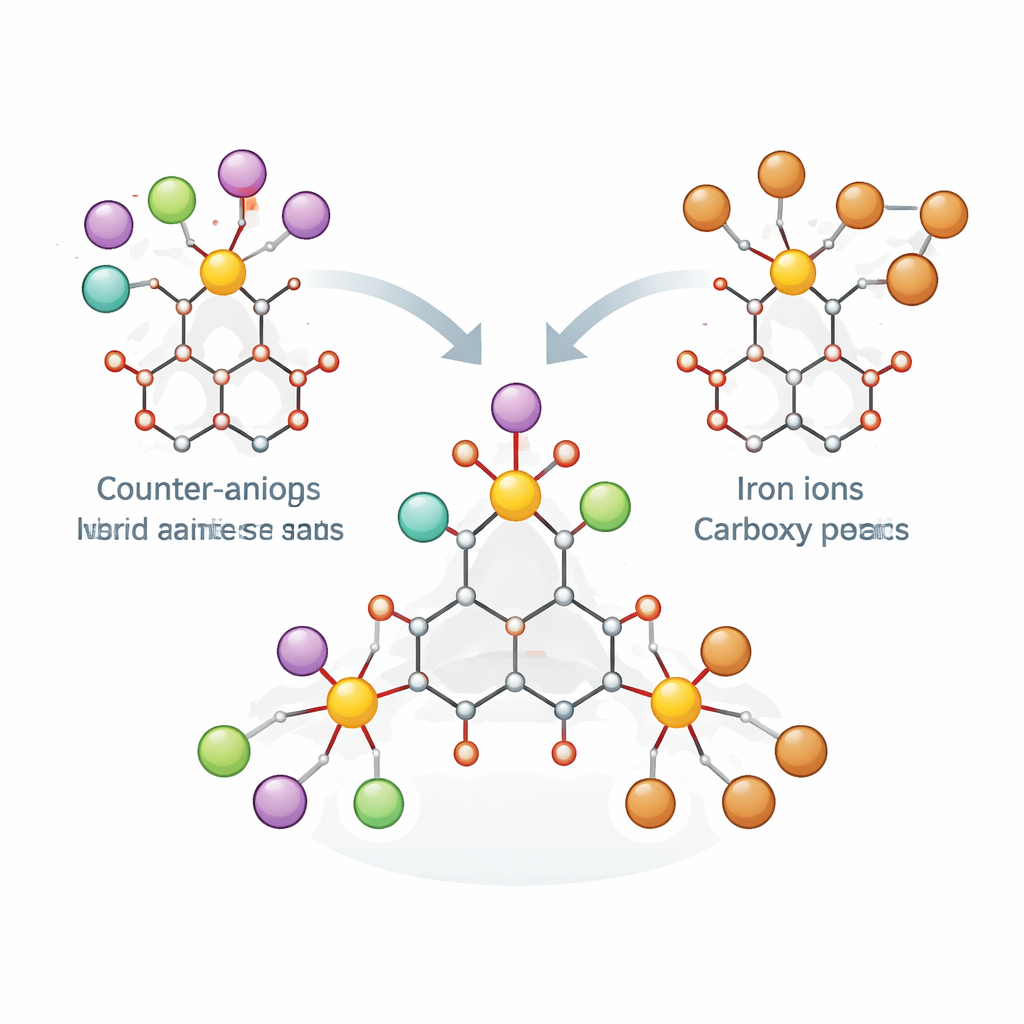
The researchers tackled this problem by building a small, well‑defined organic molecule that combines two types of active sites in one framework. Their star compound, called PTBA, places three acid‑like carboxyl groups and one phosphorus‑containing center into a rigid, triangular aromatic scaffold. Computer calculations revealed that the phosphorus atom subtly reshapes how electrons are shared across the molecule, narrowing the energy gap and making it easier for charge to move. This design also strengthens the attraction between the molecule and iron ions, while pulling nearby counter‑ions close to the phosphorus center. Together, these changes create many easily reachable redox sites and a sturdy structure that resists dissolving in water.
How the battery stores charge
Experiments showed that PTBA behaves like a “bipolar” electrode, storing charge through both negatively and positively behaving sites. Detailed infrared and X‑ray measurements tracked the chemical bonds in PTBA during charging and discharging. At higher voltages, counter‑ions from the electrolyte coordinate with the phosphorus center; at lower voltages, iron ions bind to the carboxyl groups. These two steps proceed with low energy barriers, meaning the ions move quickly and reversibly. Advanced simulations confirmed that electrons can delocalize over the whole PTBA framework and that both iron ions and counter‑ions form strong yet reversible interactions at the designed sites.
Performance that lasts and lasts
When paired with an iron metal negative electrode in a simple water‑based salt solution, PTBA delivers a high specific capacity of about 276 milliampere‑hours per gram and an average working voltage of roughly 0.8 volts. Remarkably, the battery maintains about 91% of its capacity after 5,000 cycles at moderate current and still retains more than three‑quarters of its capacity after 60,000 fast charge‑discharge cycles. The rigid, phosphorus‑linked framework prevents PTBA from dissolving into the electrolyte, preserving its structure even after long operation. Tests at higher material loadings and in pouch‑cell format show that this chemistry can also work under more practical, device‑like conditions.
What this means for future energy storage
In plain terms, the study demonstrates that carefully placing phosphorus atoms into small organic molecules can create positive electrodes that store more charge, run at higher voltage and last far longer than earlier designs in iron‑based aqueous batteries. By allowing both iron ions and counter‑ions to share the work of storing energy at multiple sites, PTBA nearly fully uses its active atoms while remaining chemically stable. This phosphorus‑activated carboxyl strategy offers a blueprint for designing a new family of low‑cost, long‑life, water‑based batteries that could complement or partially replace today’s lithium‑ion systems in large‑scale energy storage.
Citation: Zhang, Y., Huang, Q., Liu, P. et al. Phosphorus-activated carboxyl small molecule positive electrode for high specific capacity and long-life iron-organic batteries. Nat Commun 17, 4001 (2026). https://doi.org/10.1038/s41467-026-70800-w
Keywords: aqueous iron batteries, organic cathode, phosphorus redox, energy storage, iron-ion battery