Clear Sky Science · en
Reinforced biotubes as readily available and regenerative vascular grafts
New hope for damaged blood vessels
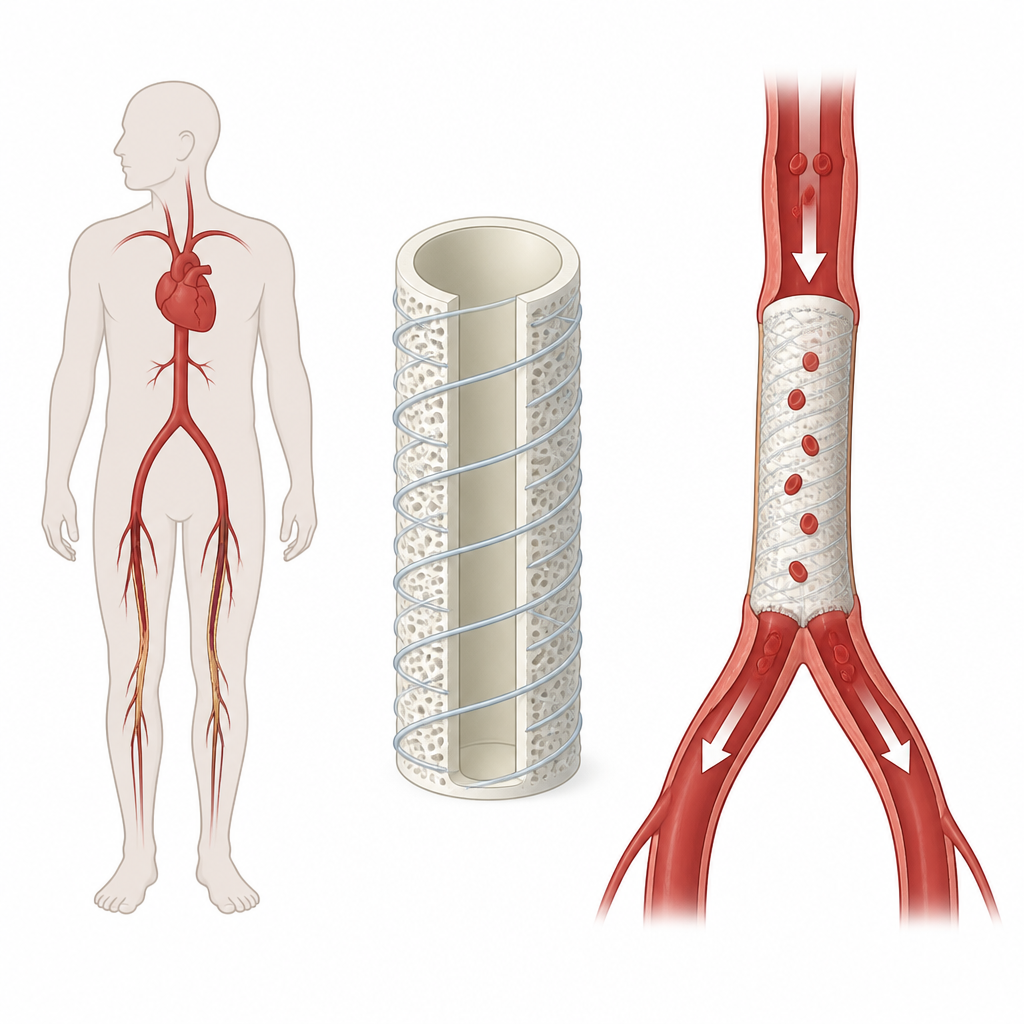
Heart disease, strokes and kidney failure often damage or block our blood vessels, forcing surgeons to reroute blood with tiny tubes called vascular grafts. Today they rely on synthetic plastic tubes or spare veins from a patient’s own body, both of which can clog, get infected, or simply be unavailable. This study introduces a new kind of living-like tube that can be made in advance from animals, stored on a shelf and then implanted to help the body rebuild healthy arteries.
Why current replacement vessels fall short
Small arteries are surprisingly hard to replace. Plastic grafts behave like lifeless pipes and tend to trigger clots, scarring and infections, especially when their inner diameter is under six millimetres. Donated or preserved arteries from people or animals look more natural, but once their cells are stripped away they become dense and difficult for new cells to enter. As a result they often fail in the long run, ballooning, narrowing or hardening with calcium. Surgeons therefore still lack a reliable, ready-made tube for heart bypasses, limb-saving bypasses and access for long-term dialysis.
How the reinforced biotube is made
The team behind this work combined a soft, degradable plastic skeleton with the body’s own healing response. They first shaped fine polycaprolactone fibres into a spring-like frame and implanted this frame under the skin of animals, where the foreign material triggered the growth of a natural tissue sleeve around it. After about a month this sleeve was removed, and all its living cells were carefully washed away, leaving behind a porous scaffold of natural proteins wrapped around the plastic core. For small, clot-prone arteries the researchers then bonded the blood thinner heparin to the inner surface, creating what they call a decellularized, polymer-reinforced biotube.
What makes these tubes behave like living vessels
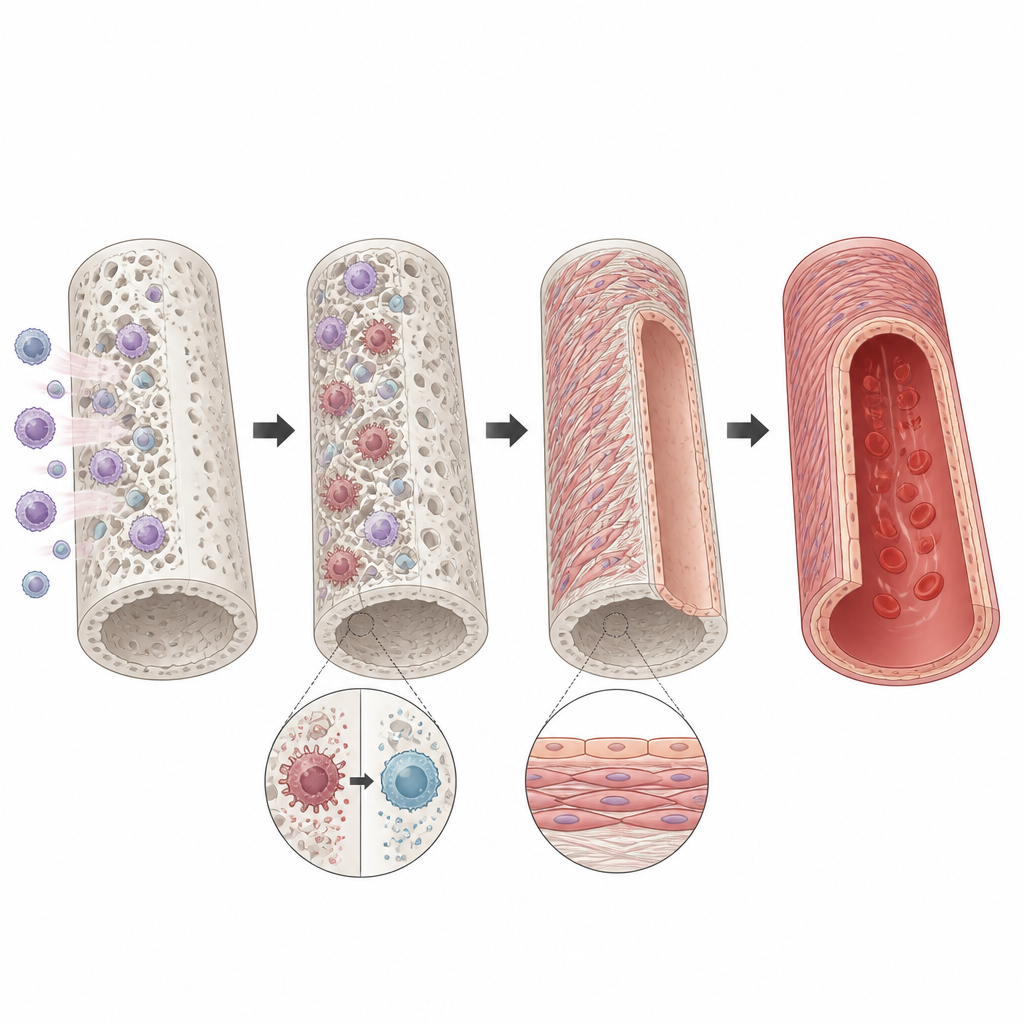
Laboratory tests showed that the reinforced biotubes were strong enough to withstand blood pressure, flexible enough to bend without kinking, and tough enough to hold sutures and repeated needle punctures. Under the microscope their walls were loose and sponge-like rather than densely packed, which allowed blood vessel cells to move in quickly. Protein analysis revealed high levels of collagen types linked to tissue repair and a collection of natural factors that nudge immune cells called macrophages toward a healing, anti-inflammatory state. In cell culture, macrophages that sat on these tubes shifted into this repair mode and in turn released signals that spurred blood vessel lining cells to grow and migrate.
Putting the grafts to the test in large animals
The researchers then tested animal-derived biotubes in several demanding surgical models. In rabbits, small heparin-treated tubes replaced segments of carotid artery and stayed open more often than standard decellularized arteries, while attracting fewer inflammatory cells. In dogs, sheep-derived tubes used to replace carotid arteries remained open for up to a year, gradually filling with organized muscle and forming a smooth inner lining that responded to drugs like a natural artery. In pigs, similar tubes were used for heart bypass surgery and stayed open for three months with signs of healthy healing. Finally, in dogs needing simulated dialysis access, larger tubes without heparin outperformed commercial plastic grafts, sealing quickly after repeated needle punctures and showing less infection, scarring and narrowing.
Why this approach matters for patients
For people who lack suitable veins or arteries of their own, the idea of an off-the-shelf graft that becomes part of the body is very attractive. These reinforced biotubes can be grown in batches using animals as living bioreactors, stripped of their original cells to reduce rejection, and stored in simple cold solutions. Once implanted, they invite in the patient’s own cells and guide the immune system toward repair rather than chronic irritation. While longer-term studies and human trials are still needed, the work suggests a future where surgeons reach for pre-made tubes that behave less like plastic plumbing and more like a scaffold for the body to rebuild its own blood vessels.
Citation: Cheng, Q., Zhi, D., Midgley, A.C. et al. Reinforced biotubes as readily available and regenerative vascular grafts. Nat Commun 17, 4300 (2026). https://doi.org/10.1038/s41467-026-70799-0
Keywords: vascular graft, tissue engineering, biotube, macrophage polarization, coronary bypass