Clear Sky Science · en
Bst2-targeted senotherapy restores visual function by eliminating senescent retinal cells
Why aging eyes matter
As people grow older, many begin to notice that fine print blurs, colors dull, or dark patches creep into their vision. One major culprit is damage to the retinal pigment epithelium, a thin sheet of cells at the back of the eye that nourishes the light-sensing photoreceptors. In this study, researchers describe a precision strategy to find and remove worn-out retinal cells while sparing healthy ones, with the goal of preserving sight in age-related conditions such as macular degeneration.
Worn-out cells that refuse to retire
Our tissues constantly accumulate cells that have stopped dividing but stubbornly remain in place. These so‑called “senescent” cells leak inflammatory signals and disrupt their neighborhood, contributing to aging and chronic disease. In the retina, senescent pigment cells are closely linked to age-related macular degeneration, a leading cause of irreversible blindness in older adults. Earlier drugs called senolytics can kill senescent cells, but they often hit healthy cells too, which is especially risky in the delicate eye. The challenge is to distinguish bad actors from normal cells so treatment can be both effective and safe.
A molecular flag on sick retinal cells
The team first searched for a distinctive “flag” on senescent retinal pigment cells that could guide targeted therapy. They reanalyzed large single-cell RNA sequencing datasets from mouse eyes, comparing young versus aged retinas and healthy versus chemically injured retinas that mimic senescence. Among thousands of genes, one stood out: Bst2, a membrane protein best known for its role in antiviral defense. Bst2 was consistently higher in aged and injured retinal pigment cells, but not in most neighboring cells. Follow‑up protein studies confirmed that Bst2 levels rose alongside classic hallmarks of senescence. Importantly, when the scientists experimentally reduced Bst2, the cells still became senescent, indicating that Bst2 functions mainly as a marker, not as the engine driving the damage—an ideal handle for selective targeting.

Smart particles that seek and clear problem cells
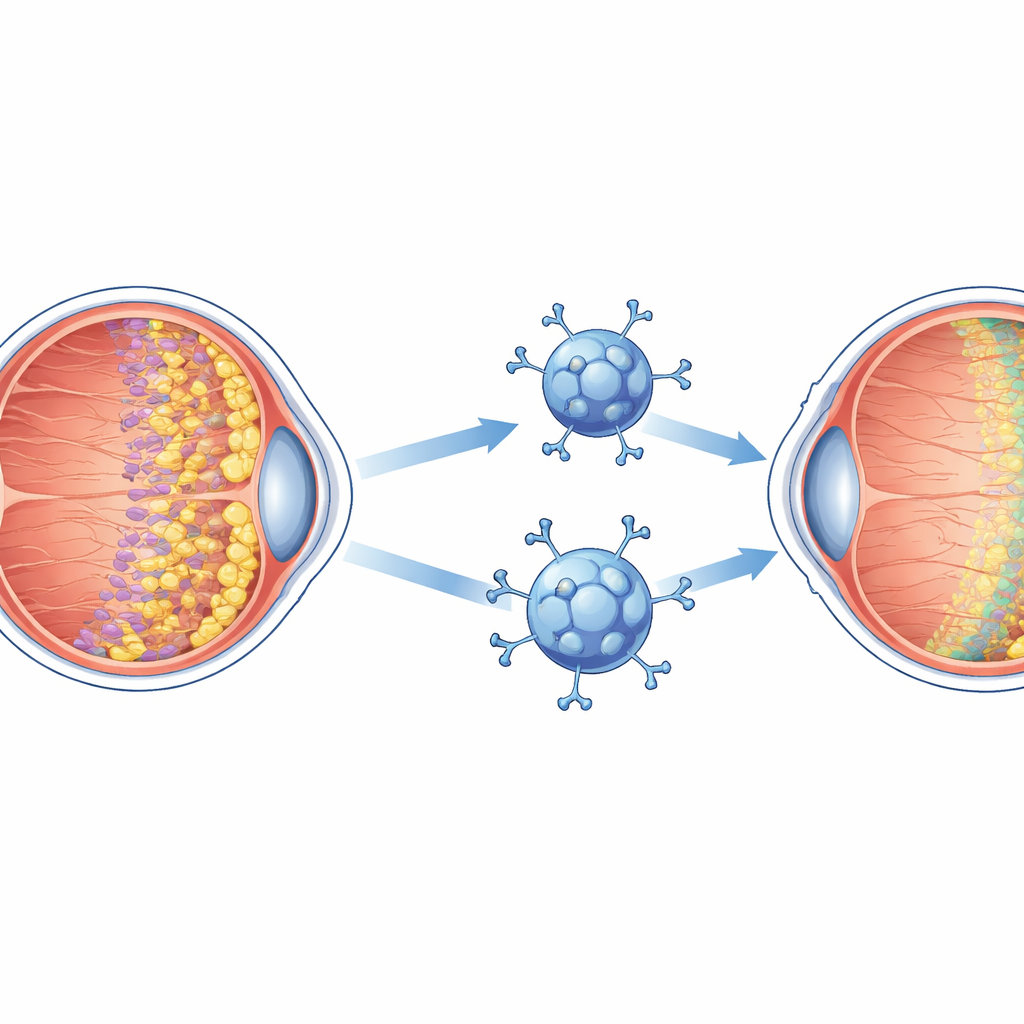
Building on this marker, the researchers engineered a “plug-and-play” nanoparticle system. At its core is a porous silica sphere designed to fall apart in a highly reducing chemical environment, a condition more common inside senescent cells. They coated this core with a protein that can latch onto the tail end of any antibody, turning it into a universal docking station. By attaching antibodies that recognize Bst2, they created B-Z-PON particles that home in on Bst2-rich senescent retinal cells. These particles can be loaded with ABT-263, a potent senolytic drug that triggers death in stubborn cells but can be toxic if it spreads widely. In cell culture, B-Z-PON carrying ABT-263 was taken up far more strongly by senescent retinal cells than by healthy ones, killed the targeted cells efficiently, and greatly reduced off-target damage compared to free drug.
From mouse eyes to better vision
The team then tested the targeted particles in mice. In a model where the retina is pushed into a senescent state by a chemotherapy drug, the Bst2-guided nanocarriers accumulated specifically in damaged retinal pigment cells after injection into the eye. Treatment selectively reduced markers of senescence, improved the structure of the light-sensing layer, and restored electrical responses of the retina, a readout of visual function. In naturally aged mice, repeated injections of the same formulation shrank the pool of senescent retinal pigment cells, increased signs of tissue renewal, thickened the photoreceptor layer, and boosted retinal responses. In contrast, free ABT-263 or non-targeted particles produced weaker benefits, underscoring the importance of both precise targeting and controlled drug release.
What this could mean for future eye treatments
For a lay reader, the key message is that the study links two powerful ideas: first, that a specific surface protein, Bst2, reliably marks problematic aging cells in the retina, and second, that tiny engineered particles can use this marker as a landing pad to deliver a “retirement notice” only to those cells. By pruning senescent cells and leaving healthy cells intact, this approach restored retinal structure and function in aging mouse eyes. While more work is needed before it can be tested in people, the findings point toward a future in which age-related vision loss might be treated not just by slowing damage, but by actively removing the cells that drive degeneration.
Citation: Oh, J.Y., Chae, JB., Lee, H.K. et al. Bst2-targeted senotherapy restores visual function by eliminating senescent retinal cells. Nat Commun 17, 4135 (2026). https://doi.org/10.1038/s41467-026-70797-2
Keywords: retinal aging, senescent cells, age-related macular degeneration, targeted nanomedicine, senolytic therapy