Clear Sky Science · en
Giant ZT enhancement in rhombohedral GeTe-based thermoelectric materials
Turning Waste Heat into Useful Power
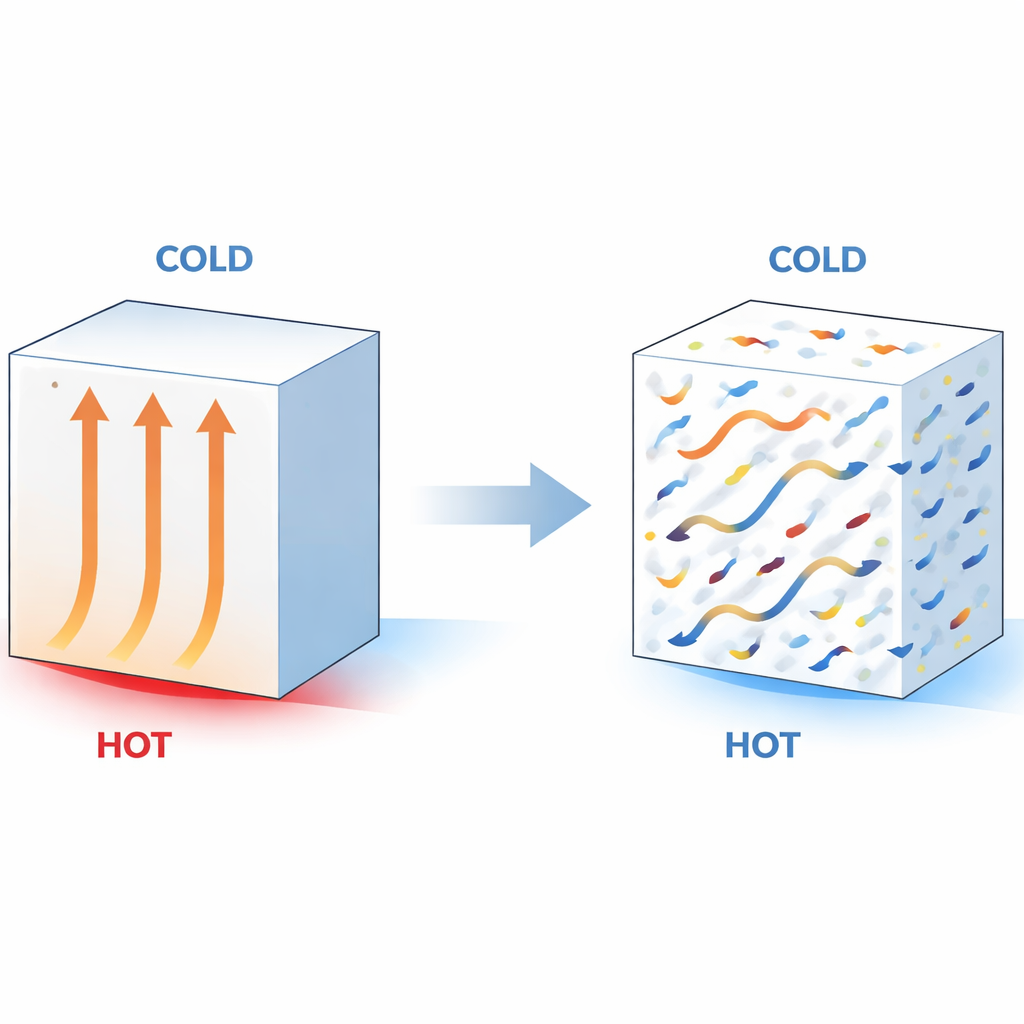
Much of the energy we use in cars, factories, and electronics is lost as heat. Thermoelectric materials can turn some of that waste heat directly into electricity, offering cleaner power and solid-state cooling with no moving parts. In this study, researchers report a way to make a promising thermoelectric, based on the compound germanium telluride (GeTe), work better and more reliably at practical temperatures by carefully adding tiny ceramic particles. Their approach pushes the material’s efficiency close to record levels while avoiding a troublesome internal phase change that usually limits its use.
Why This Material Matters
Thermoelectric devices are judged by a performance number called ZT, which rises when a material conducts electricity well but conducts heat poorly. Commercial modules today often rely on bismuth telluride, which works best near room temperature and is less suitable for hotter environments such as car exhausts or industrial flues. GeTe is an attractive alternative for mid- to high-temperature operation and is also lead-free. However, its best ZT values usually appear only after it changes from a low-temperature rhombohedral structure to a high-temperature cubic one. That phase change can introduce mechanical and electrical instability at interfaces inside working devices. The challenge is to achieve very high ZT in the low-temperature rhombohedral form, below the phase transition, so practical systems can avoid complicated multi-segment designs.
Adding Tiny Particles for Big Effects
The team tackled this challenge by forming a nanocomposite: they started with an optimized GeTe-based compound that already contains a small amount of bismuth, and then mixed in minute amounts (fractions of a weight percent) of extremely stiff titanium diboride (TiB2) nanoparticles. After high-energy milling and rapid sintering, the resulting material showed dense grains whose boundaries were decorated with TiB2-rich nano-sized inclusions and occasional nanopores. Electron microscopy revealed that these inclusions form distinct crystalline particles embedded in the GeTe matrix with clean but incoherent interfaces. Although the overall crystal structure of GeTe remains rhombohedral and its average lattice parameters barely change, the local strain and grain size distribution are strongly altered by the presence of the nanoparticles.
Letting Charges Flow While Blocking Heat
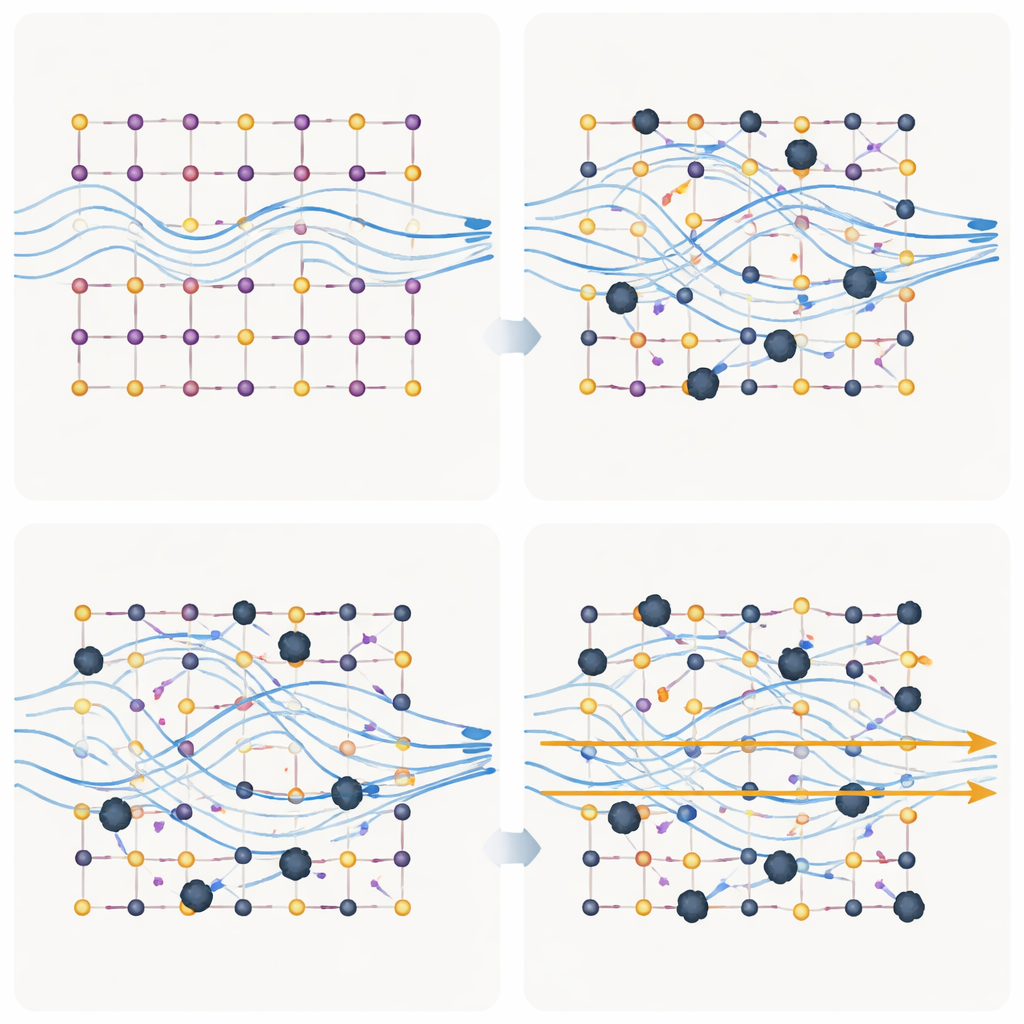
Electrical measurements showed that adding TiB2 slightly lowers the number of mobile charge carriers in GeTe, because electrons tend to move from the particles into the surrounding matrix at the interfaces. At the same time, and perhaps more surprisingly, the ability of these carriers to move—their mobility—actually increases and can exceed theoretical expectations for this class of material. The authors trace this to an interfacial constraint effect: since TiB2 is much stiffer than GeTe, it restricts how easily the GeTe lattice can stretch and compress under thermal vibrations. This mechanical constraint reduces how strongly charge carriers feel those vibrations, effectively weakening the coupling between electrons and crystal vibrations without needing heavy chemical alloying. As a result, the electrical power factor improves while avoiding the usual drop in mobility that plagues many other doping strategies.
Turning Down the Heat Flow
At the same time, the TiB2 inclusions substantially reduce the material’s ability to conduct heat. The nanoparticles introduce extra interfaces and local strain fields that scatter heat-carrying vibrations (phonons) much more effectively than they scatter charge carriers. Because GeTe and TiB2 vibrate at largely different characteristic frequencies, the region around each interface supports new, high-frequency vibration modes that further disrupt the passage of low-frequency heat waves. Modeling and analysis show that these interfaces generate a large thermal resistance that shortens the average distance phonons can travel, driving the lattice thermal conductivity down by nearly 40 percent in the best compositions while keeping sound velocity nearly unchanged.
A High-Efficiency Path Without a Phase Change
By combining enhanced carrier mobility with strongly suppressed heat transport, the optimized nanocomposite achieves a peak ZT of 2.66 at about 613 K and a high average ZT of 1.29 from room temperature up to that point—all in the rhombohedral phase of GeTe, below its usual transition to the cubic form. These figures rival the best performance previously seen only in more complex or higher-temperature GeTe-based materials. For a lay reader, the takeaway is that carefully chosen nanoparticles can act like internal structural braces and heat filters at the same time, allowing charges to move quickly while heat is slowed down. This dual action brings efficient waste-heat harvesting and solid-state cooling a step closer to robust, real-world devices that do not depend on fragile phase changes or environmentally problematic elements.
Citation: Yu, J., Liu, X., Jiang, Y. et al. Giant ZT enhancement in rhombohedral GeTe-based thermoelectric materials. Nat Commun 17, 4000 (2026). https://doi.org/10.1038/s41467-026-70793-6
Keywords: thermoelectric materials, waste heat recovery, nanocomposites, GeTe, energy conversion