Clear Sky Science · en
Active learning in latent spaces enables rapid inverse design of ferroelectric ceramics for energy storage
Smaller, Smarter Capacitors for Everyday Tech
From electric cars to laptop chargers, many modern devices rely on components that quickly store and release electrical energy. The ceramics inside today’s capacitors already do this well, but making them both compact and highly efficient has been a stubborn challenge. This study shows how combining physics-based models with artificial intelligence can speed up the discovery of new ceramic materials that pack more energy into smaller, safer devices.
Why These Ceramics Matter
Ferroelectric ceramics are special materials that change their internal electric alignment when a voltage is applied. This switchable behavior lets them store and release electrical energy very rapidly, which is why they are key parts of power electronics, pulsed systems, and portable gadgets. However, their natural tendency to “remember” some of their previous alignment wastes energy as heat and limits how much useful energy can be stored. Engineers try to tame this by turning them into so-called relaxor ceramics, where the internal regions become tiny and weakly linked, reducing energy losses while keeping high storage capacity.
Teaching a Computer to Explore Hidden Possibilities
The authors tackle a central problem in materials design: there are countless ways to mix chemical ingredients and tune internal structures, and testing them one by one is far too slow. Instead, they train a generative machine learning model to learn how both the recipe and the microscopic pattern of electric regions together affect performance. This model compresses complex patterns of polarization and chemistry into a low-dimensional “latent” space, a kind of map where nearby points represent materials with similar internal behavior. Within this space, the model can quickly imagine new domain patterns that are physically realistic, without having to run extremely expensive physics simulations for each candidate. 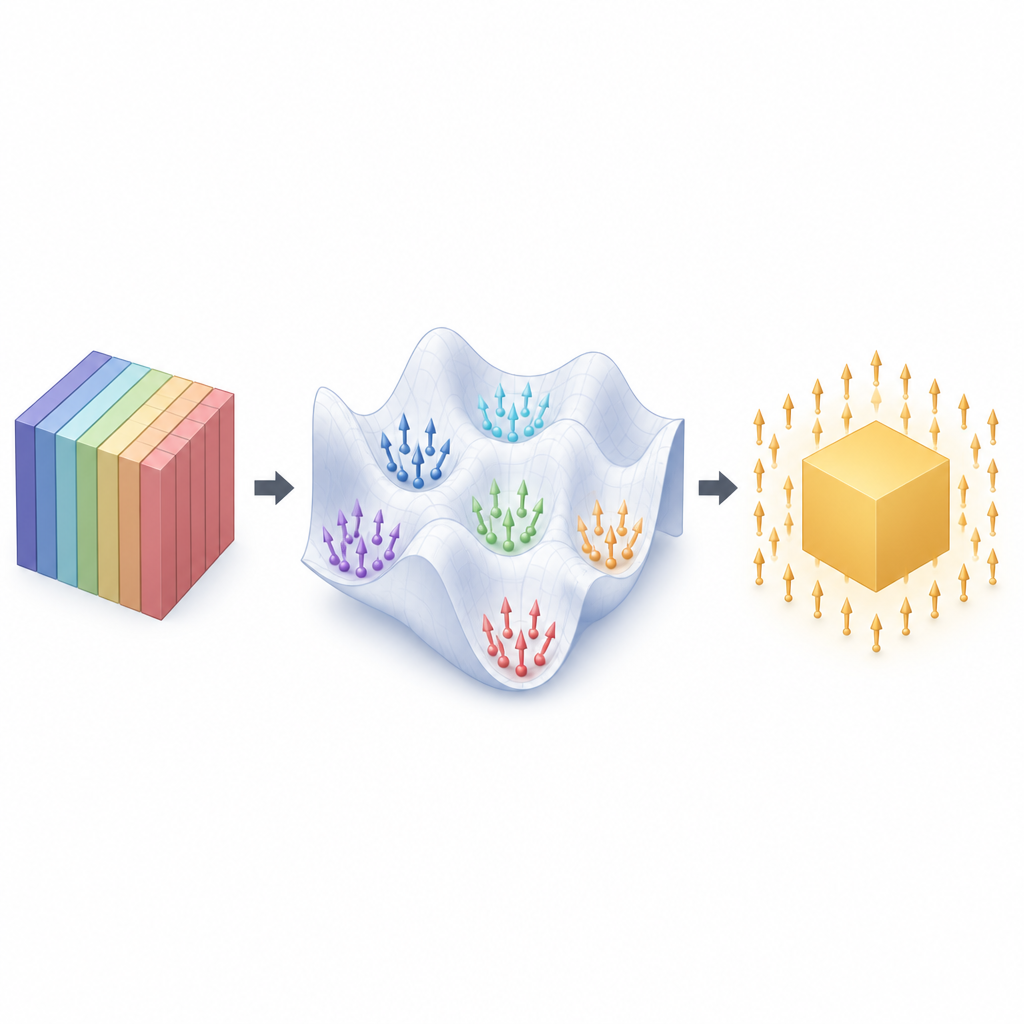
Letting Active Learning Steer the Search
Once this map is built, the team uses an active learning strategy to guide which compositions to try next in the lab. Rather than simply predicting how each candidate might behave, they build surrogate models that estimate both expected energy storage performance and the uncertainty of those predictions. A genetic optimization algorithm then searches the latent space for combinations that are likely to give high stored energy and high efficiency under a modest electric field, while also avoiding regions where the model is unsure. This inverse design approach starts from the desired properties and works backward to promising recipes, instead of blindly scanning the whole composition range.
From Computer Suggestions to Real Materials
The researchers focus on a lead-free ceramic family based on bismuth sodium titanate mixed with small amounts of barium titanate and strontium titanate. Guided by their framework, they carried out only four cycles of experiments. In each round, they synthesized a handful of computer-recommended compositions, measured their performance, and fed the results back into the models. Over these iterations, the materials’ internal patterns evolved from larger ferroelectric regions toward finer, more disordered nanodomains that switch more easily. One particular composition, with a carefully balanced mix of the three ingredients, stood out by achieving both high energy density and high efficiency at a relatively low operating field. 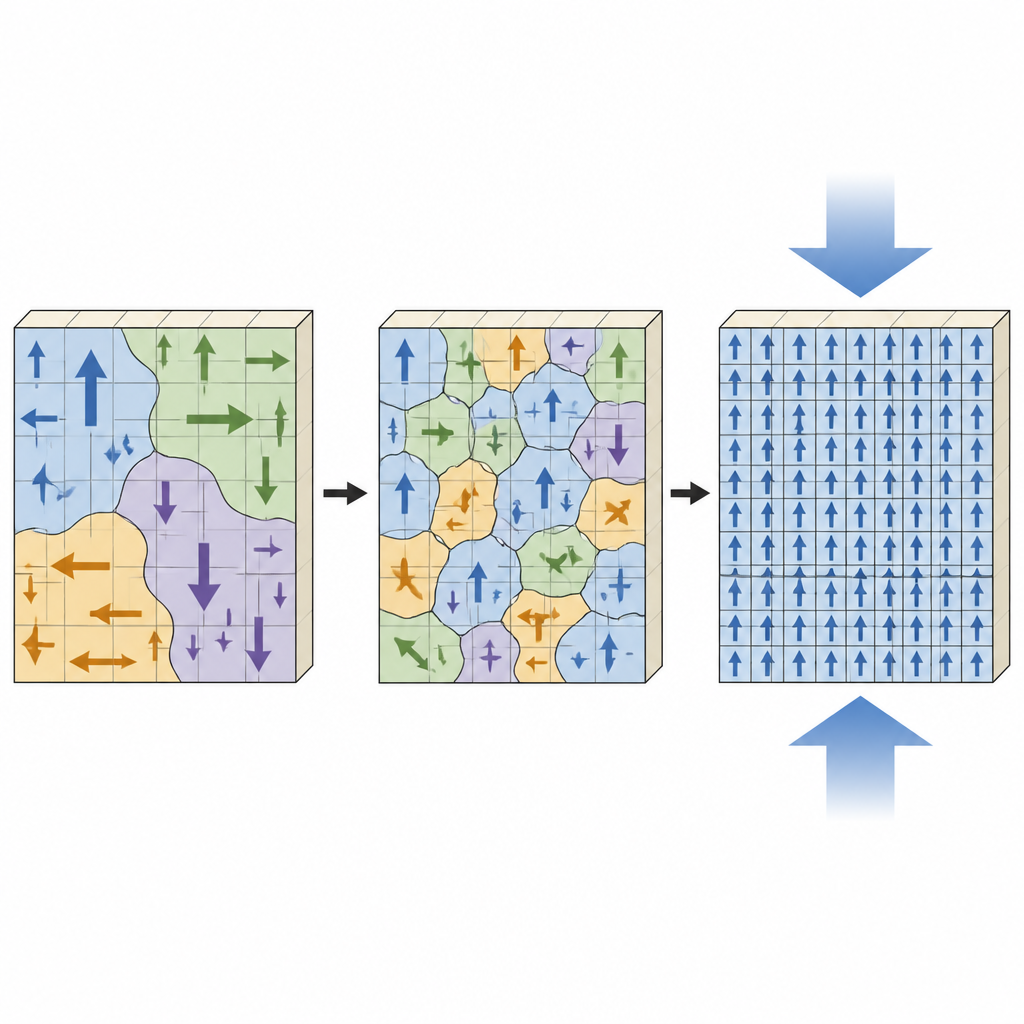
What This Means for Future Devices
The best ceramic discovered in this study stores about 2.3 joules of energy per cubic centimeter with roughly 80 percent efficiency at a modest electric field, and even higher energy at stronger fields, while remaining reliable over many charge and discharge cycles. For everyday technology, this means the potential for smaller, cooler-running capacitors that can handle fast pulses and demanding power conditions. More broadly, the work demonstrates that coupling detailed physical insight with modern machine learning in a closed loop can greatly shorten the path from theory to working materials, opening a practical route to designing next-generation energy storage ceramics and beyond.
Citation: Xi, Z., Wang, Z., Guo, C. et al. Active learning in latent spaces enables rapid inverse design of ferroelectric ceramics for energy storage. Nat Commun 17, 4281 (2026). https://doi.org/10.1038/s41467-026-70792-7
Keywords: ferroelectric ceramics, energy storage, relaxor materials, machine learning design, active learning