Clear Sky Science · en
Smad7-based biologic targeting epidermis and stroma promotes healing of diabetic wounds in mice and pigs
Why stubborn wounds matter
For many people with diabetes, a small cut on the foot can turn into a stubborn wound that refuses to close, sometimes leading to infection or even amputation. Doctors have few topical medicines that truly help these wounds heal faster and more completely. This study explores a new protein-based treatment designed to be spread directly on the skin, aiming to calm harmful inflammation, protect skin cells, and guide the wound back onto a healthy healing track in both mice and pigs.
What goes wrong in diabetic wounds
Healthy wounds move through a timed sequence: brief inflammation, growth of new tissue, and then remodeling into durable skin. In diabetes, this sequence stalls in the early inflammatory stage. Skin cells at the surface, called keratinocytes, struggle to survive and migrate to cover the wound. At the same time, certain white blood cells, especially neutrophils, linger too long and release high levels of reactive molecules and tissue-digesting enzymes. These combined problems damage the local environment, disrupt blood vessel growth, and keep the wound open and fragile.
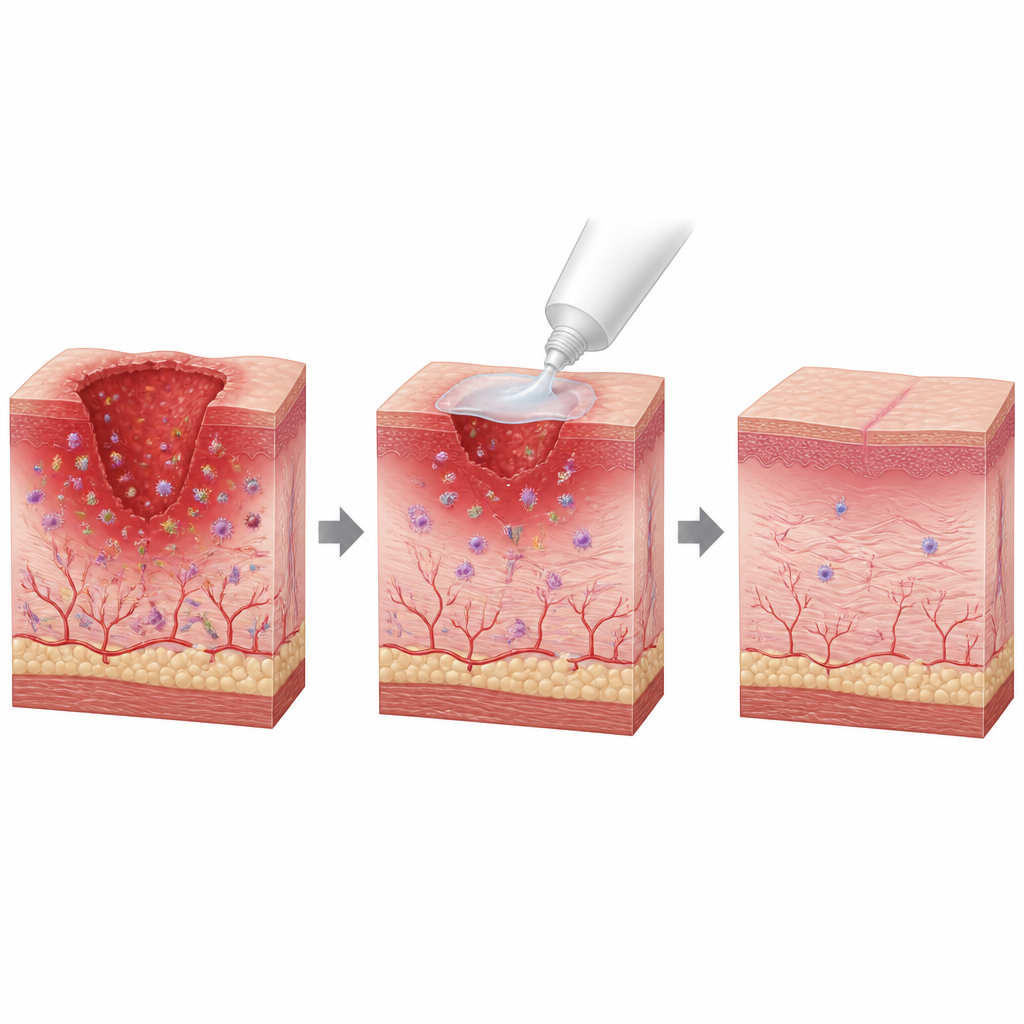
A targeted protein cream for the skin
The researchers focused on a natural protein regulator called Smad7, which can dial down two major inflammation and scarring pathways inside cells. They first showed that mice genetically engineered to produce extra Smad7 in their skin healed diabetic wounds faster. To turn this idea into a practical medicine, they built a shortened Smad7-based protein, Tat-PYC-Smad7, that can cross cell membranes when applied as a gel on top of the wound. In diabetic mice, this topical treatment sped up wound closure as effectively as genetic overexpression and performed as well as, or better than, the current approved drug Regranex while using much smaller doses.
Testing in pig skin that resembles humans
Because pig skin behaves more like human skin than mouse skin, the team next tested Tat-PYC-Smad7 in diabetic miniature pigs with full-thickness circular wounds. The protein stayed local to the treated area, was not detectable in the bloodstream, and did not trigger measurable anti-drug antibodies. Compared to control gels, Tat-PYC-Smad7-treated wounds closed more rapidly, with a higher fraction fully healed by day 16. Microscopic examination showed longer tongues of new epidermis growing in from the edges, more newly formed blood vessels beneath the surface, and more orderly elastic and collagen fibers, all signs of healthier, more regenerative repair rather than stiff scarring.
Calming overactive immune cells
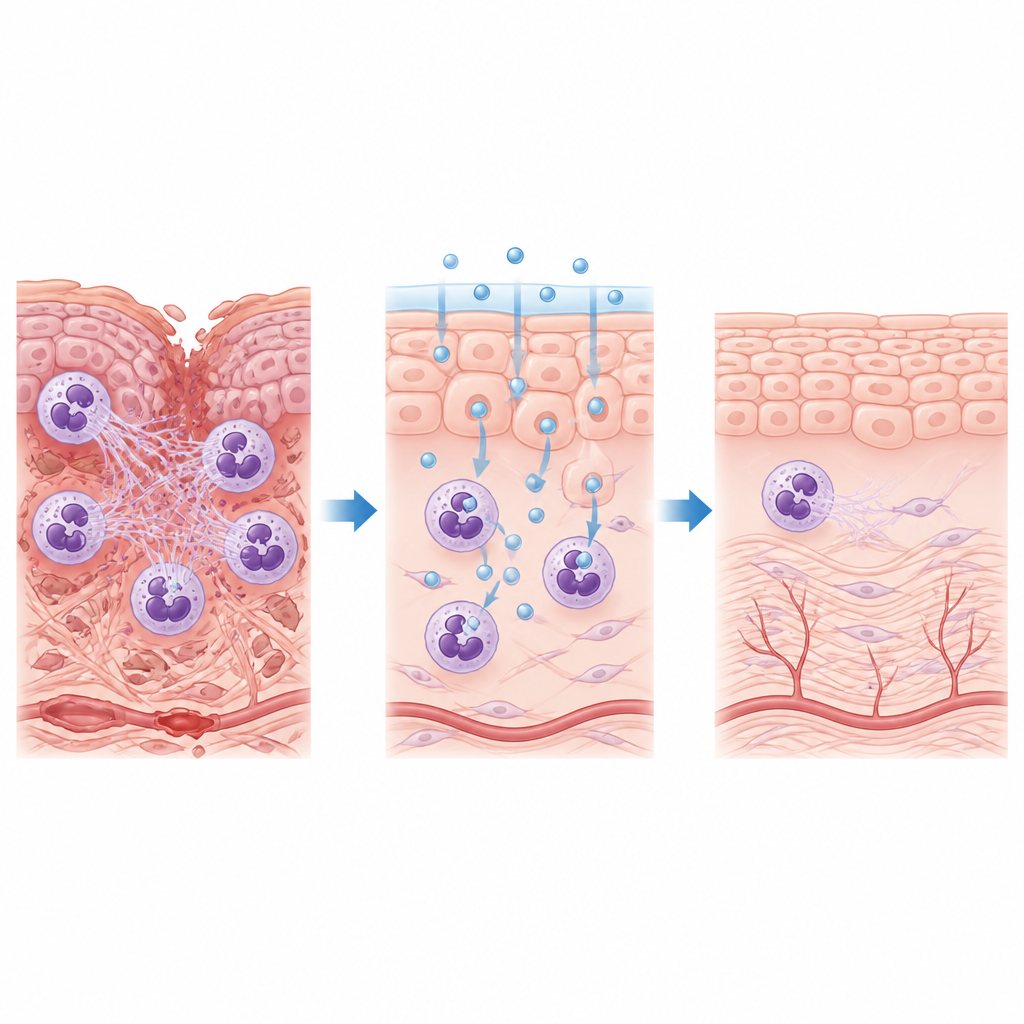
To understand how the treatment works inside the wound, the scientists analyzed gene activity and proteins in treated mouse tissue. They found that Tat-PYC-Smad7 reduced signals related to the TGFβ and NFκB pathways, which are known to drive inflammation, cell death, and fibrosis. It also tamped down genes and proteins linked to neutrophil function. In both mice and pigs, wounds treated with the protein contained fewer neutrophils that were undergoing a dramatic process called NET formation, in which these cells release webs of DNA and enzymes that can damage surrounding tissue when overproduced. Levels of key neutrophil products, including the enzyme myeloperoxidase and elastase, were lower in treated wounds.
How the protein blocks harmful traps
Lab experiments with a neutrophil-like cell line showed that Tat-PYC-Smad7 can directly enter these cells within minutes and reduce NET formation triggered by chemical signals or high sugar levels. The protein interfered with a crucial step in which histones in the cell nucleus are chemically modified, a change that normally allows DNA to loosen and be expelled as a web. Tat-PYC-Smad7 physically associated with myeloperoxidase, reduced its enzyme activity, and limited its movement into the nucleus, a key requirement for full NET formation. When the cells’ own Smad7 was knocked down, NET production increased, suggesting that boosting Smad7 tilts neutrophils away from this destructive behavior while still allowing them to be present at the wound.
What this could mean for patients
Overall, the study shows that a Smad7-based topical biologic can improve healing of diabetic wounds in both mice and pigs by acting locally on two main cell types: skin cells that rebuild the surface and neutrophils that can otherwise keep the wound inflamed. By easing harmful signaling inside these cells, supporting orderly tissue regrowth, and curbing excessive NET release, Tat-PYC-Smad7 helps stalled wounds move toward closure without detectable systemic exposure in animal models. While further studies are needed in people, this approach illustrates how precisely tuned biologic creams might one day offer new options for chronic diabetic wounds.
Citation: Ke, Y., Li, BZ., Li, F. et al. Smad7-based biologic targeting epidermis and stroma promotes healing of diabetic wounds in mice and pigs. Nat Commun 17, 4489 (2026). https://doi.org/10.1038/s41467-026-70790-9
Keywords: diabetic wounds, wound healing, topical biologic, neutrophil NETs, skin inflammation