Clear Sky Science · en
Isomer design unlocks rainbow phosphorescence
Glowing Colors That Linger in the Dark
Imagine a material that glows in any color of the rainbow long after the lights go out—without using heavy metals or complex mixtures. This study shows how chemists can dial in long‑lasting afterglow colors simply by shifting the position of a single nitrogen atom within a small organic molecule. The work not only helps explain how these glow‑in‑the‑dark materials function, but also points toward practical uses in anti‑counterfeiting, safety signs, and even marine research.
Why Long-Lasting Glow Matters
Glow‑in‑the‑dark materials that keep shining after the light is turned off rely on a trick: they temporarily store energy in a long‑lived “hidden” state before slowly releasing it as visible light. Many existing materials that do this well depend on heavy metals or brittle crystals, which can be costly, toxic, or hard to process. Purely organic alternatives are safer and more flexible, but they usually suffer from weak glow and unpredictable colors. The key difficulty is controlling how excited energy is stored and released inside the molecules—the so‑called triplet states—without making the design overly complicated.
Small Structural Changes, Big Color Shifts
The researchers focused on a family of closely related ring‑shaped molecules built around carbazole and benzindole skeletons. These molecules are almost identical except for where a single nitrogen atom sits in the fused three‑ring framework. By preparing four specific versions—carbazole (Cz) and three benzindole “isomers” called Bd[g], Bd[e], and Bd[f]—they created a clean testbed to see how this tiny structural shift affects glow behavior. Using a mix of traditional solution chemistry and a greener, one‑step solvent‑free ball‑milling method, they could efficiently make all four scaffolds, including two (Bd[g] and Bd[e]) that had been hard to access before. Each molecule was then blended at low concentration into common plastics such as poly(vinyl alcohol) and other transparent polymers, forming thin, flexible films.
Building a Rainbow from One Molecular Family
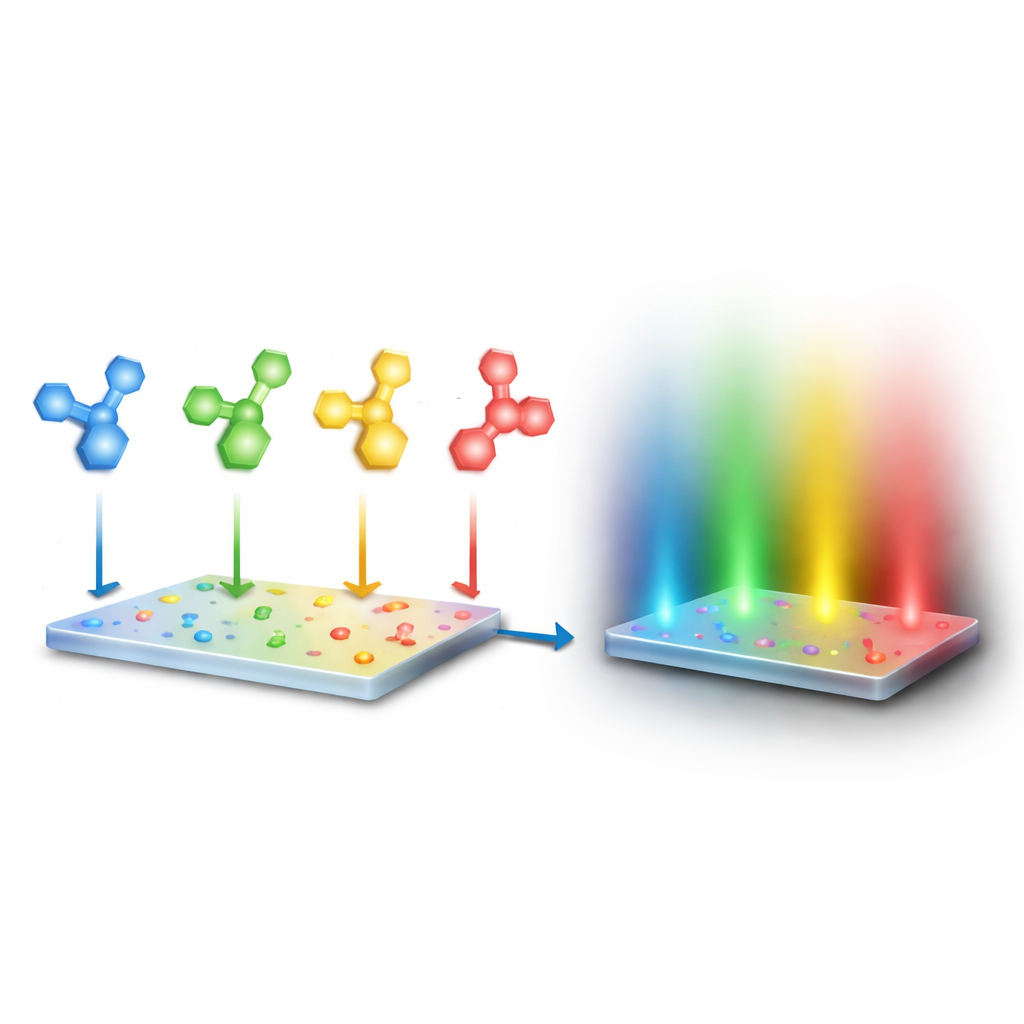
When the films were exposed to ultraviolet light and the lamp was switched off, something striking happened: each isomer produced a different color of long‑lasting afterglow. The carbazole‑based film shone blue, Bd[g] glowed green, Bd[e] appeared yellow, and Bd[f] gave a deep red, together covering the full visible spectrum. The emission colors matched low‑temperature measurements, showing that the glow comes from intrinsic molecular states rather than impurities. The lifetimes also varied: carbazole in poly(vinyl alcohol) produced a particularly long afterglow lasting over four seconds, while the benzindole variants glowed for shorter but still clearly visible times. This “rainbow phosphorescence” was achieved without changing side groups, adding heavy atoms, or building complex multi‑component systems—only by repositioning one nitrogen within a shared backbone.
How the Polymer Host and Nitrogen Position Work Together
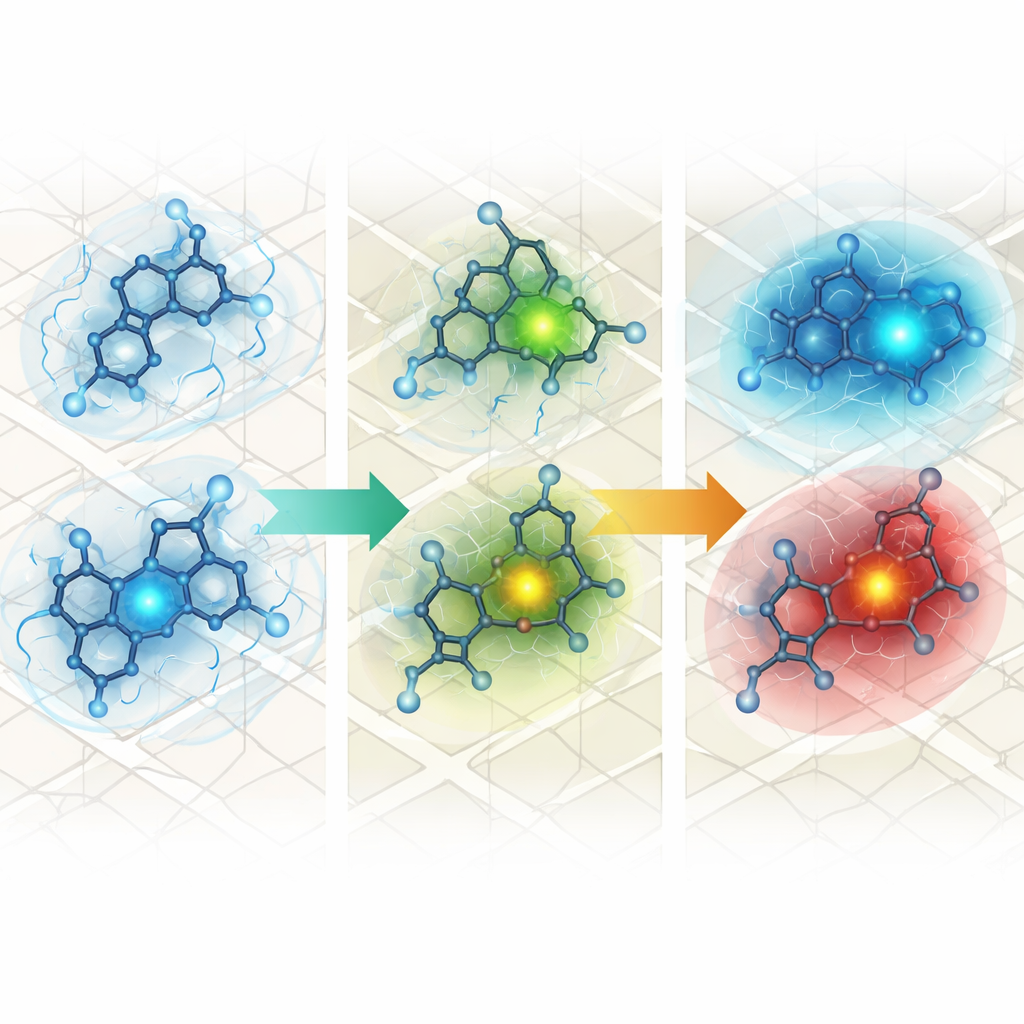
To understand why such subtle changes have such dramatic effects, the team combined computer simulations with crystal‑structure analysis. Calculations showed that moving the nitrogen steadily lowers the energy gap between the molecule’s ground and excited states and shifts the triplet energy, which naturally tunes the glow color from blue to red. At the same time, the way charge is distributed across each isomer determines how strongly it interacts with the surrounding polymer chains. Carbazole, for example, presents a very polar region around its nitrogen–hydrogen group, which forms strong hydrogen bonds with the hydroxyl‑rich poly(vinyl alcohol). Those bonds lock the molecule in place and reduce its internal motions, making it much harder for the stored energy to leak away as heat instead of light. Benzindole isomers, with weaker polarity or fewer bonding options, experience looser confinement and therefore shorter glow times, even though their basic ability to form the triplet state is comparable.
From Smart Afterglow to Real-World Uses
Because these glow properties are robust across several plastics, the materials can be tailored for different uses simply by choosing the right host and isomer combination. The authors demonstrated high‑temperature anti‑counterfeiting patterns that reveal multicolored digits only after heating and turning off the UV lamp, sunlight‑charged emergency markers that keep shining without electricity, and durable coatings that retain their glow after long immersion in seawater. They even highlighted that some of the green‑to‑yellow emissions overlap with visual sensitivity ranges of marine organisms, suggesting future roles in light‑based studies of ocean life. Overall, the study shows that careful isomer design—moving a single atom within a small organic framework—can reliably control both the color and persistence of afterglow, offering a general blueprint for safer, tunable, and scalable glow‑in‑the‑dark materials.
Citation: Xu, X., Ding, D., Ding, X. et al. Isomer design unlocks rainbow phosphorescence. Nat Commun 17, 4093 (2026). https://doi.org/10.1038/s41467-026-70784-7
Keywords: room temperature phosphorescence, organic afterglow materials, molecular isomers, polymer doped phosphors, anti-counterfeiting applications