Clear Sky Science · en
Topologically reconstructing Pancharatnam-Berry phase via encircling exceptional point for chiral spin-orbit interaction steering
Shaping Light in New Ways
Light is more than just brightness and color: it carries tiny twists and swirls that can be used to encode and move information. This study shows a new way to control those twists using ultra-thin patterned surfaces, letting scientists switch, silence, or amplify light’s swirl in a simple and reliable way. Such control could feed into advanced optical communication, special imaging systems, and even new approaches to information security.
How Light’s Spin Talks to Its Path
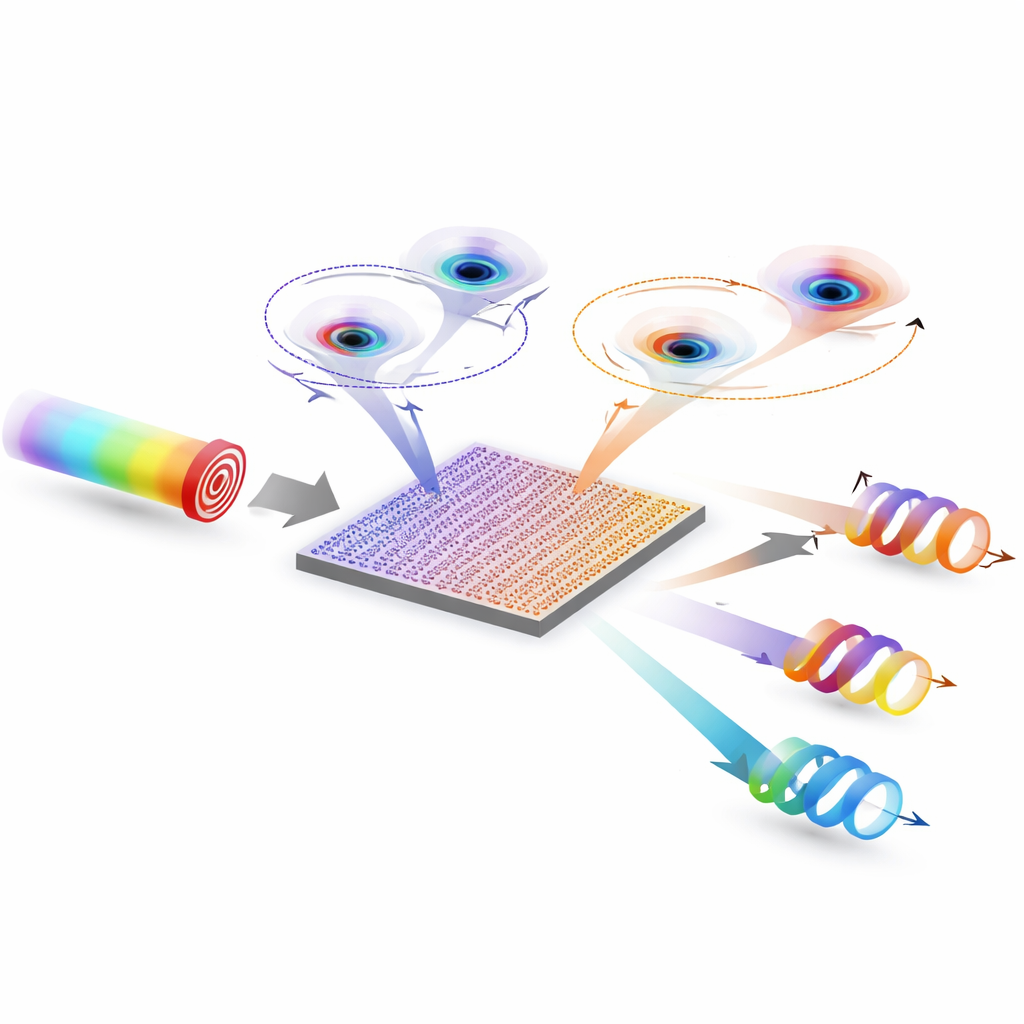
When light travels, it can spin like a corkscrew while also carrying a separate kind of “whirl” linked to how its wavefront winds through space. The coupling between these two traits—spin and orbit—is called spin–orbit interaction. Engineers already use this effect in flat optical devices called metasurfaces, whose tiny building blocks can be rotated to imprint a special “geometric” phase on light, known as the Pancharatnam–Berry phase. Traditionally, this phase scales in a simple, predictable way with the rotation of those building blocks, giving a fixed rule for how spin is converted into orbital twist.
Hidden Singularities in Flat Optics
The authors show that this familiar geometric phase can be reinterpreted in a strikingly different way. In their view, rotating the elements of a metasurface is mathematically equivalent to tracing a closed loop around a special kind of singular point—called an exceptional point—in an abstract plane that describes how polarization is converted. These exceptional points arise because the metasurface is an “open” system: energy leaks out, making its behavior effectively non-Hermitian. Encircling such a point gives the light a topological phase, much like walking once around a mountain peak always brings you back with a net change in direction. Crucially, which way you walk around the peak depends on the handedness of the incoming circular polarization, so left- and right-handed spins experience the structure very differently.
Switching Off, Flipping, and Doubling the Twists
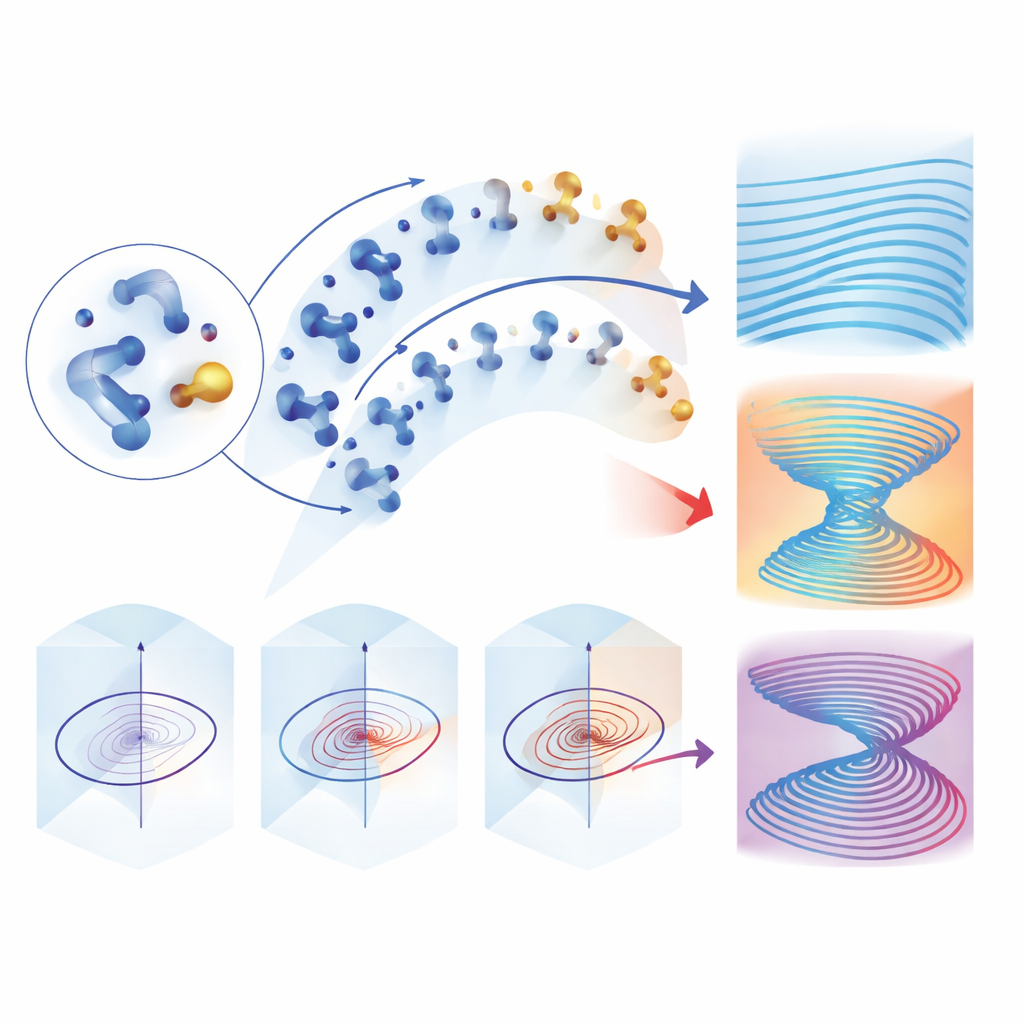
Building on this picture, the team deliberately adds small fixed elliptical features to their metal-on-glass meta-atoms. These act as gentle disturbances that change how the main L-shaped parts couple to light as they rotate. By tuning the size and placement of these perturbations and by choosing the wavelength carefully, the rotation path can be made to touch or circle exceptional points in different ways. The result is a “topologically reconstructed” geometric phase: for one chosen spin of light and a chosen color, the usual spin–orbit rule can be suppressed so that rotation no longer matters, flipped so that the twist reverses sign, or doubled so that the twist becomes twice as strong. The other spin of light, however, keeps the usual behavior, revealing a built-in chirality to the effect.
Watching the Effects in Real Beams
To see these changes directly, the researchers design several metasurfaces and test how they reshape beams in two different ways. First, they study the spin Hall effect of light, where beams with opposite spins shift sideways in opposite directions after passing through the device. In the “suppression” regime, one spin continues to shift while the other suddenly stops, even though the structure is still rotated. Second, they perform spin-to-vortex conversion, where circularly polarized light is turned into beams carrying orbital angular momentum, marked by spiral interference fringes. They observe cases where the orbital twist number changes from a finite value to zero, where it flips from negative to positive, and where it doubles, all triggered by changing the wavelength and spin in line with the exceptional-point picture.
Hiding Messages in Light
The ability to choose between normal, inverted, and doubled geometric phase for only one spin and a narrow band of colors gives a rich “library” of responses. The authors use this to build an optical encryption scheme. They design a metasurface so that under one circular polarization the outgoing pattern always shows a harmless decoy image, regardless of color. Under the opposite polarization, however, changing the wavelength causes the device to swap between an inverted version of the decoy and a completely different hidden image. Only by knowing both the correct polarization and the right color can a viewer reveal the secret picture, turning the topological control of light into a practical security feature.
Why This Matters
By tying a familiar geometric phase to the winding around exceptional points, this work adds a new topological “knob” to flat optics. Instead of relying on delicate phase-change materials or complex multi-layer stacks, the devices use stable metals and carefully shaped nano-elements to steer how spin and orbit of light interact. The demonstrations of suppression, inversion, and doubling of spin–orbit effects, along with a proof-of-concept encryption system, suggest that future photonic chips could harness these robust topological rules to route, process, and hide information using nothing more than cleverly twisted light.
Citation: Lyu, Q., Yan, Q., Zhao, W. et al. Topologically reconstructing Pancharatnam-Berry phase via encircling exceptional point for chiral spin-orbit interaction steering. Nat Commun 17, 3991 (2026). https://doi.org/10.1038/s41467-026-70782-9
Keywords: spin–orbit interaction of light, metasurfaces, geometric phase, exceptional points, optical encryption