Clear Sky Science · en
Ultrahigh energy-storage dielectric ceramics via synergistic polymorphic nanodomain and defect design
Smaller, faster power for future electronics
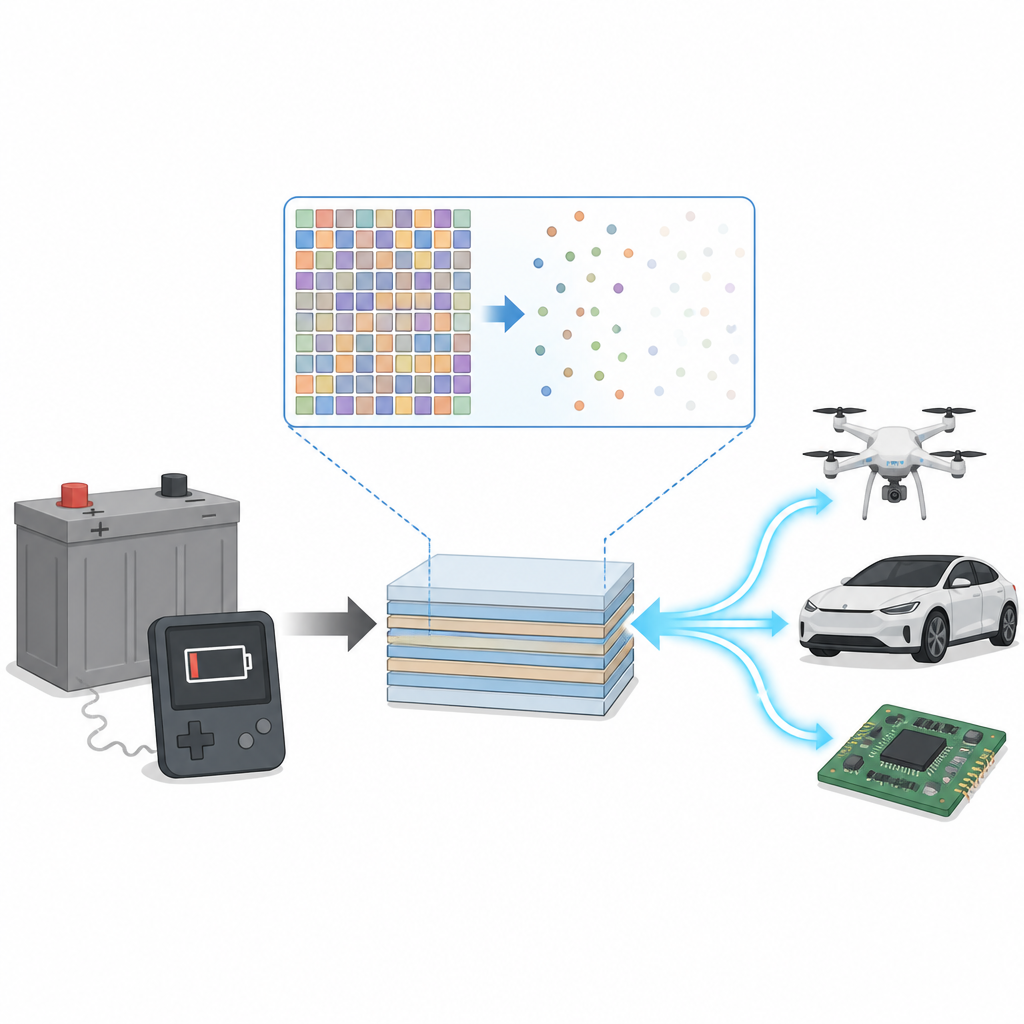
From electric cars to tiny internet-connected sensors, modern electronics hunger for components that can store and release energy in a split second without taking up much space. This study explores a new kind of ceramic material for capacitors, aiming to pack far more usable energy into a small volume while keeping the devices safe, efficient, long lasting, and stable across a wide range of temperatures.
Why today’s capacitors fall short
Capacitors are the sprinters of the energy world: they can charge and discharge extremely quickly and deliver very high power. Yet most ceramic capacitors hold relatively little energy, which limits how small or how capable next-generation systems can be. Improving them is tricky because three key properties pull against each other. High stored charge, low leftover charge after switching, and the ability to withstand very high electric fields usually cannot be maximized at the same time. Existing approaches often either boost stored charge at the cost of higher losses and heat, or reduce losses but give up too much capacity.
Designing a new ceramic recipe
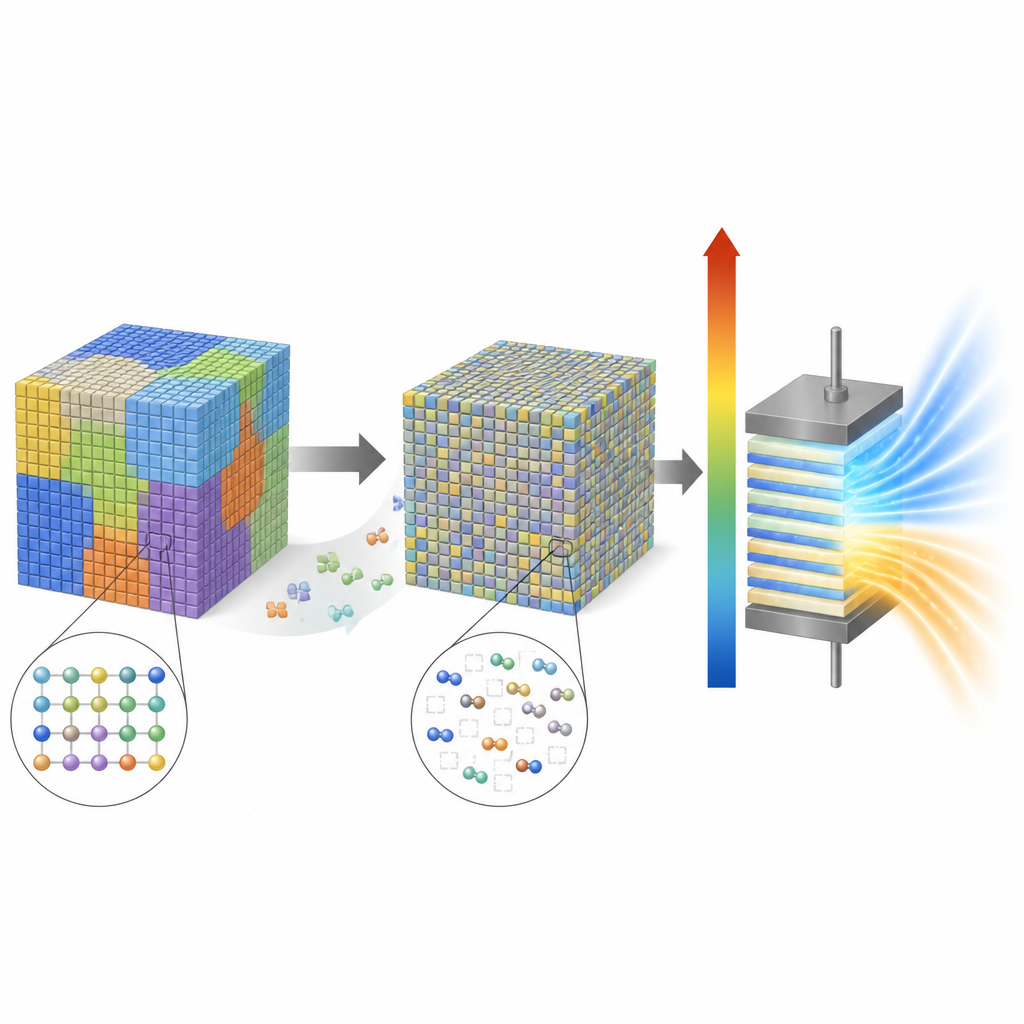
The researchers tackled this problem by crafting a complex mixture of well-known oxide ceramics. They started from barium titanate, a classic capacitor material, then blended in two other compounds that shift how its atoms arrange themselves and how defects form inside the crystal. The goal was to create countless tiny regions, just one to two nanometers across, that favor slightly different atomic arrangements, while also reshaping the landscape of missing oxygen atoms and other imperfections. By finely adjusting the chemical ratios, especially of bismuth and sodium, they could tune both the internal structure and the types of defects that appear.
Taming tiny regions and helpful defects
Inside the new ceramic, advanced electron microscopy revealed a patchwork of ultrafine regions with different local shapes, all squeezed together. These nanometer-scale areas act like many small, loosely linked polar zones that can flip in response to an electric field without dragging along large, rigid domains. At the same time, careful defect design reduced the number of free oxygen vacancies, which can carry charge and trigger electrical breakdown, and instead promoted defect complexes that act as traps. Electrical measurements showed that these complexes help block unwanted charge motion and subtly boost how the material polarizes, cutting energy loss and raising the field the ceramic can safely withstand.
From laboratory pellets to real devices
The team did not stop at testing simple ceramic pellets. They manufactured multilayer ceramic capacitors, similar to those used in real circuits, with thin stacked layers of the new material separated by metal electrodes. These devices achieved a recoverable energy density of 18.7 joules per cubic centimeter and an efficiency of about 92 percent, all under very high electric fields. They kept performing reliably over more than ten million rapid charge–discharge cycles and held their energy and efficiency within a few percent from room temperature up to 150 degrees Celsius. Fast discharge tests showed that the capacitors could release most of their stored energy in less than a millionth of a second while remaining stable over time and temperature.
What this means for future technology
For a layperson, the bottom line is that the authors have shown how to build compact ceramic capacitors that behave more like ideal energy springs: they store a lot of energy, waste very little as heat, withstand intense electrical stress, and keep working in harsh conditions. By jointly shaping both the tiny structural regions and the defects inside the material, they outline a recipe that could be applied to other ceramics. Such advances could help shrink and strengthen the power-handling parts of electric vehicles, renewable energy systems, and fast electronics, enabling devices that are smaller, more efficient, and more reliable without changing how users interact with them.
Citation: Zhang, M., He, Y., Pan, H. et al. Ultrahigh energy-storage dielectric ceramics via synergistic polymorphic nanodomain and defect design. Nat Commun 17, 4445 (2026). https://doi.org/10.1038/s41467-026-70768-7
Keywords: dielectric capacitor, energy storage, ceramic materials, relaxor ferroelectric, multilayer capacitors