Clear Sky Science · en
Polyglutamate-loaded chitosan nanogels reprogram plant metabolism for increased growth and viral resistance
Helping Crops Fight Viruses and Grow Better
Farmers around the world struggle with plant viruses that quietly stunt growth and slash yields, often with few safe treatment options. This study explores a clever way to help plants both grow more vigorously and resist viral infections, using a natural plant pathway and tiny biodegradable particles instead of traditional chemical sprays. The work focuses on tobacco mosaic virus, a classic plant pathogen, but the principles could inform safer protection strategies for many crops.
How Plants Turn Food into Defense
Plants constantly juggle a trade off between growing and defending themselves. The researchers examined an enzyme in the model plant Nicotiana benthamiana called NbAS B, which helps the plant process nitrogen, a key nutrient. They discovered that when plants make more of this enzyme, they not only grow larger roots and leaves but also become harder for several different viruses to infect. Plants lacking NbAS B, on the other hand, were smaller and far more vulnerable to viral spread, revealing that this metabolic “worker” doubles as a quiet guardian of plant health.
A Key Building Block with a Second Job
Digging deeper, the team used large scale gene activity and chemical profiling to see what changes when NbAS B levels rise or fall. They found that the enzyme shifts how nitrogen rich molecules are used, pushing the production of glutamate, a common amino acid in plants. Glutamate turned out to be more than food. Applied from outside, it directly boosted resistance to tobacco mosaic virus in a dose dependent way, and blocking glutamate production weakened the plant’s defenses. Further tests showed that glutamate triggers a chain reaction through plant receptors that let calcium ions flow into cells, which in turn boosts the stress hormone salicylic acid and switches on classic immune genes.
Rewiring Energy for Faster Growth
NbAS B did not just change the plant’s defense chemistry. Plants with more of this enzyme had greener leaves, higher chlorophyll, and stronger photosynthesis, meaning they captured light and carbon dioxide more efficiently. Measurements of sugar and protein content showed that these plants built up more organic matter across their life cycle, from seedlings to mature plants. In contrast, plants missing NbAS B had weaker photosynthesis and disrupted cell wall formation. Together, these findings suggest that glutamate and related nitrogen compounds help the plant coordinate how it builds tissues and when it invests in protection, linking nutrition and immunity.
Tiny Gels that Deliver Natural Protection
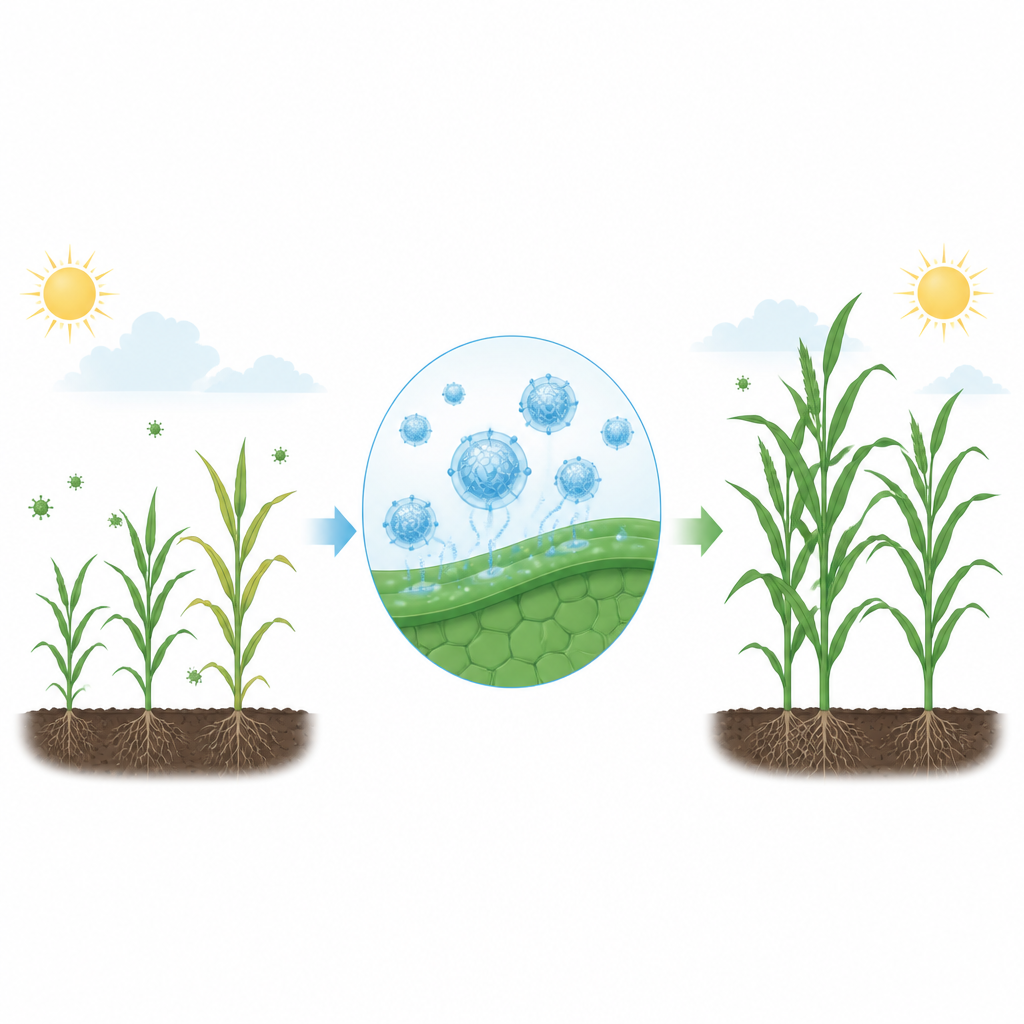
Knowing that glutamate boosts both growth and antiviral defenses, the researchers asked how to deliver this signal in a practical way in the field. Simple glutamate or its longer chain form, polyglutamic acid, do not easily enter plant tissues and wash off leaves in rain. To solve this, the team created nanogels by packing polyglutamate inside a positively charged natural polymer called chitosan. These very small, smooth particles stuck to leaves, slipped in mainly through pores, and then slowly released glutamate as plant enzymes broke them down. The nanogels raised glutamate and salicylic acid levels inside plants for days, turning on defense genes more strongly and for longer than free glutamate or polyglutamic acid alone.
How the Nanogels Block Viruses
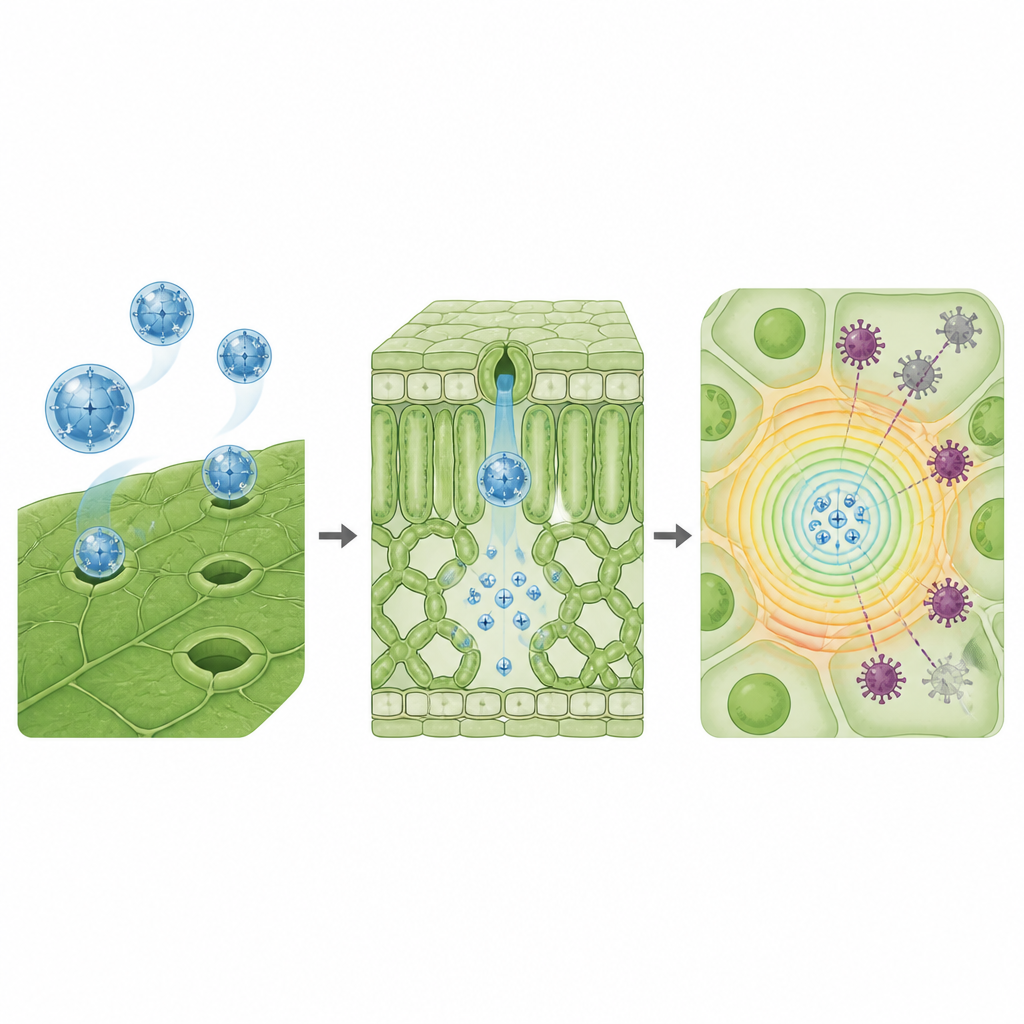
When sprayed on leaves before infection, the optimal nanogel dose sharply reduced the spread of fluorescently labeled tobacco mosaic virus throughout the plant. Tests with mutant plants lacking a specific glutamate receptor, GLR3.3, showed that this protein is required for the nanogel effect. Without the receptor, the nanogels no longer triggered strong defense gene activity or viral resistance, confirming that the particles work by feeding extra glutamate into the plant’s own calcium and salicylic acid signaling route. The nanogels also clung to leaves even after repeated simulated rain and did not harm seed germination or growth, instead slightly boosting plant size and vigor.
A New Tool for Safer Crop Protection
In simple terms, this study reveals that a single natural molecule, glutamate, can help plants grow better and fight viruses when channeled through the right enzyme and receptor. By packaging polyglutamate into sticky, slow release nanogels made from chitosan, the researchers turned this basic plant building block into a practical, long lasting spray that strengthens immunity without obvious growth penalties. While more work is needed to adapt the approach to different crops and field conditions, the results point toward plant friendly, biodegradable treatments that work with, rather than against, the plant’s own metabolism to manage viral diseases.
Citation: Qiao, G., Liu, C., Chen, L. et al. Polyglutamate-loaded chitosan nanogels reprogram plant metabolism for increased growth and viral resistance. Nat Commun 17, 4523 (2026). https://doi.org/10.1038/s41467-026-70753-0
Keywords: plant antiviral immunity, glutamate signaling, nanogel crop treatment, tobacco mosaic virus, sustainable plant protection