Clear Sky Science · en
The relative role of direct orbital forcing versus CO2 and ice feedbacks on Quaternary climate
Why the distant ice ages still matter today
Earth’s climate has swung between deep ice ages and warmer periods over the last 2.58 million years. Understanding what drove those swings helps us test climate models and sharpen our picture of how carbon dioxide and ice sheets shape temperatures on timescales far longer than human history. This study tackles a long standing question: were these ancient ups and downs caused mainly by tiny wobbles in Earth’s orbit around the Sun, or by the way greenhouse gases and ice sheets responded to those orbital nudges?
Using smart shortcuts to simulate deep time
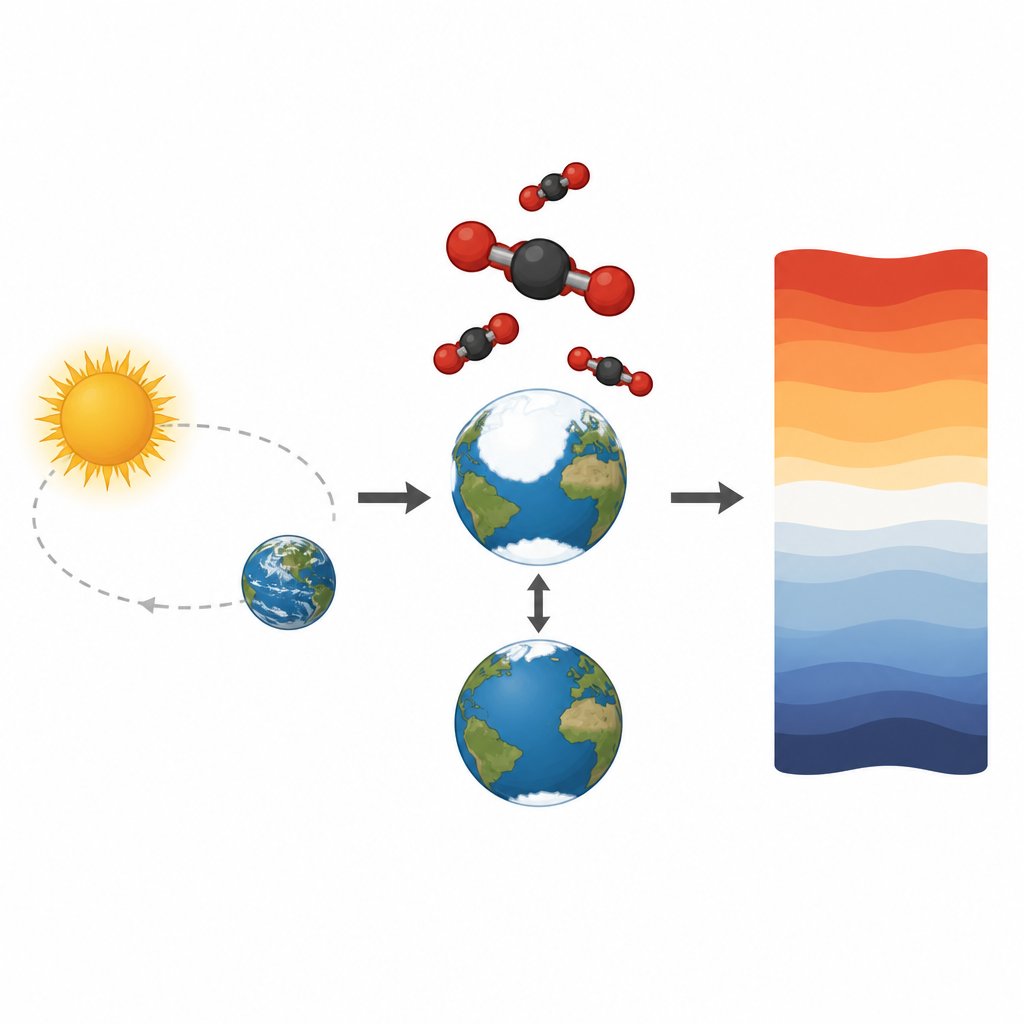
Running a full scale global climate model continuously across millions of years would take decades of supercomputer time. To get around this, the authors first used a complex climate model to create a large library of snapshots under many combinations of greenhouse gas levels, ice sheet sizes, and orbital settings. They then trained a statistical tool, called an emulator, to learn how temperature and rainfall respond to these inputs. Once trained, the emulator can produce global maps of surface air temperature and precipitation every thousand years across the whole Quaternary at a tiny fraction of the computing cost.
Checking the emulator against Earth’s climate archives
To see whether the emulator is trustworthy, the team compared its output with climate clues preserved in ice cores and ocean sediments. For Antarctica’s Dome C ice core, which records local air temperature, the emulator closely tracks both the timing and size of most warm and cold periods over the last 800,000 years. In several ocean sites, it also captures the rhythm of glacial and interglacial swings, although it tends to underestimate how large some early temperature changes were. For rainfall, they compared the emulator with oxygen isotope records from Chinese caves that reflect monsoon strength. Here too, the emulator reproduces the major ups and downs and their pacing by orbital cycles, especially the precession driven shifts in seasonal monsoon rains.
Separating the drivers of ancient climate change
Once validated, the emulator became a laboratory for asking what really drives long term climate shifts. The authors ran a suite of “what if” experiments in which they allowed only one factor, or particular combinations of factors, to vary while holding the others constant. They then compared each experiment with the full run that included varying greenhouse gases, ice volume, and all three orbital parameters. This analysis revealed that changes in atmospheric carbon dioxide explain just over half of the global annual mean temperature signal, while changes in ice sheets account for roughly a third. In contrast, the direct influence of orbital changes on yearly average temperature is very small, contributing only a few percent overall, although obliquity (tilt) has a noticeable effect at high latitudes.
What the results say about Earth’s past and future
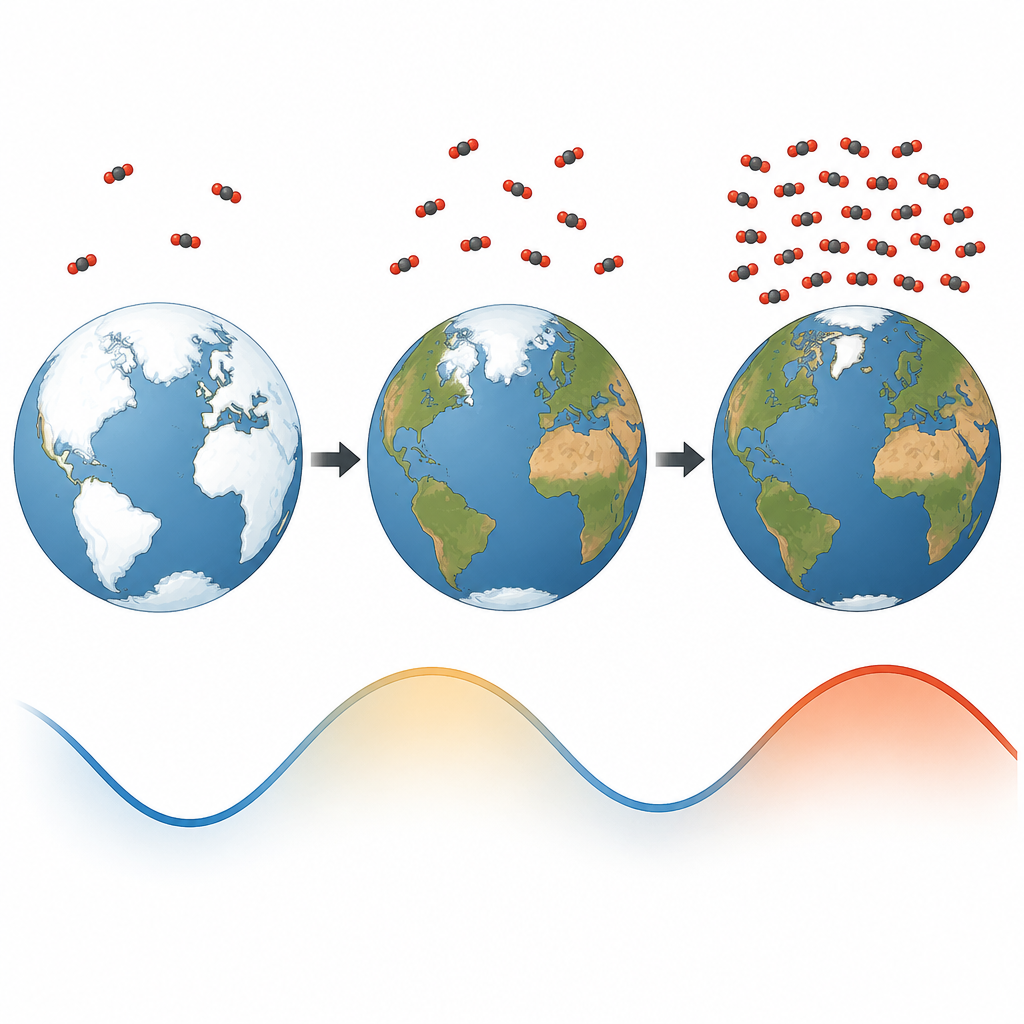
The study shows that over the Quaternary, Earth’s slow orbital cycles acted mainly as a pacemaker: they nudged the climate system, but the large temperature swings were amplified by carbon dioxide and ice sheet feedbacks. In other words, orbital changes set the timing of glacial and interglacial periods, while shifting greenhouse gases and growing or shrinking ice sheets did most of the work in cooling and warming the planet. For a lay reader, the key message is that climate sensitivity to carbon dioxide and ice is strong enough to reshape the planet’s climate over long timescales, even when the original push from orbital changes is relatively small. This reinforces the idea that changes in greenhouse gases are central to understanding both past and future climate.
Citation: Williams, C.J.R., Lord, N.S., Kennedy-Asser, A.T. et al. The relative role of direct orbital forcing versus CO2 and ice feedbacks on Quaternary climate. Nat Commun 17, 4254 (2026). https://doi.org/10.1038/s41467-026-70750-3
Keywords: Quaternary climate, orbital forcing, CO2 feedbacks, ice sheets, climate emulator