Clear Sky Science · en
Oligomerization-competent PIF4 drives thermomorphogenesis through functional redundancy in transactivation and DNA binding
How Plants Sense a Gentle Warm-Up
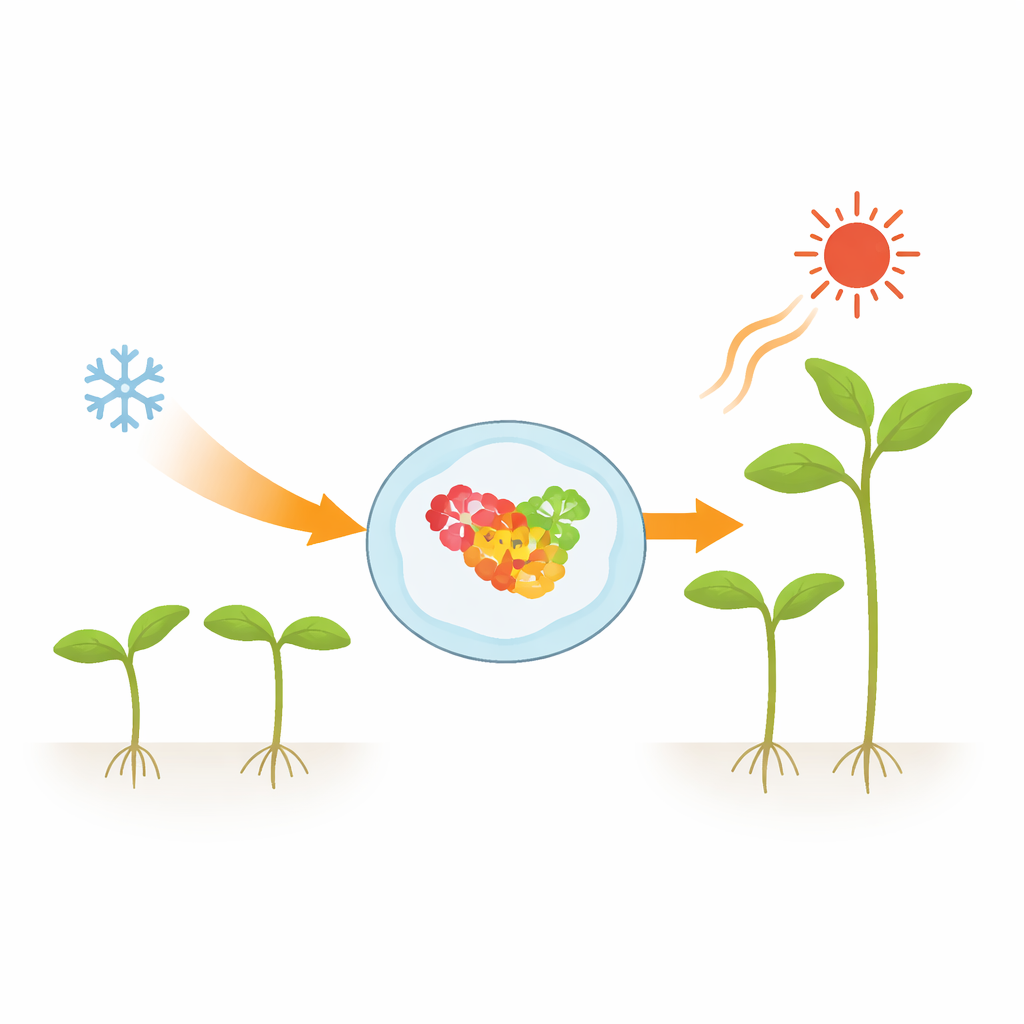
When a cool spring day turns pleasantly warm, many plants quietly change their body shape. Their stems stretch, leaves angle differently, and the whole plant rearranges itself to make the best use of light and heat. This temperature‑shaping of plant form, called thermomorphogenesis, is crucial for survival as climates shift. The study behind this article digs into a single master regulator protein, PIF4, to ask a surprising question: which of its many molecular tricks are truly necessary for plants to grow taller in warm weather?
The Shape‑Shifting Growth Program
Within a comfortable temperature range, a few degrees of warming are enough to remodel young plants. Seedling stems and leaf stalks lengthen, altering how the plant captures light and cools itself. This response is orchestrated by temperature‑responsive transcription factors—proteins that turn genes on and off. At the heart of this network sits PIF4, a member of a large family of light‑ and temperature‑sensing regulators. PIF4 sits just downstream of known thermosensors and integrates inputs from many signaling partners, ultimately controlling genes involved in hormone production and cell‑wall loosening that drive stem elongation.
A Protein with Ordered and Unruly Parts
PIF4 has two very different regions. One end forms a structured “basic helix‑loop‑helix” core that helps it bind DNA and assemble with copies of itself or relatives. The other end is long and floppy—an intrinsically disordered region that refuses to adopt a single fixed shape. The authors show that this disordered segment can clump into dense droplets, or condensates, both in test tubes and inside plant cell nuclei. Unlike some stress‑sensing proteins whose droplets melt or harden as temperature changes, PIF4’s condensates are sluggish and largely insensitive to shifts between cooler and warmer room‑like conditions, suggesting a more static compartment.
When Key Functions Turn Out to Be Optional
Classic textbook views say a transcription factor needs two main talents: it must grip DNA at specific sequences, and it must use an activation segment (a transactivation domain) to recruit the gene‑switching machinery. The team systematically mutated acidic and oily amino acids in PIF4’s activation segment and basic amino acids in its DNA‑contacting region. These changes almost wiped out PIF4’s ability to turn on reporter genes in yeast and greatly reduced its ability to form condensates. Yet, when these crippled versions were put back into Arabidopsis plants lacking native PIF4, the seedlings still elongated their stems in warm conditions nearly as well as plants carrying normal PIF4. Even versions that barely bound DNA could restore warm‑induced growth, overturning the assumption that PIF4 must personally grab its target genes.
The Power of Teamwork and Clustering
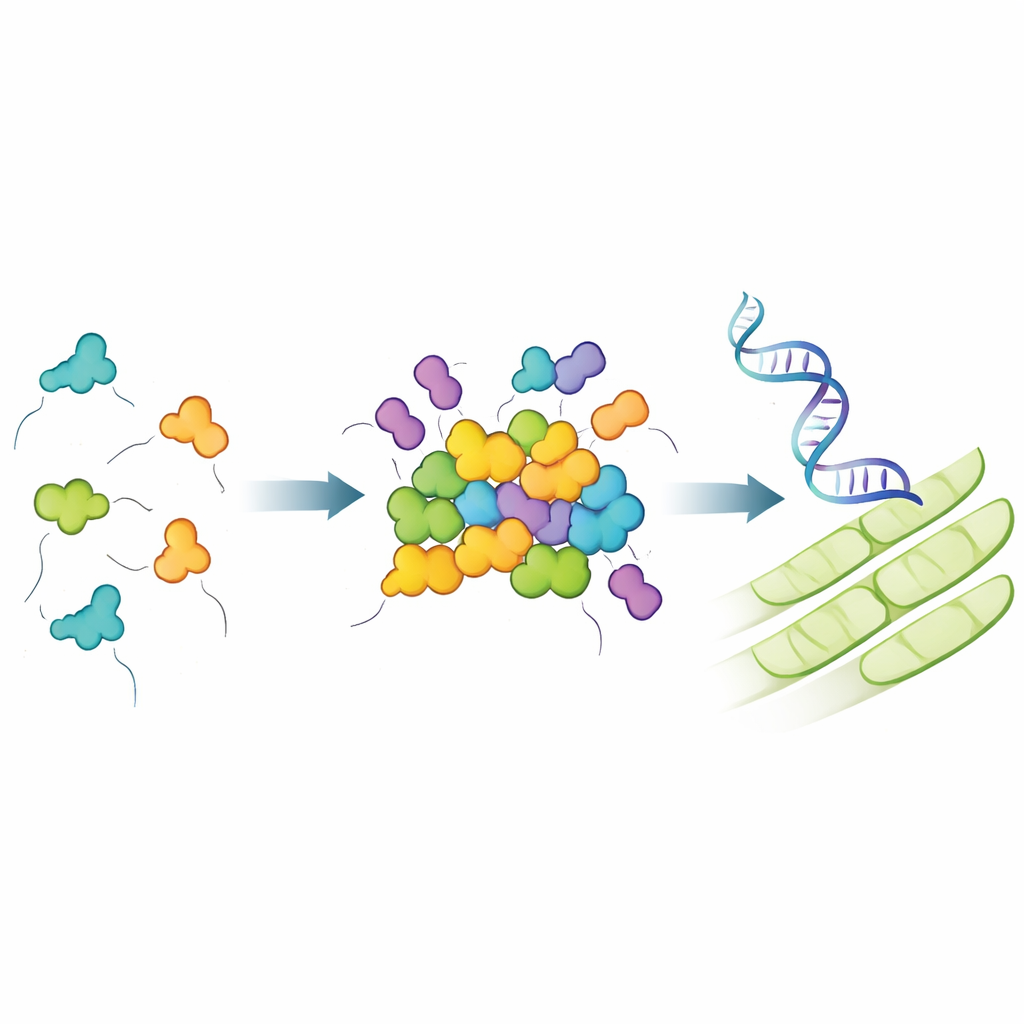
The real breaking point appeared when the researchers disrupted PIF4’s ability to oligomerize—that is, to build larger complexes from multiple copies. By altering a set of twelve basic residues spread across the DNA‑contacting region and the first helix of the core, they produced a PIF4 variant that could no longer form higher‑order assemblies with itself. Plants expressing this version failed to elongate under warm conditions despite accumulating plenty of protein. Additional biochemical tests confirmed that these same residues are crucial for PIF4 to build multimeric complexes. Importantly, when close relatives of PIF4 were removed from the plant genome, the defects in the weakened activation domain suddenly became visible: without partners, damaged PIF4 could no longer be “rescued” and thermomorphogenesis collapsed.
Why This Matters for a Warming World
Taken together, the work supports a new view of PIF4 as a scaffold more than a lone hero. Its ability to form multi‑protein clusters appears central, while its own DNA‑binding and activation segments can be backed up by similar domains from partner proteins. In everyday conditions, PIF4’s relatives help supply missing functions, masking even severe mutations in its key regions. For non‑specialists, this means that the plant’s warm‑temperature growth program relies less on any one molecular “on switch” and more on a resilient team effort. Understanding this redundancy and clustering could guide future efforts to engineer crops that adjust their architecture more reliably in a warming climate, without having to perfectly preserve every detail of a single protein’s design.
Citation: Xiong, H., Bajracharya, A., Odari, R. et al. Oligomerization-competent PIF4 drives thermomorphogenesis through functional redundancy in transactivation and DNA binding. Nat Commun 17, 4044 (2026). https://doi.org/10.1038/s41467-026-70748-x
Keywords: plant temperature responses, PIF4 protein, thermomorphogenesis, transcription factor complexes, crop adaptation to warming