Clear Sky Science · en
Pre-splicing conformation and stepwise circularization of a group I intron in Azoarcus pre-tRNA
RNA That Edits Itself
Inside every cell, some RNA molecules can cut and paste themselves without help from proteins. This study looks at one such RNA from a bacterium called Azoarcus and asks a simple question with deep consequences: how does this RNA both splice itself out of a larger molecule and then curl into a stable ring, all on its own?
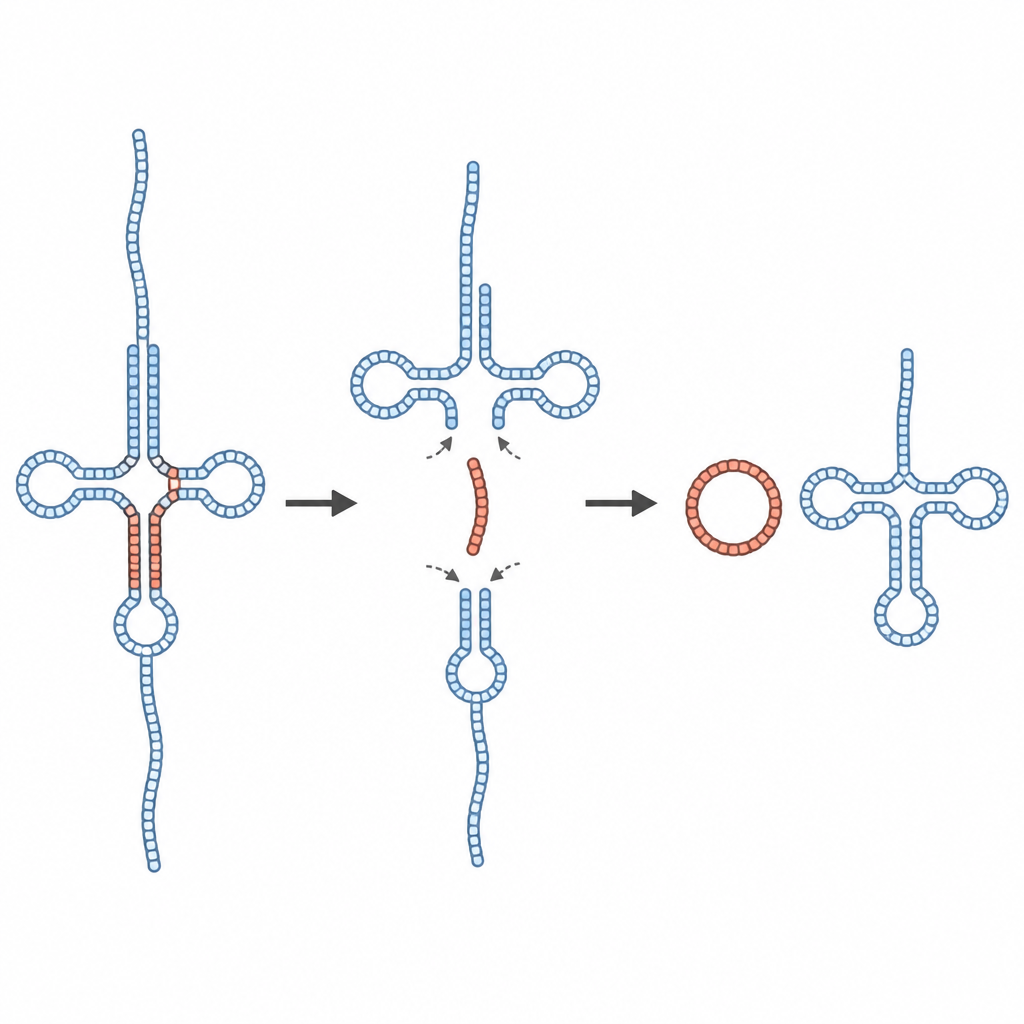
A Tiny Machine Hidden in Transfer RNA
The RNA in question sits inside a transfer RNA, or tRNA, which normally helps decode genetic information during protein production. In this case, a stretch of extra RNA, known as a group I intron, interrupts the tRNA. This intron behaves like a miniature machine: it cuts itself out and joins the flanking pieces to restore a complete, working tRNA. Earlier work had only captured fragments or inactive versions of this system, leaving a gap in our understanding of how the full-length molecule folds and moves before and after cutting.
Freezing Motion to See the Steps
To watch this process in action, the researchers used cryo electron microscopy, a technique that rapidly freezes molecules so they can be imaged at near atomic detail. They prepared three main forms of the RNA: the intact precursor with intron and exons together, the freed intron after the tRNA is repaired, and the intron after it has joined its own ends into circles. These snapshots revealed that even before the first cut, the starting site is already lined up in a helix-like structure, putting the RNA in a ready state for self splicing. The rest of the catalytic core closely matches earlier structures, showing that the essential framework stays steady even when attached to full tRNA arms.
A Sliding Helix and a Flipping Nucleotide
Comparing the precursor and the freed linear intron, the team discovered that a short helical segment near the cutting site slides by exactly two building blocks after splicing. This subtle shift repositions the end of the intron into the catalytic center so that it can attack its own backbone and close into a ring. Another key feature is a single nucleotide, called G37, which flips orientation when the intron turns into a circle. In the circular form, G37 forms a stabilizing contact that helps hold the reaction site in just the right shape. When G37 was swapped for other bases in lab tests, one change made circularization more efficient, while others disrupted it, underscoring how a single pivot point can tune the whole reaction.
Two Rings from One Intron
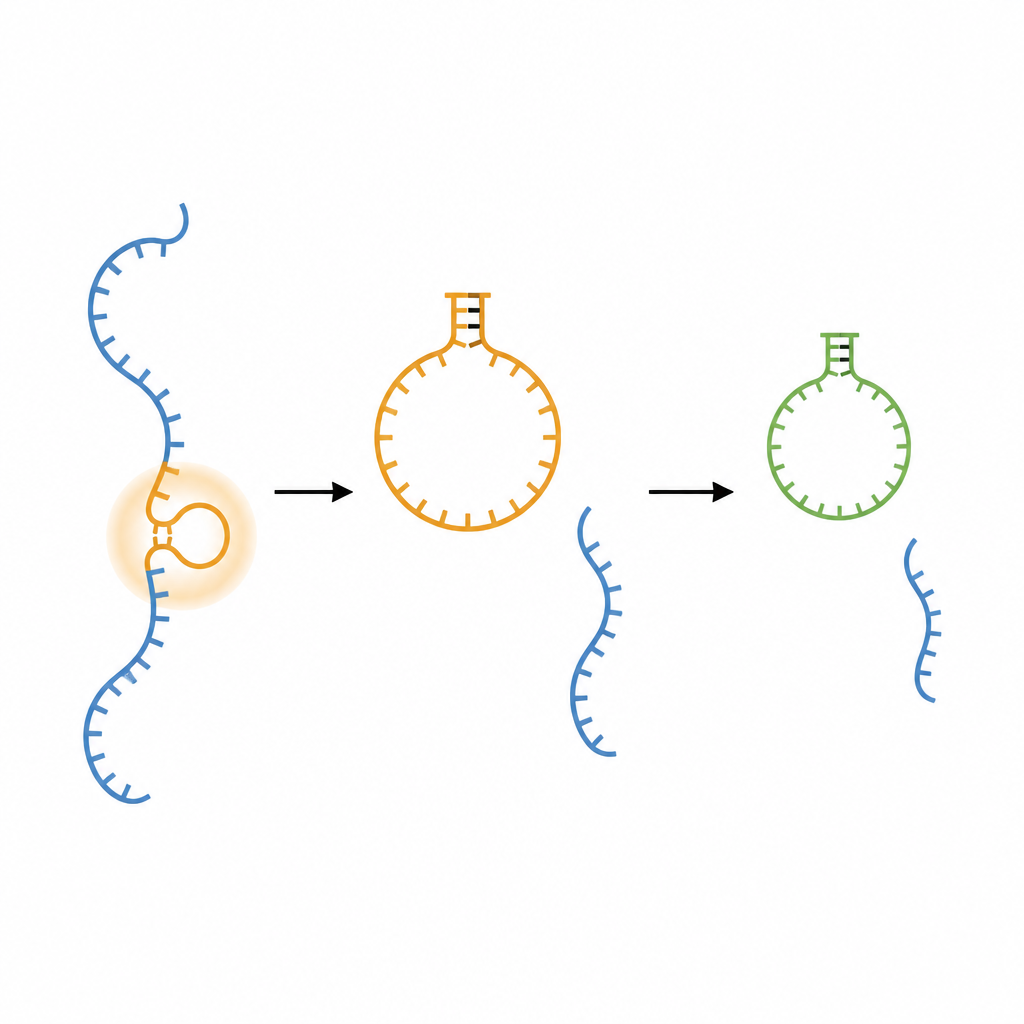
Surprisingly, the intron does not stop after making one ring. Over longer times, the researchers saw a second, slightly smaller circular RNA appear. Biochemical tests showed that the first ring can quietly reopen at its junction under neutral conditions, creating a new linear form that is then reclosed at a different position, trimming a few more nucleotides. Cryo electron microscopy of this second circle revealed that part of the nearby helix has unwound, leaving a more open and flexible region near the active center. This looser structure likely helps the RNA realign the bond that will be broken and rejoined during the second circularization step.
Shaping Metal Ions and Designing Future Tools
The structures also highlight how metal ions help steer the chemistry. Several metal sites stay in place across all stages, supporting the overall fold, while others shift their exact contacts as the RNA moves from splicing to circularization. These changes help anchor the reactive bonds and the attacking groups at each step. Together, the helix sliding, nucleotide flipping, and metal rearrangements show how a single RNA scaffold can carry out different reactions with high precision simply by reconfiguring its own shape.
Why This Matters for Biology and Biotechnology
For a lay reader, the take home message is that RNA can behave like a smart, flexible machine built from just four chemical letters. This work offers a detailed, step by step view of how one such machine cuts itself out of a larger RNA and then folds into one and even two ring shaped products. By revealing the key movable parts and their positions, the study provides a blueprint for designing artificial RNAs that reliably form circles. Such circles are being explored as stable carriers of genetic information and as tools for future therapies, making these basic structural insights directly relevant to emerging RNA technologies.
Citation: Hong, Y., Liu, J., Zhang, X. et al. Pre-splicing conformation and stepwise circularization of a group I intron in Azoarcus pre-tRNA. Nat Commun 17, 4280 (2026). https://doi.org/10.1038/s41467-026-70747-y
Keywords: group I intron, circular RNA, cryo-EM, self-splicing RNA, RNA structure