Clear Sky Science · en
Miniaturized olfactory sensor chip-based AI-wearable biometric ring for human body metabolic odor analysis
Smelling health from your own skin
Most of us know that our bodies give off scent, but few realize that this everyday odor carries a rich stream of information about how we eat, move, and metabolize food. This study introduces a futuristic but practical idea: a small ring that can "sniff" faint chemical traces from your skin and, with the help of artificial intelligence, translate them into clues about your diet and physical activity, opening a new path toward effortless health tracking.
The hidden language of body odor
Human body odor is made up of many tiny airborne chemicals called volatile organic compounds that drift from our skin, breath, and other fluids. These molecules are leftovers of the countless reactions that turn our meals into energy and building blocks. Doctors already know that some of these compounds can hint at illnesses such as lung cancer, metabolic disorders, or chronic disease, but routine measurement typically requires big, expensive lab machines. The authors argue that if we could instead monitor these chemicals continuously and gently from the skin, we might guide daily food choices and exercise habits long before serious illness develops.
From bulky lab tools to a smart ring
In hospitals and research labs, the gold standard for reading these smell signals is a technique called gas chromatography mass spectrometry, which is powerful but large, slow, and far from wearable. To shrink this capability onto a finger, the team built a miniaturized "electronic nose" on a chip and embedded it into a flexible biometric ring. The chip sits just above the skin, where it encounters the faint plume of compounds released from sweat glands and blood vessels. Layers of tiny metal oxide structures, arranged in a three dimensional honeycomb, act like a collection of sensitive noses, each reacting a bit differently to various gases. Together they generate a complex response pattern that can be sent wirelessly to a phone or computer for analysis. 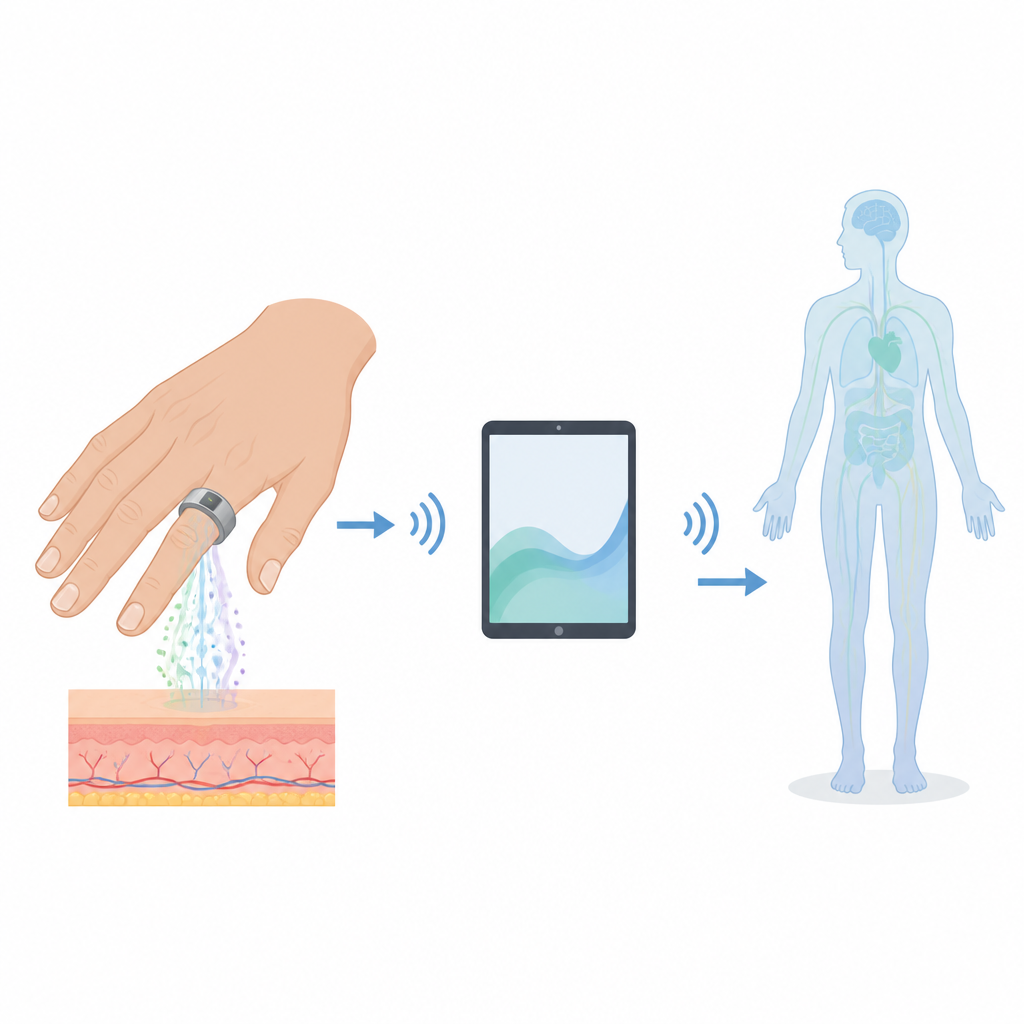
Teaching artificial intelligence to read scent patterns
Because the ring does not measure single chemicals one by one, the raw data look more like a set of shifting waveforms than a list of ingredients. The researchers therefore turned to machine learning to make sense of these patterns. They first trained models to recognize seven common test gases at incredibly low levels, even when humidity changed. A more advanced network, designed to pay attention to how signals vary across the tiny grid of sensors and over time, learned to estimate gas concentrations with near perfect match to known values. This showed that the miniature chip could replace much larger sensing setups without losing precision.
Tracking what you eat and how you move
The real test came when healthy volunteers wore the ring during everyday activities. Participants consumed six common types of food or drink: fruit, nuts, meat, carbohydrates such as rice, vegetables, and alcohol. For each meal, the ring captured changing skin odor patterns over time. Distinct signatures emerged, such as a strong, delayed response after alcohol intake, dual peaks after meat that mirror stepwise protein breakdown, and rapid shifts after high glycemic carbohydrates. Using a simple classification model, the system correctly identified which of the six foods had been eaten with about 98 percent accuracy. The ring also tracked three physical states—relaxing, exercising, and recovering afterward—by observing how odor patterns rose during activity and fell as the body returned to rest. 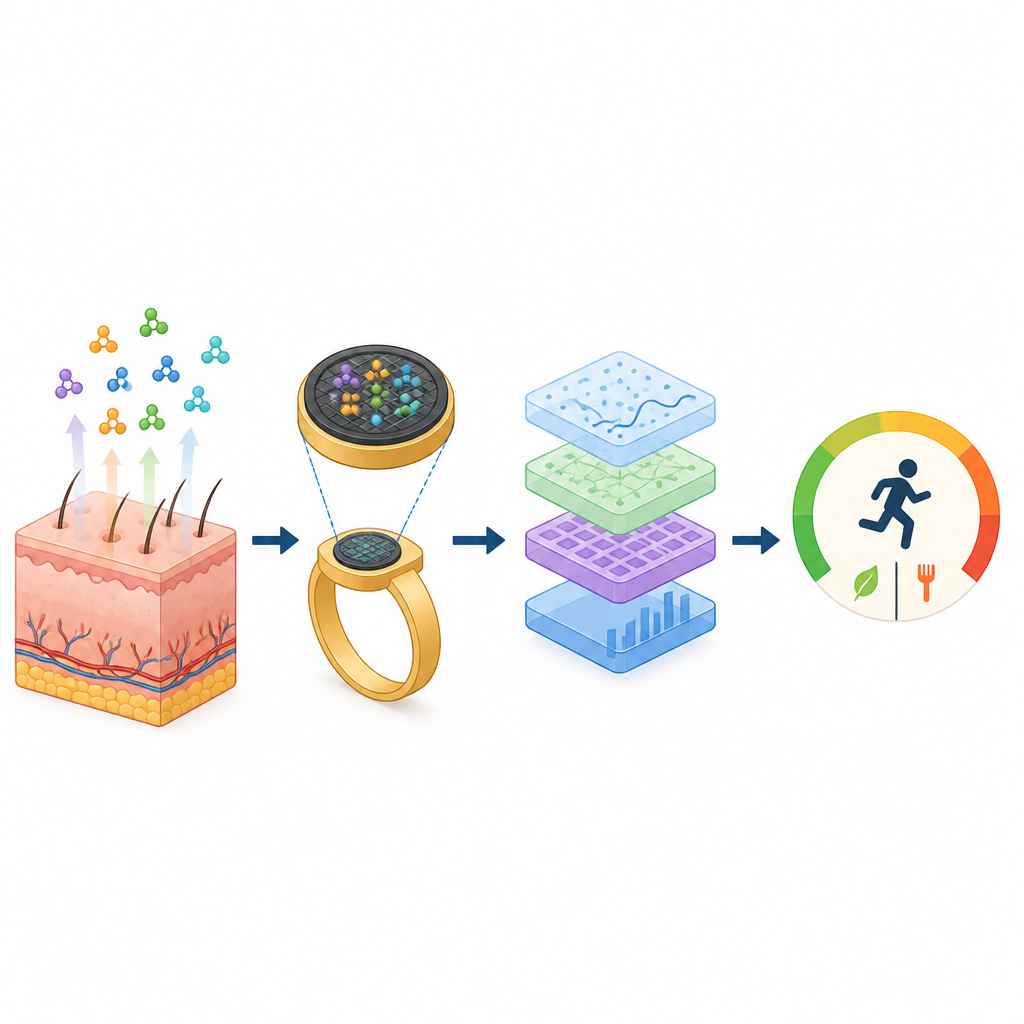
Turning scent into personal health guidance
To check that these on-body readings reflected real metabolic chemistry, the team compared them with traditional lab measurements of skin odor using gas chromatography mass spectrometry. Differences in the lab spectra before and after eating confirmed that diet truly reshapes the chemical cloud around the body. Finally, the researchers used their advanced neural network to estimate how much alcohol volunteers drank, achieving a tight match between predicted and actual volume. In simple terms, the work shows that a small, comfortable ring can continuously sense the body’s faint chemical signals, distinguish between different meals and activity levels, and even estimate how much was consumed. While still a research prototype, this AI powered biometric ring points toward a future where checking diet habits and metabolic health could be as easy as glancing at a wearable device instead of visiting a lab.
Citation: Ye, W., Ding, R., Wang, C. et al. Miniaturized olfactory sensor chip-based AI-wearable biometric ring for human body metabolic odor analysis. Nat Commun 17, 4541 (2026). https://doi.org/10.1038/s41467-026-70746-z
Keywords: wearable sensor, body odor, metabolism, diet monitoring, artificial intelligence