Clear Sky Science · en
Design of robust networks via reinforcement learning prompts the emergence of multi-backbones
Why stronger networks matter to everyday life
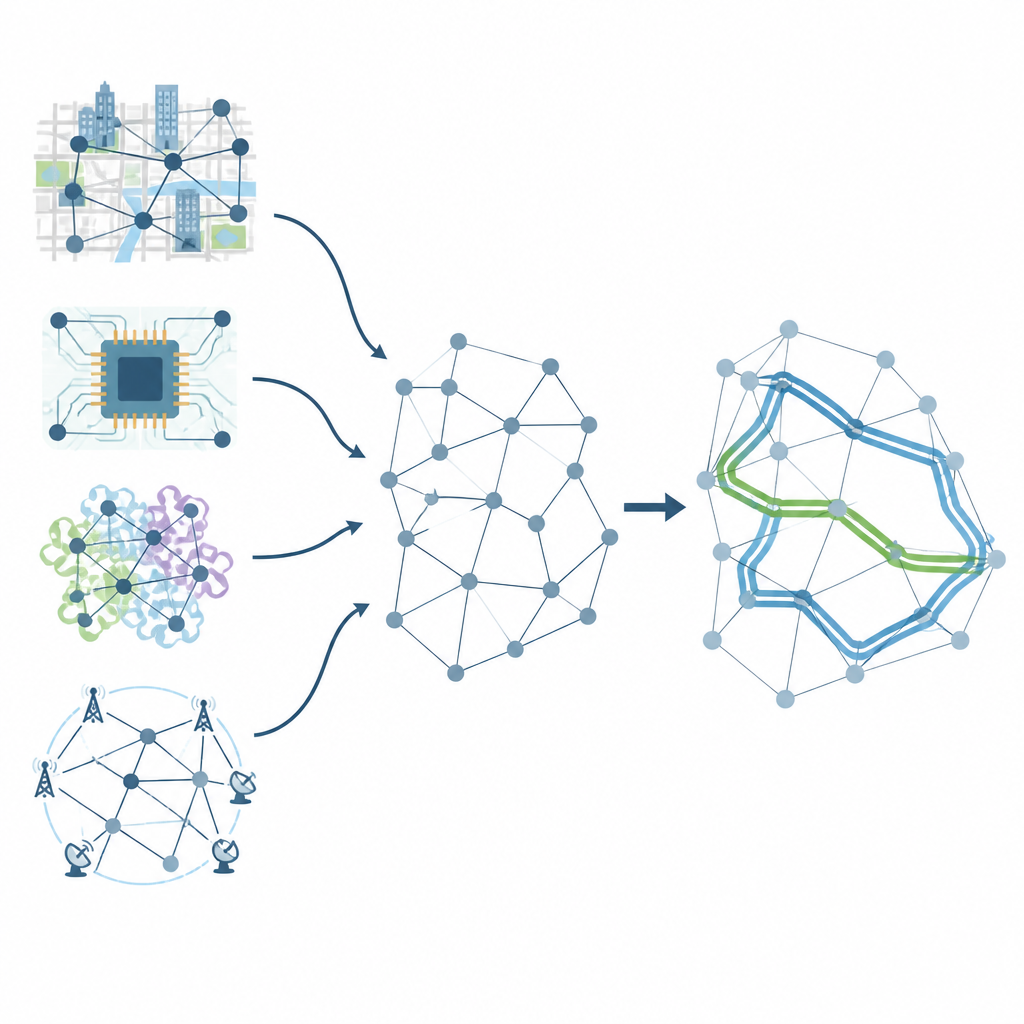
From phone calls and power grids to city streets and protein molecules, our world runs on invisible webs of connections. When a few key links fail, those webs can unravel fast, causing blackouts, traffic jams, or broken communication. This study explores how artificial intelligence can help design networks that keep working even when they are under attack or suffering failures.
How networks can break down
Many systems look like simple maps of dots and lines, but their behavior under strain is anything but simple. Attacks or failures often target the most important points in a network, such as highly connected routers on the internet or busy intersections in a city. Remove enough of these points and the system splits into isolated islands. Traditional ways to strengthen networks rely on human rules of thumb, like making node connections more even or adding long links between distant parts. These strategies help in some cases but struggle when networks are large and when attackers use many different tactics.
Teaching an AI to play the design game
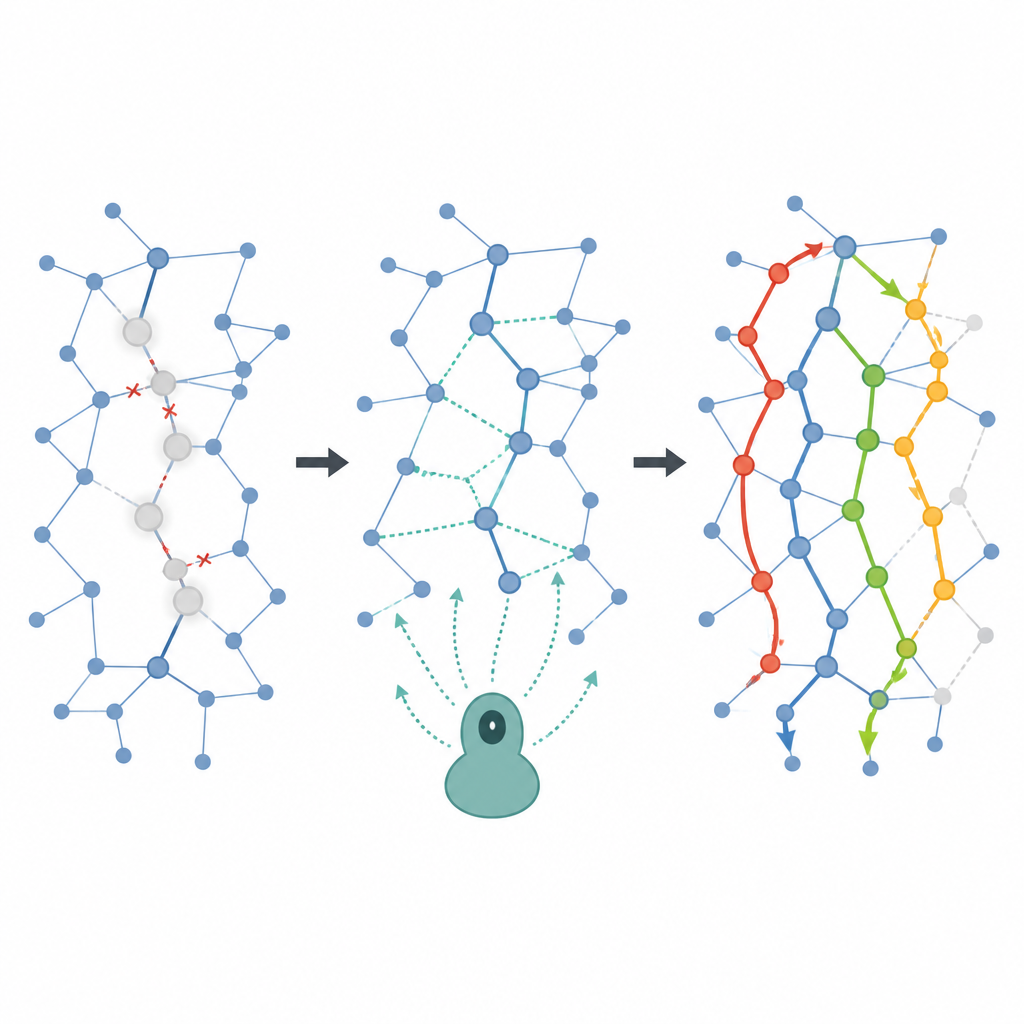
The authors turn network design into a step by step game between a designer and an imagined attacker. The designer’s move in each round is to add one new link to the network, subject to a fixed budget. After each move, the attacker removes critical nodes according to a chosen strategy, and the designer receives a score that reflects how well the network holds together. This back and forth is framed as a reinforcement learning problem, where an AI agent gradually discovers which added links lead to the most robust final network. A graph based neural network helps the agent read the structure of the network at each step and evaluate the impact of its choices.
Hidden multi backbones as a new defense
When the AI is trained on model networks and on several types of attack, a distinctive pattern emerges. Instead of simply strengthening obvious hub nodes or drawing the longest possible links, the AI tends to weave several overlapping pathways that quietly span the network. These “multi backbones” are formed mostly from modest looking nodes rather than from the most prominent hubs. During a simulated attack, traffic first flows along one such backbone. As that pathway becomes exposed and damaged, another backbone takes over, and later a third, and so on. This staged handoff delays the moment when the network fragments and keeps a large connected core alive for longer than competing design methods.
Working across different systems and attacks
The researchers compare their AI designs with rule based methods and with slower search techniques on a range of test networks. Across many attack styles, from simple removal of high degree nodes to more global dismantling strategies, the reinforcement learning approach typically yields larger gains in robustness for the same cost. On random networks that are already fairly uniform, the room for improvement is smaller. On highly uneven networks, which resemble many real systems, the gains are substantial. Remarkably, a network tuned to resist one type of attack often becomes tougher against others as well, because the multi backbone arrangement hides several critical routes at once.
Applying the approach to real world webs
To show practical value, the authors apply their trained designer to an actual internet service provider network. Instead of simply adding links, they rewire a fraction of the existing ones while keeping the total cost fixed. The original network has only a couple of major pathways, which are damaged early and almost together during attack, leading to quick loss of connectivity. After AI guided rewiring, the same network contains three or more distinct backbones that take turns carrying traffic as attacks progress. The improved design more than triples robustness in some cases, without adding extra hardware.
What this means for future network design
This work suggests that letting AI explore many design possibilities can reveal network structures that human intuition would likely miss. The key insight is that a good defense is not just one strong spine, but several overlapping, partly hidden backbones that share the load as damage accumulates. Such designs could help engineers build more resilient versions of power grids, transport systems, communication networks, and even molecular structures, all while respecting realistic cost limits.
Citation: Zhu, B., Zhu, T., Gao, J. et al. Design of robust networks via reinforcement learning prompts the emergence of multi-backbones. Nat Commun 17, 4278 (2026). https://doi.org/10.1038/s41467-026-70745-0
Keywords: network robustness, reinforcement learning, complex networks, infrastructure resilience, graph neural networks