Clear Sky Science · en
Electrochemically mediated disproportionation for selective formaldehyde upcycling in acid
Turning Tough Plastics into Useful Liquids
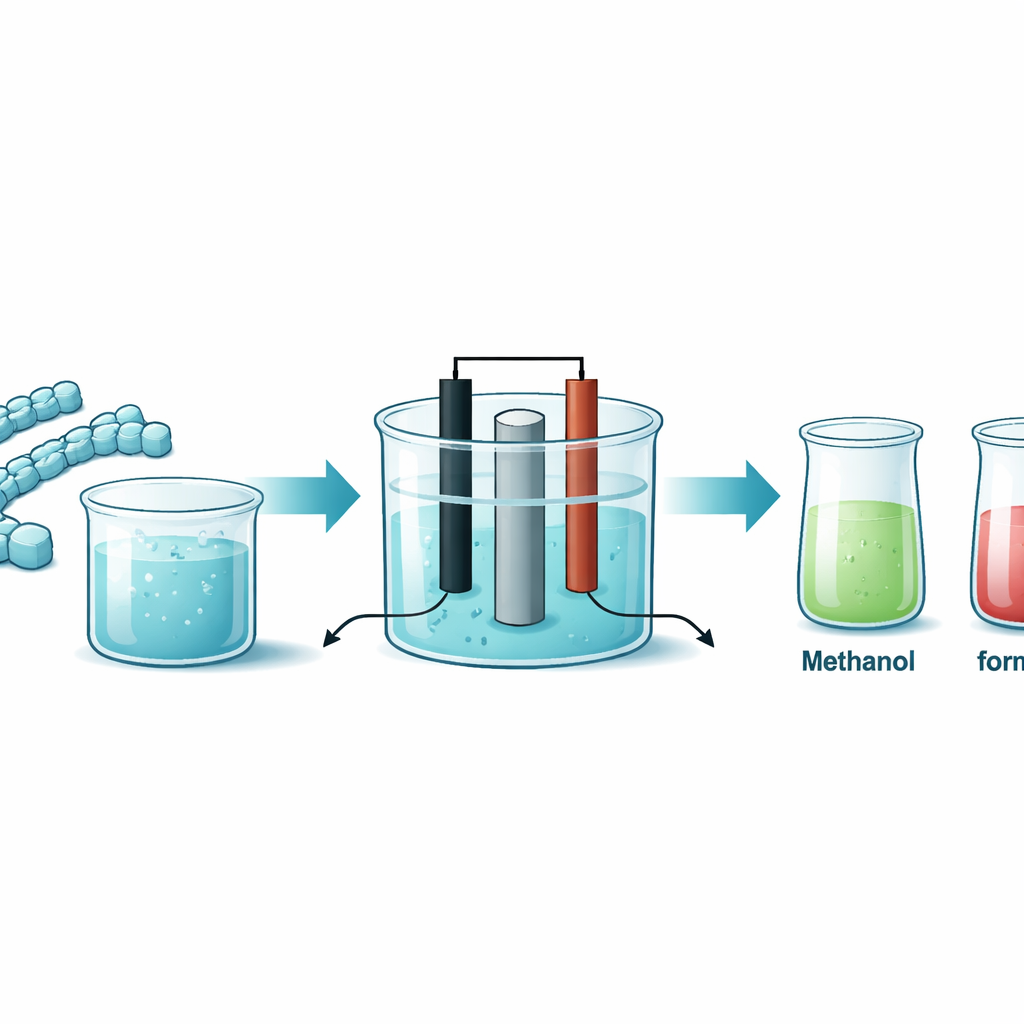
Many of the plastics that make modern life possible are also some of the hardest to recycle. One especially stubborn example is polyoxymethylene, a strong, precise engineering plastic used in cars, machines, and medical devices. This study shows a new way to break down this plastic and use its building block, formaldehyde, to make two valuable chemicals—methanol and formic acid—using electricity in an acidic solution. The work points toward cleaner recycling methods that could turn a growing waste problem into a resource.
Why This Plastic Is a Growing Problem
Polyoxymethylene (often called POM) is prized because it flows easily when molded yet forms tough, precise parts. As its use grows worldwide, so does the pile of waste. Conventional disposal methods—incineration, high‑temperature cracking, mechanical recycling, and landfilling—all have serious drawbacks. Burning or heating POM tends to release formaldehyde gas, a toxic and potentially cancer‑causing substance that must be carefully captured. Grinding and remelting the plastic weakens its properties, while burying it risks slow release of pollutants into soil and water. These approaches do little to recover the chemical value locked inside the material.
From Waste Chain to Reactive Building Block
Chemists have begun to explore “upcycling” routes that convert polymers into higher‑value molecules rather than simply destroying them. POM can be chemically unzipped in acid to release formaldehyde, a small but highly reactive molecule. Earlier methods tried to push this formaldehyde toward products like methanol using heat and metal catalysts, but they often wasted a large fraction of the carbon as carbon dioxide. Others turned to electrochemistry in alkaline (basic) solutions, pairing formaldehyde oxidation with hydrogen production. However, under basic conditions formaldehyde tends to undergo a spontaneous side reaction called disproportionation, which scrambles it into a mix of methanol and formate without control and causes losses of up to three‑quarters of the feedstock. This not only wastes material but also complicates purification and adds cost.
Designing an Acidic Electrochemical Factory
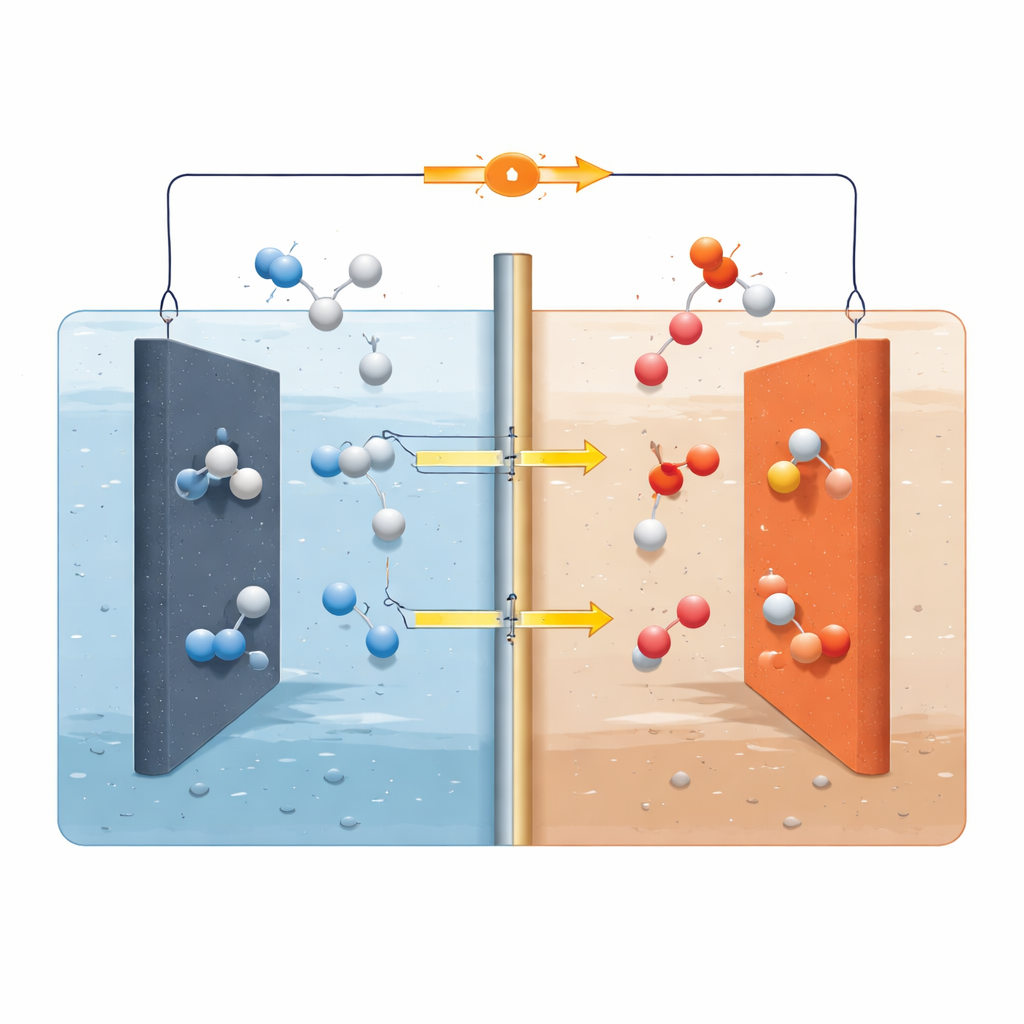
The authors propose a different strategy: carry out the entire process in acidic water, from breaking down POM to converting the resulting formaldehyde. They build a two‑electrode electrochemical cell in which formaldehyde flows past both electrodes. At the negatively charged side, they place an ultrathin layer of a copper‑based molecular material called CuTAPc‑layer, engineered to be highly dispersed and water‑repelling. This hydrophobic environment suppresses unwanted hydrogen generation, allowing formaldehyde to be selectively turned into methanol with Faradaic efficiencies above 90%, meaning almost all the electrical current goes into the desired product. At the positively charged side, a tiny‑particle alloy of platinum and ruthenium serves as a powerful catalyst to convert formaldehyde into formic acid, again with efficiencies around 90%.
Peeking Under the Hood of the Reaction
To understand why this acidic setup works so well, the team combines advanced infrared spectroscopy with computer simulations. On the cathode, they show that formaldehyde first reacts with water to form a diol, then binds to the copper surface and is stepwise reduced to methanol. The tailored, water‑repelling microenvironment around CuTAPc‑layer keeps strongly hydrogen‑bonded water near the surface, which surprisingly makes it harder for hydrogen gas to form and leaves more electrons available for formaldehyde conversion. On the anode, the platinum–ruthenium surface grips oxygen‑containing parts of the formaldehyde‑derived molecules more strongly than many pure metals do. Calculations reveal that this “oxophilic” character lowers key energy barriers for stripping protons and electrons, guiding the reaction along a sequence of intermediates toward formic acid while avoiding wasteful side paths.
Economic Promise and Future Uses
Beyond laboratory performance, the researchers examine whether this route could make sense at scale. In a larger flow cell, their device reaches high single‑pass conversion—about 86% of the formaldehyde becomes methanol and nearly 90% becomes formic acid during one trip through the cell—while operating at room temperature and modest voltages. A techno‑economic analysis compares three recycling routes: traditional alkaline electrolysis, an organic‑solvent process, and the new acidic approach. Once the hidden costs of alkaline chemistry and disproportionation losses are included, both existing routes either just break even or lose money per ton of POM processed. In contrast, the acidic method is projected to yield a net profit, thanks to better selectivity, lower electrolyte costs, and simpler product separation.
What This Means for Plastic Waste
This work demonstrates that carefully designed electrochemical systems in acidic water can turn a difficult engineering plastic into two widely used liquid chemicals with high efficiency and stability. By suppressing side reactions that previously plagued formaldehyde conversion, and by operating under mild conditions, the approach offers a more sustainable path for handling POM waste. The same principles—tuning catalyst surfaces, local water structure, and solution acidity—could be extended to other problematic plastics and even to toxic small molecules. In the long run, such strategies may help shift plastic disposal from an environmental burden to an opportunity for renewable, electricity‑driven chemical manufacturing.
Citation: Song, Y., Zhu, Z., Das, T. et al. Electrochemically mediated disproportionation for selective formaldehyde upcycling in acid. Nat Commun 17, 4120 (2026). https://doi.org/10.1038/s41467-026-70739-y
Keywords: plastic upcycling, formaldehyde electrolysis, acidic electrochemistry, methanol production, formic acid synthesis