Clear Sky Science · en
Highly ionic-dispersed oxygen electrode for reversible proton ceramic electrochemical cells
Cleaner power from clever materials
Turning fuels and water into electricity and hydrogen efficiently is a key step toward a low‑carbon energy system. This study shows how a carefully engineered ceramic material can make a new type of solid-state energy device—reversible proton ceramic electrochemical cells—work harder, last longer, and run at lower temperatures. By redesigning the tiny building blocks inside the material, the authors unlock faster ion transport and greater durability in hot, humid air, conditions that normally wear these devices out.
Why these cells matter for everyday energy
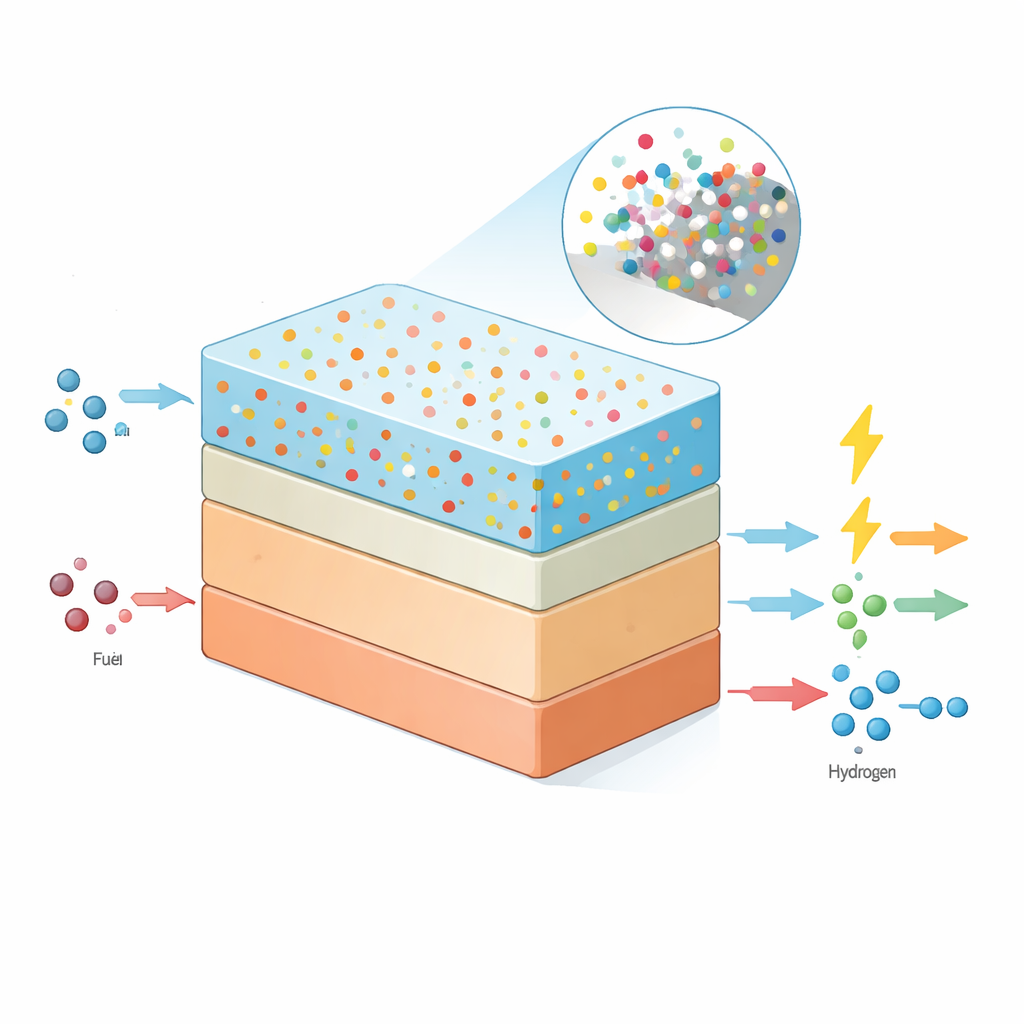
Reversible proton ceramic electrochemical cells can both generate electricity from fuels and run in reverse to produce hydrogen from steam. Unlike conventional solid oxide cells that need extreme heat near 1000 °C, these devices operate in a milder range of about 350–600 °C, which makes them easier to seal, cheaper to build, and more compatible with real-world power systems. The main bottleneck has been the "oxygen electrode"—the air-facing side of the cell—where sluggish proton movement and cracking under thermal stress limit efficiency and lifetime. Improving this one component could push the whole technology much closer to everyday applications in clean power and hydrogen production.
Designing a smoother path for ions
The researchers start from a common family of crystal structures known as perovskites and design a new oxygen electrode material called BCZTZICM. Instead of relying on just one or two added elements, they spread a small total amount of six different dopant metals throughout the structure. This "micro-doping" does not aim to maximize disorder for its own sake; rather, it creates a very even, fine‑grained mix of ions that prevents clumping and keeps most of the main cobalt atoms active for catalyzing reactions. Advanced microscopy techniques that can map individual atoms in three dimensions show that, unlike earlier materials where certain metal ions bunch together, the elements in BCZTZICM are strikingly uniform at the nanoscale.
How atomic order improves performance
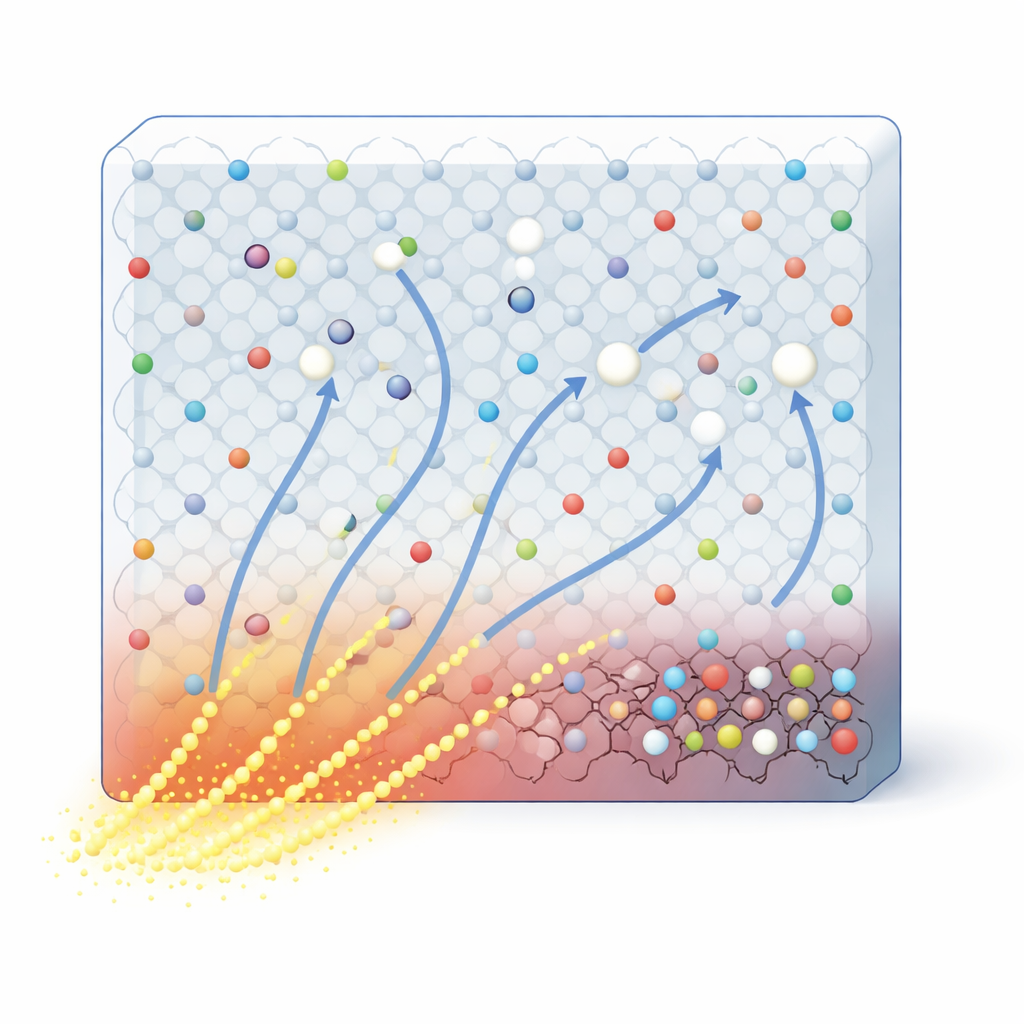
Computer simulations and a range of lab measurements reveal why this highly dispersed mixture helps the cell work better. Protons move through the oxygen electrode by hopping between oxygen atoms, a process that is very sensitive to local distortions and energy barriers. In more uneven materials, regions with clustered dopants and irregular bonding create "dead zones" where proton motion slows or stops. In BCZTZICM, the smoother distribution of ions and oxygen vacancies produces consistently low barriers along many different pathways, so protons can flow more freely in three dimensions. At the same time, the strengthened metal–oxygen bonds mean the material gives up less oxygen at high temperature, which keeps its structure stable and prevents wild swings in expansion.
Staying strong through heat and moisture
Real devices must survive repeated heating and cooling in humid air, where many promising oxygen electrodes crack or peel away from the electrolyte. The new material expands much more gently and almost linearly with temperature than widely used alternatives, bringing it closer to the behavior of the underlying electrolyte and reducing internal stress. Experiments show that under aggressive thermal cycling, rival electrodes develop wide cracks and detach from the cell, while BCZTZICM stays largely intact. Spectroscopic studies also show that, in the presence of steam, this electrode can take up protons into its lattice without losing structural integrity; in fact, the combined effects of mild oxygen release and proton uptake help offset mechanical strain.
From materials science to device gains
When built into full cells, the benefits of the new oxygen electrode translate into practical gains. At 600 °C, cells using BCZTZICM reach a peak power density of 1.56 watts per square centimeter in fuel cell mode and achieve an electrolysis current density of 2.0 amperes per square centimeter at a voltage of 1.3 volts. These values are high for this temperature range and are paired with long‑term operation exceeding 780 hours, with only tiny voltage drift in both power‑generation and hydrogen‑production modes. The cells also maintain good efficiency and hydrogen purity even at demanding current loads, showing that the electrode design works under realistic conditions rather than just in short tests.
What this means for future clean technologies
In simple terms, the study demonstrates that carefully spreading different metal ions throughout a ceramic crystal can make energy devices both faster and tougher. By smoothing out the atomic landscape in the oxygen electrode, the authors boost proton motion, reduce cracking, and keep performance high at moderate temperatures. This strategy of "ionic dispersion" offers a template for designing other advanced ceramic components for energy conversion. If adopted widely, such materials could help reversible proton ceramic electrochemical cells become practical tools for storing renewable energy and producing low‑carbon hydrogen at scale.
Citation: Wang, X., Cai, Z., Chen, Z. et al. Highly ionic-dispersed oxygen electrode for reversible proton ceramic electrochemical cells. Nat Commun 17, 3989 (2026). https://doi.org/10.1038/s41467-026-70738-z
Keywords: proton ceramic electrochemical cells, solid oxide fuel cells, hydrogen production, perovskite electrodes, energy storage