Clear Sky Science · en
Electrified interfacial oxygen-down water boosts efficient and durable electrolysis
Turning Water into a Cleaner Fuel
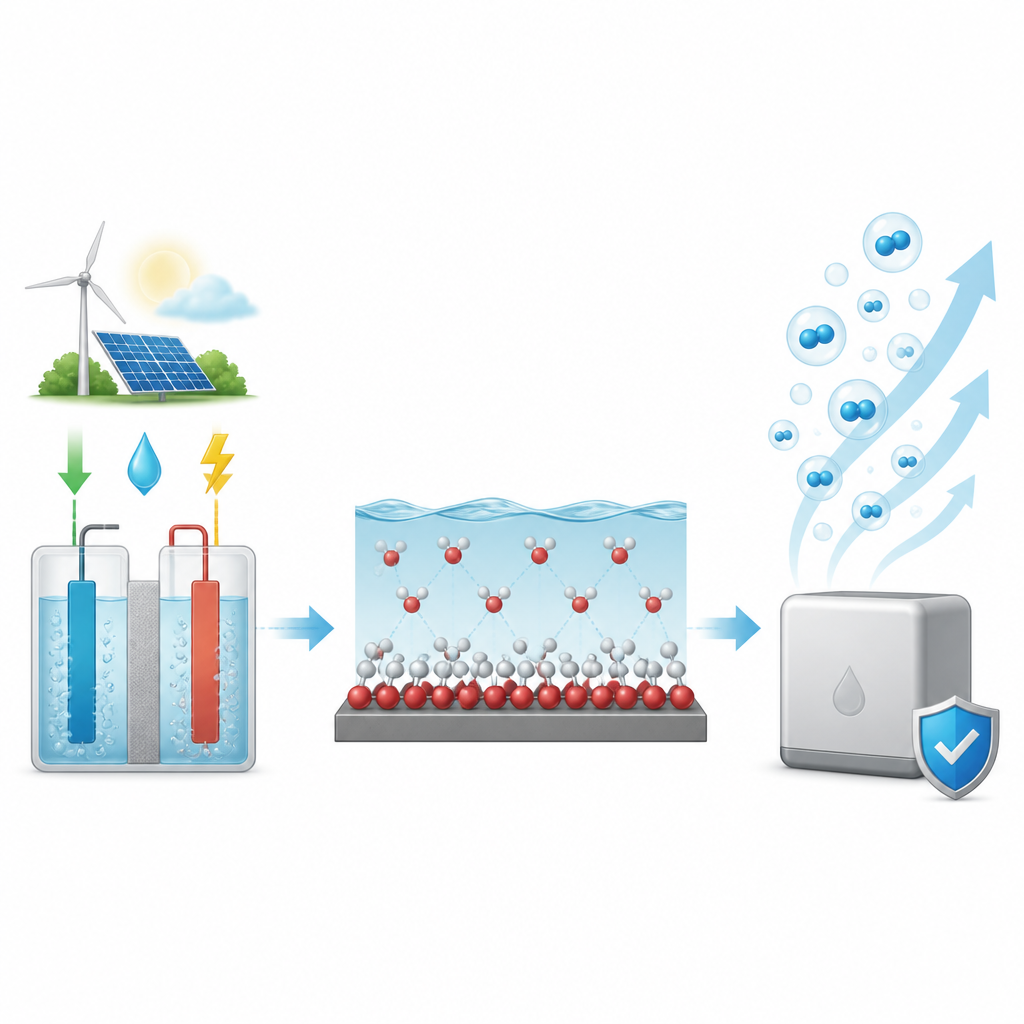
Hydrogen fuel is often hailed as a clean alternative to fossil fuels, but making hydrogen efficiently from water is still a major challenge. The slow and energy-hungry step is the release of oxygen gas at the electrode surface, where water molecules must give up both electrons and protons. This study shows that carefully arranging how water molecules sit on a catalyst surface can make this step both faster and more durable, opening a path toward more practical large-scale hydrogen production from renewable electricity.
Why the Way Water Sits Matters
At the heart of water splitting is a crowded, dynamic zone where liquid water meets a solid catalyst and an electric field. Here, water molecules act both as the raw material and as the medium through which protons move. In most devices, these molecules are jumbled and constantly reorienting, which slows down reactions and allows excess protons to pile up, corroding the catalyst. The researchers reasoned that if they could coax water into lining up in a preferred orientation right at the surface, they might speed up the reaction while also protecting the material from harsh acidic conditions.
Designing a Strained Catalyst Surface
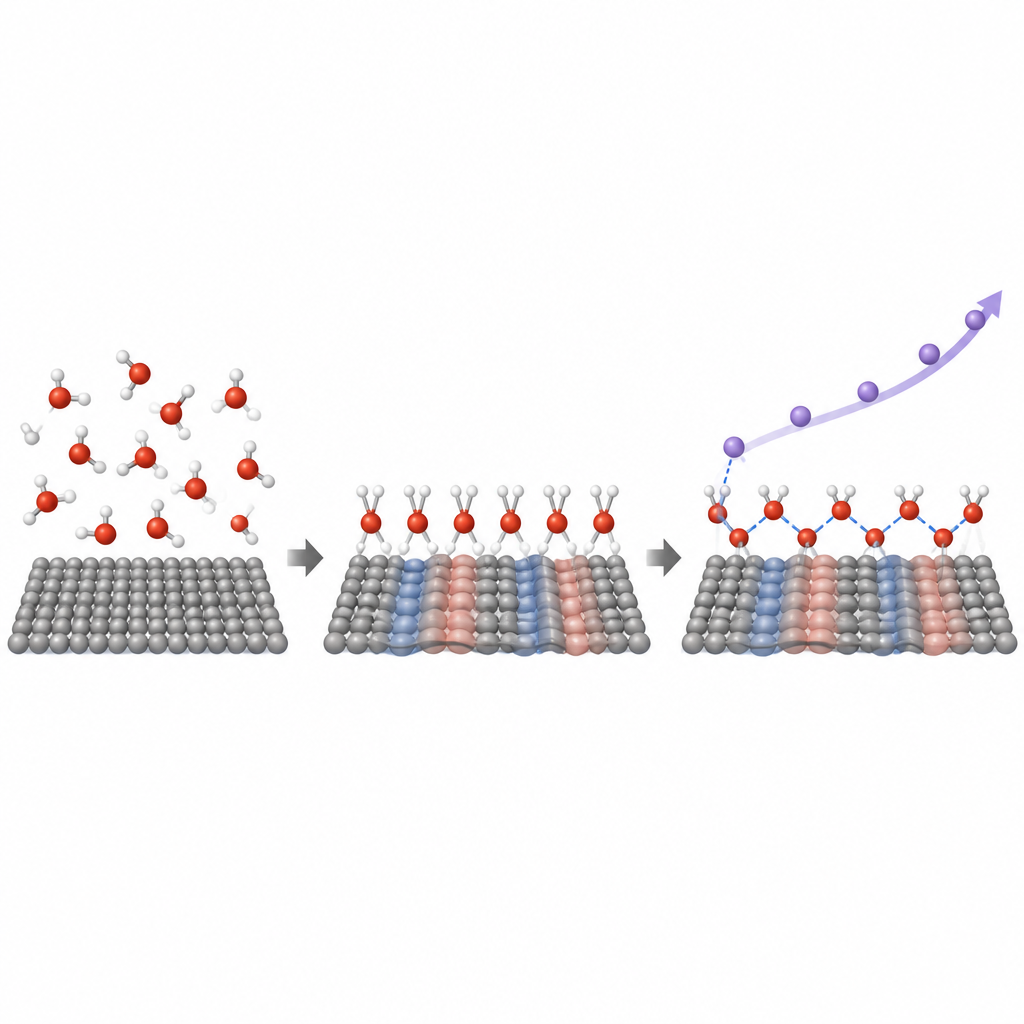
The team focused on ruthenium oxide, a well-known catalyst for oxygen release in acidic water-splitting systems. They engineered this material to contain many edge dislocations, tiny crystal defects that create paired zones of compression and tension within the solid. Computer simulations showed that these mixed stress fields push positively charged hydrogen ends of water away from compressed regions while attracting the negatively charged oxygen ends to stretched regions. As a result, water molecules near the surface tend to flip into an "oxygen-down" orientation, forming a more ordered layer instead of a random crowd. Microscopy and X-ray measurements confirmed the presence of these dislocations and the altered local structure around them.
Building a Water-Based Proton Highway
To see what the reshaped water layer was actually doing, the researchers used infrared and Raman spectroscopy while the catalyst was running. They detected a clear spectral signature linked to water molecules tilted in a specific way, confirming the presence of an oxygen-down layer that persisted under operating voltages. At the same time, the pattern of hydrogen bonding between water molecules shifted: more tightly connected, four-bonded structures appeared, forming a rigid network. This network acts like a proton highway, allowing protons to hop rapidly from one water molecule to the next and away from the catalyst surface. By shuttling protons out efficiently, the system avoids local acid spikes that would otherwise attack and eventually destroy the catalyst.
Faster Oxygen Release with Less Damage
Measurements and simulations together showed that this organized water layer also makes it easier for water molecules to begin reacting. Because the molecules are already aligned correctly, the catalyst no longer has to expend energy to randomly reorient them before breaking bonds. The calculated energy barrier for forming oxygen-containing intermediates drops by more than half compared with a standard ruthenium oxide surface. In electrochemical tests, the dislocation-rich catalyst reached a useful current density at a substantially lower extra voltage and kept working in acidic solution for over 1,000 hours. When built into a full proton exchange membrane electrolyzer, it sustained industrial-scale current with only a slow rise in operating voltage over hundreds of hours, indicating both high efficiency and long life.
What This Means for Future Hydrogen Devices
By showing that the behavior of water at the interface can be tuned just as deliberately as the catalyst itself, this work suggests a new design principle for clean hydrogen technologies. Instead of accepting a trade-off between fast reaction rates and material stability, engineers can use built-in strain and crystal defects to organize water into an oxygen-down layer that both accelerates the key steps and carries away corrosive protons. While many hurdles remain before hydrogen from water becomes a dominant energy carrier, controlling how water molecules line up on a surface offers a powerful route to more efficient and durable electrolysis systems.
Citation: Xu, Y., Shi, Z., Zhu, S. et al. Electrified interfacial oxygen-down water boosts efficient and durable electrolysis. Nat Commun 17, 4304 (2026). https://doi.org/10.1038/s41467-026-70737-0
Keywords: water electrolysis, hydrogen fuel, oxygen evolution reaction, ruthenium oxide catalyst, interfacial water