Clear Sky Science · en
Maturase K forms a plastidial splicing complex with a neofunctionalized branching enzyme
How plants keep their green engines running
Every green leaf depends on tiny compartments called chloroplasts to turn sunlight into energy. Inside these chloroplasts, genes must be edited and stitched together before they can build the machinery of photosynthesis. This study uncovers how a long‑mysterious chloroplast protein, Maturase K, teams up with a repurposed enzyme to assemble a splicing machine that is vital for plant survival.
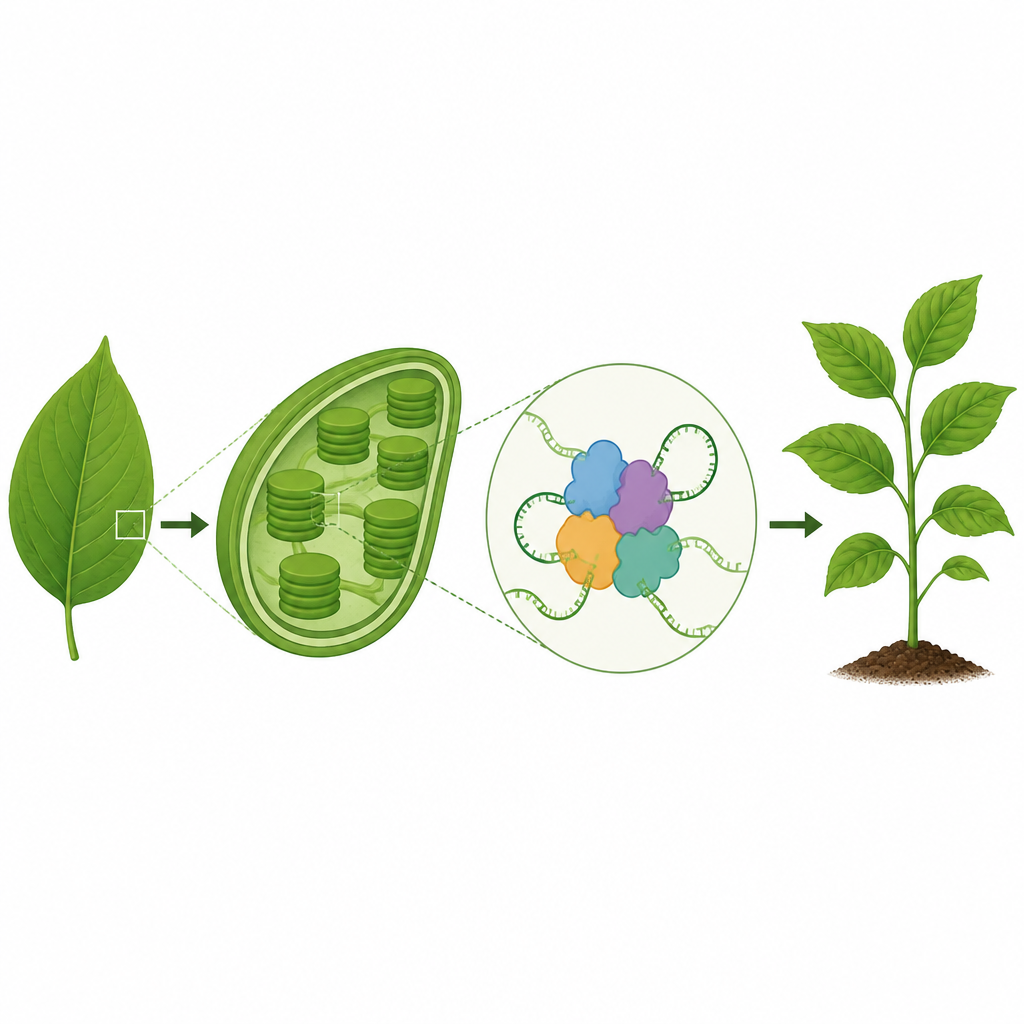
A hidden editing job inside chloroplasts
Plant chloroplasts carry their own small genome, which includes many genes broken up by extra segments called introns. Before these genes can be used, their RNA copies must be cut and rejoined in a precise way known as splicing. In bacteria, similar introns largely handle this on their own, helped by a dedicated helper protein for each intron. In land plants, however, almost all such introns have lost their personal helpers. Only one chloroplast gene still encodes a maturase‑like protein, called Maturase K, and previous clues suggested it somehow serves as a general splicing assistant for many introns rather than just one.
A branching enzyme that stopped working on starch
The authors focused on a chloroplast protein previously labeled as a starch branching enzyme, thought to help construct the branched chains of plant starch. Earlier work showed that this protein, now renamed MKIP1, had no detectable activity on carbohydrates, yet it was absolutely required for plant embryos to develop. Through evolutionary comparisons, the team found that MKIP1 and its relatives form a distinct group present in land plants and some algae, separate from ordinary starch branching enzymes. These MKIP1‑type proteins retain the same overall shape but have lost key amino acids needed for starch chemistry and instead gained a unique 150‑amino‑acid insert that sticks out from the protein surface.
Building a chloroplast splicing team
Using plants engineered to produce tagged versions of MKIP1, the researchers fished out its partners from Arabidopsis and tobacco leaves. MKIP1 consistently pulled down Maturase K along with two other essential chloroplast proteins, a tRNA‑charging enzyme and a poorly understood factor needed for chloroplast development. Size‑based separation of chloroplast contents showed that these four proteins travel together in a large complex, even when RNA is degraded, indicating that they form a stable protein machine rather than being loosely held together by RNA. Computer‑based structure prediction with AlphaFold suggested a one‑to‑one‑to‑one‑to‑one assembly, and pointed to a broad contact surface where the special insert and adjacent module of MKIP1 clasp the front end of Maturase K.
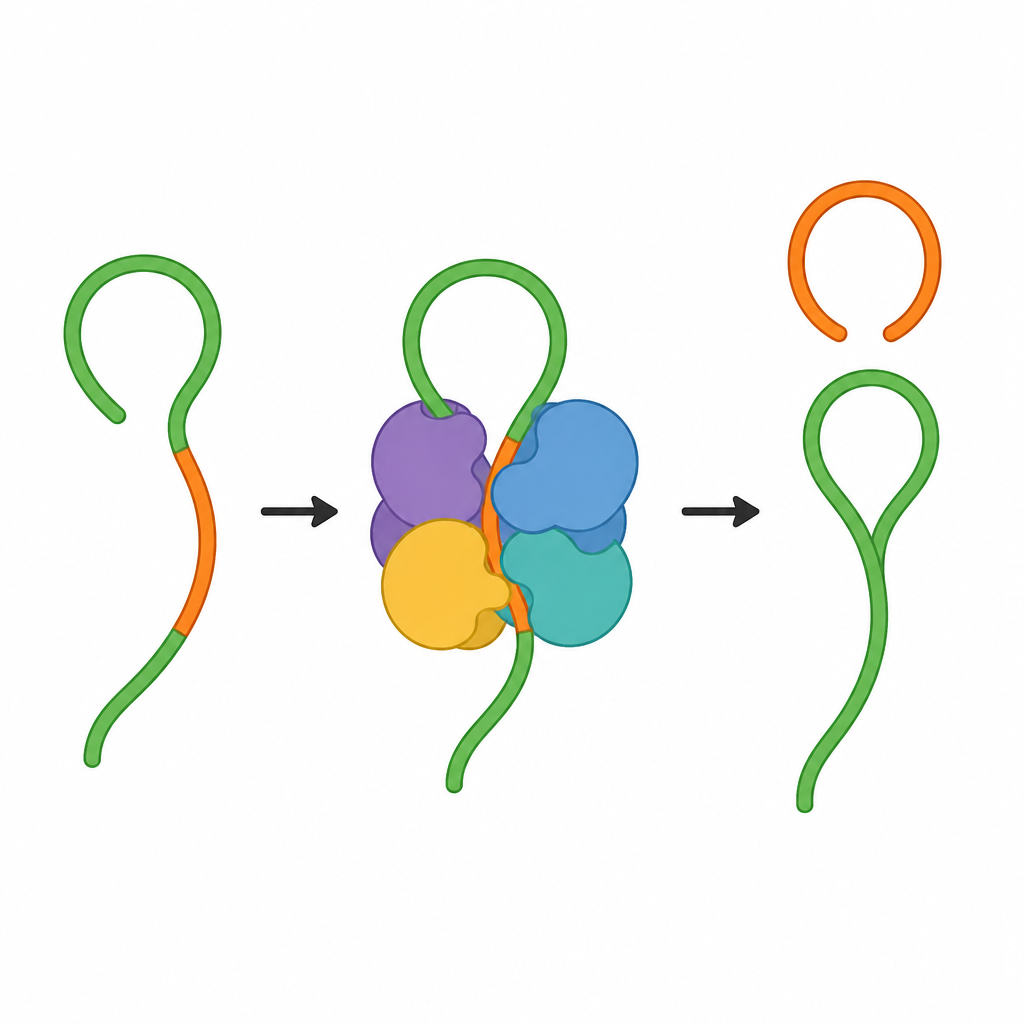
From starch workhorse to RNA splicing guide
To see what this complex does, the team captured RNAs bound to MKIP1 and sequenced them. MKIP1 was strongly enriched on all the chloroplast introns already known to associate with Maturase K, and on nearby regions in the same transcripts, closely mirroring the maturase’s binding map. Next, the authors used an inducible silencing system that lets plants grow normally and then selectively lower MKIP1 levels in new leaves. When MKIP1 was switched off, these fresh leaves became pale and their chloroplasts developed few or abnormal internal membranes. At the molecular level, the affected leaves showed sharply reduced splicing of the same introns bound by MKIP1 and Maturase K, while other introns were largely spared or only indirectly affected. A control line in which chloroplast translation, but not MKIP1 itself, was impaired did not show the same specific splicing failures.
Why this matters for plant life
The results show that MKIP1 has abandoned its ancestral role in starch formation and instead evolved into an essential part of a chloroplast RNA splicing complex centered on Maturase K. By providing a new protein‑to‑protein contact surface and perhaps extra docking points for RNA, MKIP1 appears to let Maturase K handle a broader set of introns than its bacterial ancestors, helping ensure that many chloroplast genes are correctly edited and expressed. In practical terms, this work explains why losing MKIP1 is fatal for embryos and young leaves: without this repurposed protein, the chloroplast’s genetic messages cannot be properly stitched together, and the plant’s green energy factories never fully form.
Citation: Liang, Y., Gao, Y., Fontana, A. et al. Maturase K forms a plastidial splicing complex with a neofunctionalized branching enzyme. Nat Commun 17, 4341 (2026). https://doi.org/10.1038/s41467-026-70734-3
Keywords: chloroplast RNA splicing, Maturase K, MKIP1, plant chloroplasts, intron removal