Clear Sky Science · en
Cellulose-based sensors for decentralized monitoring in precision agriculture
Why smart, plant-friendly sensors matter
Feeding a growing world without exhausting soils and water is one of this century’s toughest challenges. Today’s farms still rely heavily on guesswork: fertilizers, irrigation, and pesticides are often applied too much, too little, or at the wrong time. This review explores a surprising ally in making agriculture smarter and more sustainable—cellulose, the same plant-based material that makes up paper and cotton. By turning this abundant, biodegradable substance into low-cost sensors, scientists aim to bring simple, field-ready diagnostics to every corner of the farm, from the soil beneath our feet to the leaves and fruits on the plant.
A plant-based backbone for new tools
Cellulose is the structural “rebar” of plants, built from sugar molecules joined into tough, fibrous chains. Because it is abundant, renewable, and naturally porous, it can soak up liquids, hold chemical reagents, and host tiny electronic coatings. The authors describe how this humble material can be processed into everyday paper, textiles like cotton and viscose, or advanced forms such as bacterial cellulose and nanocellulose. Each format brings different strengths: paper is cheap and wicks fluids quickly, bacterial cellulose is pure and easily tailored, and nanocellulose films can be strong, transparent, and finely structured. On top of these fibers, researchers can print conductive inks, attach biological recognition molecules, and embed dyes or nanoparticles. The result is a family of lightweight, flexible sensing platforms that not only support chemistry and electronics but actively help move and measure water, ions, and biomolecules.
From simple test strips to mini labs in the field
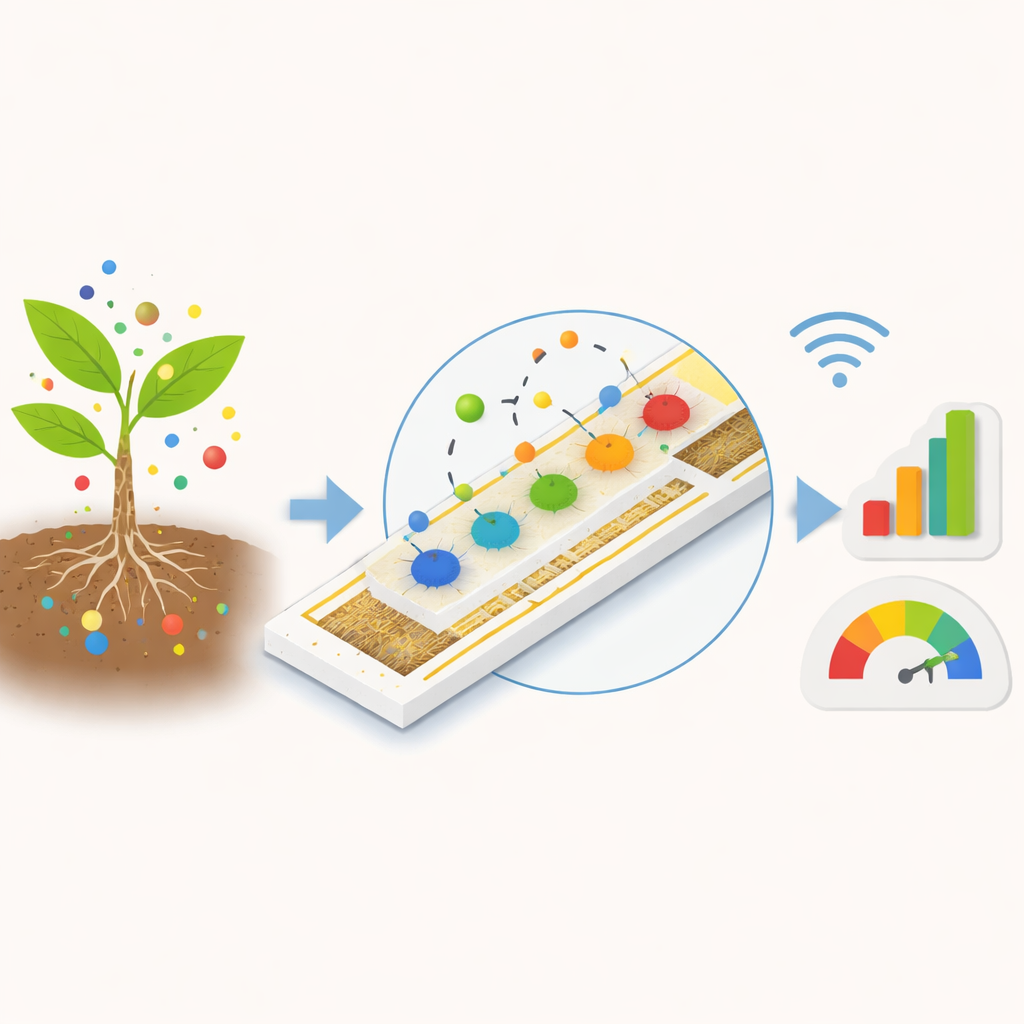
Built on this cellulose backbone, a wide range of device designs has emerged. At the simplest end are dipsticks and lateral flow strips—close cousins of home pregnancy tests—that change color when dipped in soil or plant extracts. More complex paper “chips” carve fluid pathways using wax or cuts, allowing one card to split a sample and run several tests at once. Other designs coat cellulose with metal nanoparticles to boost faint optical signals or pattern it with tiny electrodes to read out electrical changes. These devices can measure nutrients such as nitrogen, phosphorus, and potassium; track soil acidity, moisture, and microbial activity; and detect gases and small stress molecules released by plants. Importantly, many of them can be read either by eye or with a smartphone camera or small handheld reader, bringing lab-style measurements directly to the field without bulky equipment.
Watching soil and plants in real time
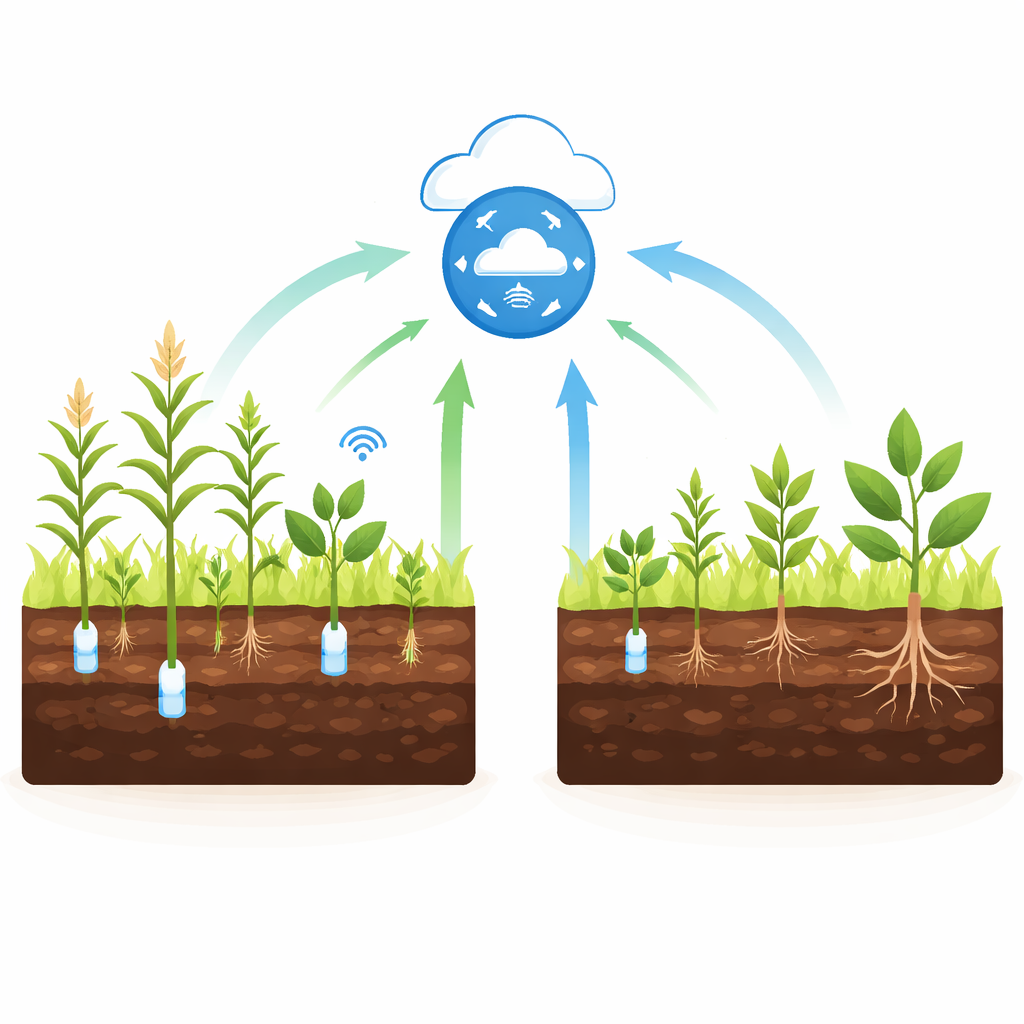
The review devotes much attention to how cellulose sensors are already reshaping soil and plant monitoring. In soils, paper-based tests can quickly profile fertility, pH, and moisture, or act as proxies for biological activity by responding to enzymes released by microbes. Some systems capture ammonia gas from moist soil and feed the results into machine-learning models that predict how nitrogen will change over the coming days, guiding more precise fertilizer use. Others use printed electrodes on biodegradable paper buried in the soil to sense moisture wirelessly over an entire season. On plants, “wearable” cellulose patches conform to leaves, stems, or fruits. These can pick up early signs of disease through airborne chemicals, follow ripening hormones like ethylene, sense changes in leaf wetness and water loss, or measure pesticide residues directly on the crop surface, all without damaging the plant.
Bringing green sensing into the digital farm
While today’s prototypes are promising, the authors highlight practical hurdles. Cellulose absorbs water and swells, which can distort measurements or limit how long a sensor survives in wet soil. Natural fibers can vary from batch to batch, complicating standardization. Many devices still rely on non-green components such as silver inks or metal nanoparticles, which add cost and environmental burden. To overcome this, researchers are engineering more uniform cellulose films, strengthening them with nanocellulose, and adding protective coatings that preserve capillary flow but tame swelling. They are also exploring carbon-based conductive inks and reusable electronics paired with disposable cellulose “cartridges,” as well as battery-free designs that draw power and transmit data through near-field or radio-frequency links to phones and farm networks.
How these ideas could change farming
The authors argue that cellulose-based sensors are poised to become a cornerstone of precision agriculture. In the near future, farmers could deploy cheap, biodegradable cards and patches across their fields, scan them with phones or simple readers, and feed that data into cloud-based tools that recommend when and where to irrigate, fertilize, or treat for pests. Over time, networks of such sensors could offer continuous, map-like views of soil and plant health, helping maintain yields while cutting waste, runoff, and environmental damage. In plain terms, this work shows how turning plants into the material for our measuring tools can help us listen more closely to the needs of crops and soils, making agriculture both smarter and kinder to the planet.
Citation: Rayappa, M.K., Flauzino, J.M.R., Grell, M. et al. Cellulose-based sensors for decentralized monitoring in precision agriculture. Nat Commun 17, 3895 (2026). https://doi.org/10.1038/s41467-026-70730-7
Keywords: precision agriculture, cellulose sensors, soil health, plant wearables, biodegradable electronics