Clear Sky Science · en
Confined-hydrogel fluidic memristor crossbar array for neuromorphic computing
Why a soft, watery chip matters
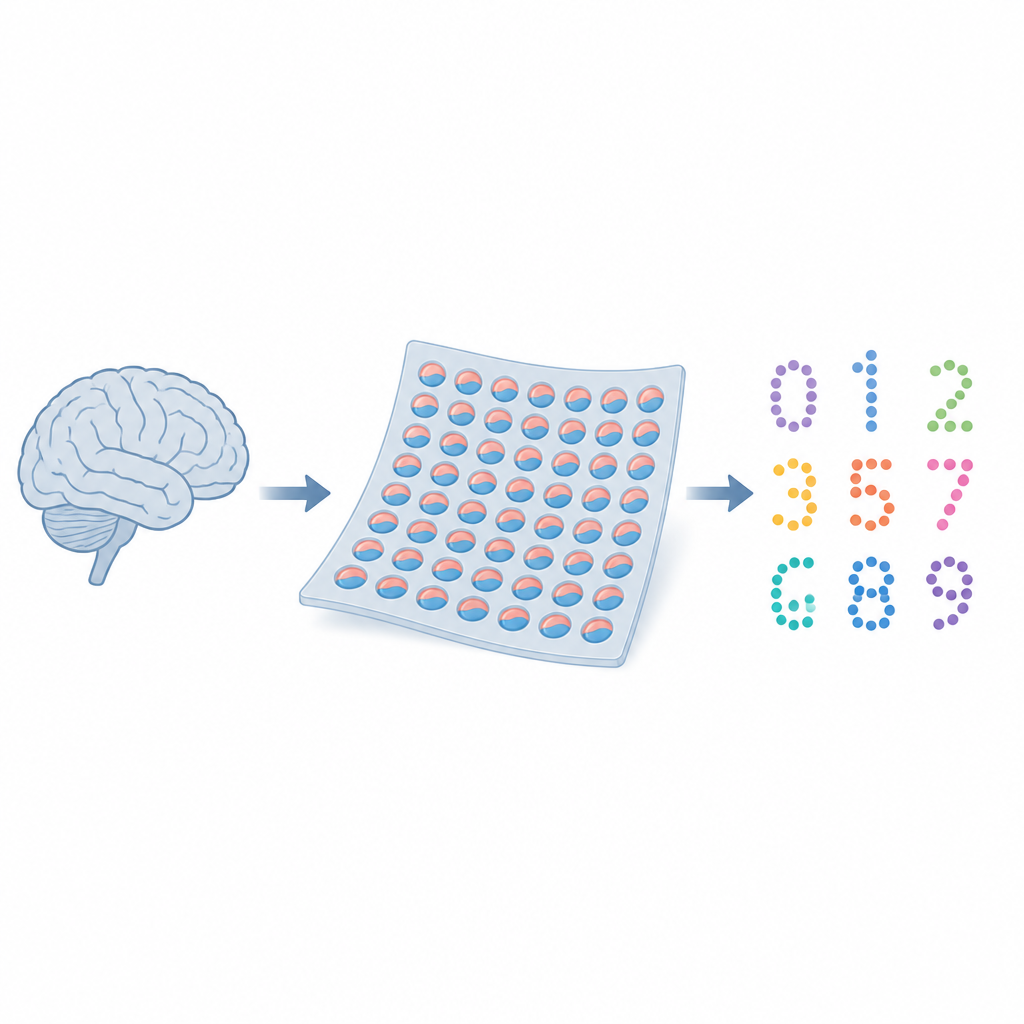
Most of today’s computers are built from rigid silicon and streams of electrons, very different from the soft, wet networks of the human brain. This study shows how a chip made from gels and flowing ions can mimic some brain-like abilities, hinting at future devices that are more energy efficient and that can directly sense and respond to chemicals in their surroundings.
Turning brain inspiration into a soft device
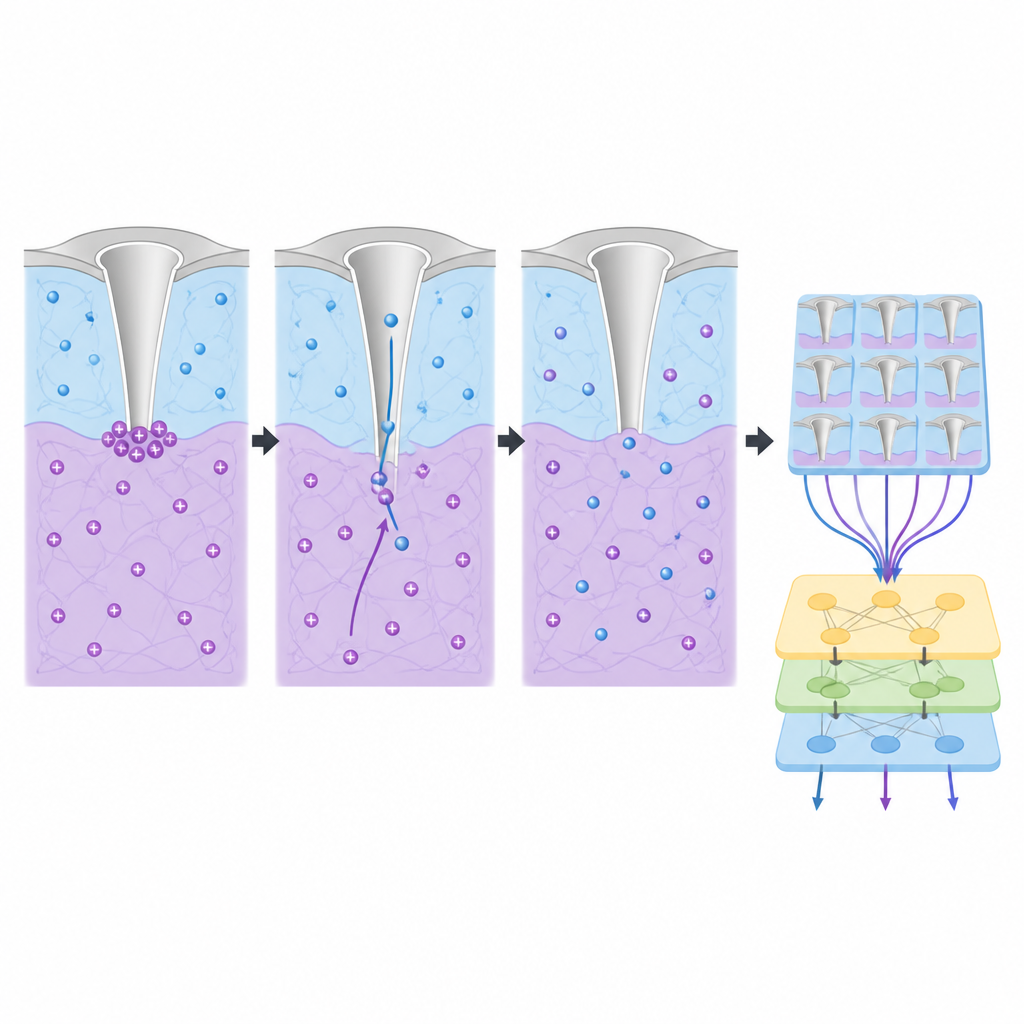
The brain processes information using charged atoms that move through gel-like connections between nerve cells. Inspired by this, the researchers created a tiny electrical component called a fluidic memristor using two soft hydrogels joined inside a microscopic pore in a plastic sheet. One gel carries fixed positive charges and attracts negative ions, while the other is neutral and holds a dilute salt solution. Where the two gels touch, ions can slowly pile up or drain away depending on the applied voltage, giving the device a built-in memory of past signals in the form of changing electrical resistance.
How the gel interface remembers signals
By sweeping the voltage across a single pore, the team observed a signature loop-shaped current response that marks true memory behavior. Computer models showed that this response comes from ions gathering or depleting at the narrow gel interface over time. Under one voltage direction, negative ions rush toward the interface and then spill into the neutral gel, making the path easier to conduct; under the opposite direction they are pulled away, making it harder. Because this rearrangement takes time to settle, the device “remembers” recent pulses as a temporary change in conductance, much like a biological synapse temporarily strengthens or weakens after activity.
Imitating learning in nerve connections
The researchers then drove the devices with short voltage pulses that stand in for nerve spikes. Pairs of closely spaced negative pulses caused the second response to grow, a behavior called facilitation, while positive pulses made the second response shrink, like depression in a real synapse. Strings of pulses with different frequency, count, and width produced graded conductance changes, showing that the device can filter signals in time and store multiple weight levels. It operates at millivolt-scale voltages and picojoule-level energy per pulse, far below typical solid-state circuits, and can be reliably switched many times, which is essential for practical computing tasks.
From one pore to a thinking grid
Because the hydrogels are easy to print and cure in place, the team built full crossbar arrays by drilling regular grids of conical pores into flexible polyimide and filling each with the two-gel stack. A small 3 × 3 array showed uniform behavior across sites, and a larger 10 × 10 array reached a 94 percent working yield, indicating that the soft, confined design scales well. The array can also respond directly to chemicals: the biological fuel molecule ATP seeps into the charged gel, binds to it, and reduces its charge, which in turn weakens the memristive effect and speeds up the loss of stored states, effectively using chemistry to tune the synaptic-like behavior.
Letting the soft hardware recognize digits
To test real information processing, the authors used the array as the dynamic core of a type of machine learning called reservoir computing. Patterns of voltage pulses representing rows of black-and-white digit images were fed into selected pores, and the resulting conductance values were read into a simple software layer that performed the final classification. With this setup, the system correctly recognized computer-generated digit patterns and reached 89.5 percent accuracy on handwritten digits from the MNIST database, a common benchmark in artificial intelligence, showing that a modest ion-based array can handle nontrivial recognition tasks.
What this means for future soft computers
This work proves that a large, ordered grid of soft fluidic memristors can be built and used for brain-inspired computing, while also reacting directly to chemical signals. Although challenges remain, such as long-term stability and achieving more permanent forms of memory, the confined hydrogel approach points toward future chips that compute with ions instead of electrons and could someday merge sensing, chemistry, and low-power intelligence in flexible, tissue-like hardware.
Citation: Guo, G., Xiong, T., Xie, B. et al. Confined-hydrogel fluidic memristor crossbar array for neuromorphic computing. Nat Commun 17, 4275 (2026). https://doi.org/10.1038/s41467-026-70728-1
Keywords: fluidic memristor, hydrogel electronics, neuromorphic computing, ion-based computing, reservoir computing