Clear Sky Science · en
Giant magneto-cubic in-plane Hall effect in a nonmagnetic material
Electric currents that take a sideways turn
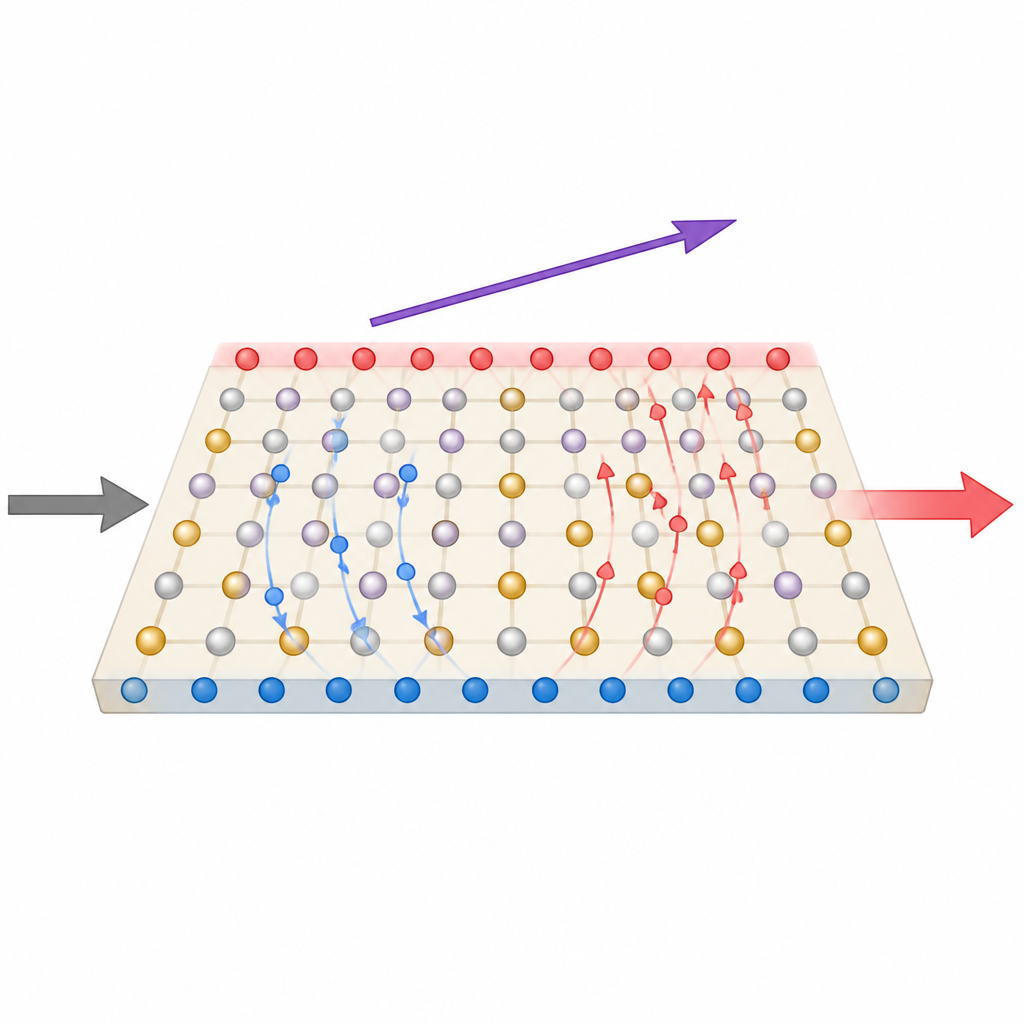
Most of the time, when an electric current flows through a metal and a magnetic field is applied, we know exactly how the current bends. This sideways deflection, called the Hall effect, is a workhorse of modern electronics and sensors. In this study, researchers show that even in a nonmagnetic material a very large sideways current can appear when the magnetic field lies within the plane of the current, revealing a new route for controlling electricity with magnets across a wide range of temperatures.
A twist on a classic electrical effect
In the conventional Hall effect, a magnetic field is applied perpendicular to a thin slab carrying current, and charges pile up along the edges. Recently, scientists discovered that a Hall response can also arise when the field is applied within the same plane as the current, an in-plane Hall effect. Earlier experiments mostly used magnetic materials, where the built-in magnetization obscures how the external field alone shapes the current. Theory, however, predicted that certain nonmagnetic crystals with threefold rotational symmetry should host a special "magneto-cubic" in-plane Hall effect whose strength scales with the cube of the magnetic field. Until now this behavior had not been cleanly seen in a three-dimensional nonmagnetic solid.
A special crystal that meets the symmetry rules
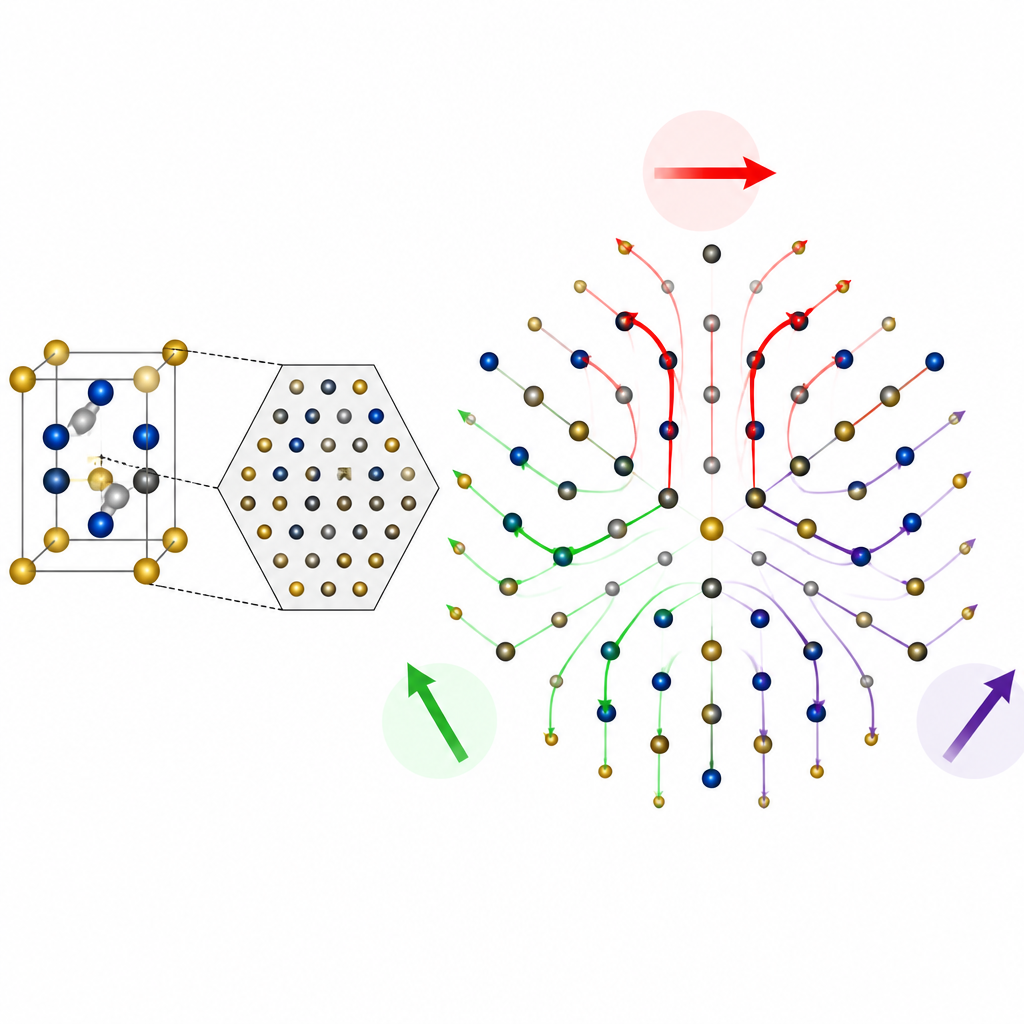
The team turned to LuAuSn, a nonmagnetic compound of lutetium, gold, and tin that crystallizes in the half-Heusler structure. When viewed along a particular direction, its atomic layers on the (111) surface form a pattern with threefold rotational symmetry and mirror planes. These symmetry properties are crucial: they forbid the usual linear in-plane Hall response yet allow a cubic one, and they predict that the sideways voltage should repeat every one-third of a full rotation as the magnetic field is turned within the plane. High-quality single crystals were grown using a tin flux technique, and their orientation was precisely checked with X-ray and Laue diffraction before transport measurements.
Watching currents bend in unusual ways
By driving current within the (111) plane and rotating a magnetic field inside that same plane, the researchers measured how the sideways voltage changed with angle and field strength. They carefully separated the familiar out-of-plane Hall signal, which was linear in magnetic field, from the in-plane contribution. The in-plane signal showed a clean three-lobed pattern as the field turned, repeating every 120 degrees exactly as symmetry demands. More strikingly, at low fields up to about 3 tesla the in-plane Hall resistivity and conductivity scaled as the cube of the magnetic field over a broad temperature window, from a few degrees above absolute zero up to room temperature. Additional tests, in which the current direction was rotated while the field direction was fixed, confirmed that the effect depended mainly on how the field related to the crystal, not to the current, distinguishing it from more familiar planar magnetoresistance.
Hidden scattering processes do the heavy lifting
The magnitude of the in-plane Hall conductivity in LuAuSn is enormous: at 2 kelvin and 3 tesla, it exceeds that of the well-studied nonmagnetic material ZrTe5 by more than an order of magnitude and even surpasses known magnetic systems that show in-plane Hall responses. To understand where this large signal comes from, the authors combined first-principles electronic structure calculations with a scaling analysis that tracks how the Hall conductivity changes with the crystal’s ordinary conductivity as temperature varies. The calculations show that intrinsic effects tied to the quantum geometry of the electronic bands, as well as the simple Lorentz force picture, are far too small. Instead, the data are best explained by more subtle scattering processes: side jump events, where charge carriers hop sideways when they hit impurities or vibrating atoms, and skew scattering, where scattering probabilities are biased to one side. Both impurity and phonon scatterings contribute strongly, and together they generate the giant cubic in-plane Hall response.
From fundamental physics to future devices
This work demonstrates that a nonmagnetic crystal can host a very large in-plane Hall effect that is both strongly nonlinear in magnetic field and robust up to room temperature. For nonspecialists, the key message is that the way electrons bounce off imperfections and vibrations inside a carefully designed crystal can be harnessed to steer currents sideways in a controllable way, without relying on magnetism built into the material itself. LuAuSn therefore offers a clean model system for exploring new families of in-plane Hall, Nernst, and thermal effects, and it suggests practical routes to devices that use in-plane magnetic fields to switch or sense electrical signals with high efficiency.
Citation: Chen, J., Cao, J., Lu, Y. et al. Giant magneto-cubic in-plane Hall effect in a nonmagnetic material. Nat Commun 17, 4276 (2026). https://doi.org/10.1038/s41467-026-70726-3
Keywords: in-plane Hall effect, nonmagnetic materials, LuAuSn, electron scattering, magnetotransport