Clear Sky Science · en
Partitioning of Rubisco activase into the pyrenoidal Rubisco condensate is mediated by a functional protein-protein interaction
How algae pack their carbon-fixing engines
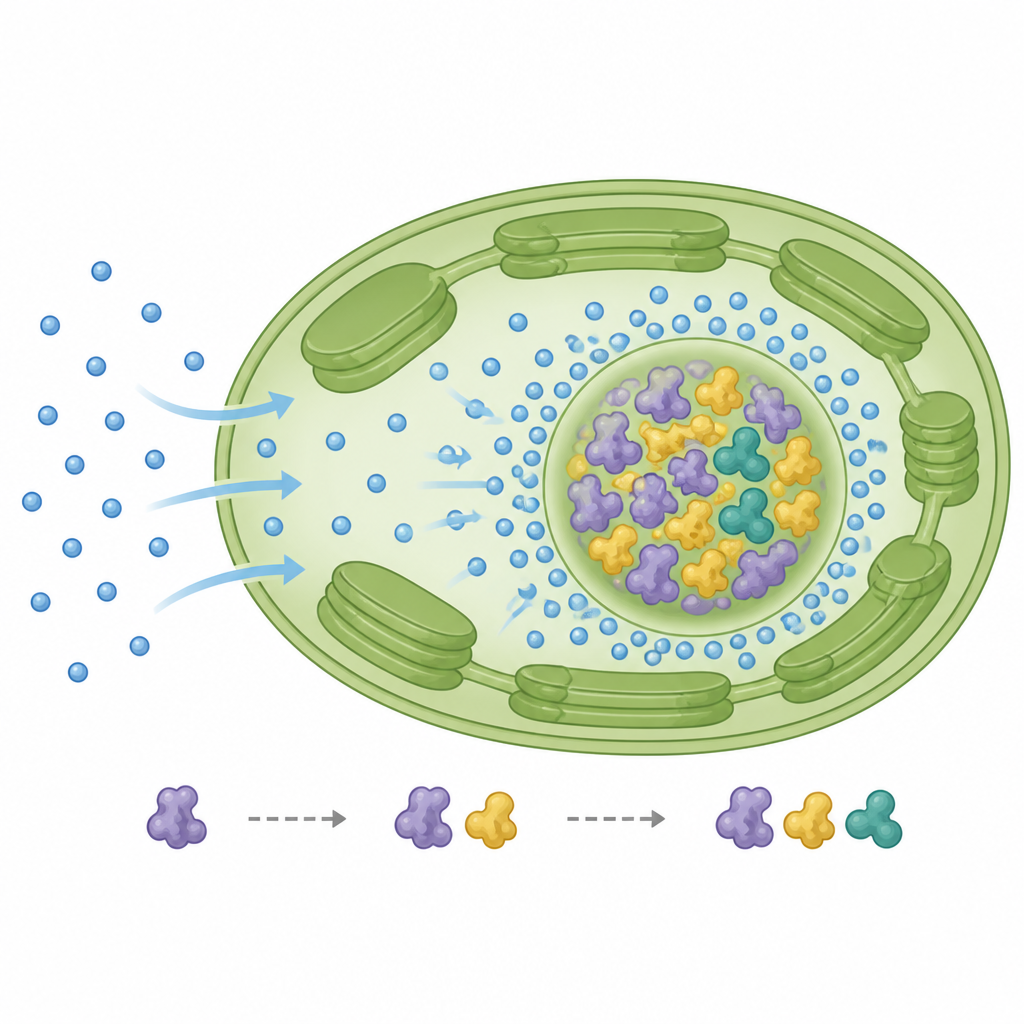
Microscopic algae are among Earth’s most important carbon harvesters, pulling carbon dioxide from the air and locking it into organic matter. Inside their cells, this job is handled by a slow and finicky enzyme called Rubisco. To make Rubisco work harder, many algae concentrate it into a tiny droplet-like structure called the pyrenoid. This study asks a key question: how does a vital helper protein, Rubisco activase, find its way into this packed droplet while many other proteins are kept out?
A tiny droplet with a big carbon job
In green algae such as Chlamydomonas reinhardtii, Rubisco is gathered into a dense, liquid-like cluster inside the chloroplast. This cluster, or condensate, behaves rather like a droplet of oil in water, but it is made of proteins instead of fats. Two main players build this droplet: Rubisco itself and a flexible linker protein called EPYC1 that binds many Rubisco molecules together. By corralling Rubisco into one place near a local carbon dioxide source, the pyrenoid helps algae carry out photosynthesis efficiently even when carbon dioxide in the surrounding water is scarce.
Letting the right helper into the crowd
Rubisco cannot keep working on its own because it frequently becomes clogged by sugar-like molecules. Rubisco activase, or Rca, is a ring-shaped helper protein that uses cellular fuel to unclog Rubisco and restore its activity. The researchers reconstructed the Rubisco–EPYC1 droplet in a test tube and added purified Rca to see whether it would join the dense phase. They found that Rca is strongly drawn into the artificial pyrenoid, both when viewed under the microscope and when the droplet material is spun down and analyzed. Rca’s entry depends on electrical attractions between charged regions of the proteins and disappears when salt levels are increased, showing that subtle chemical forces guide which proteins can enter.
A fragile key built into Rca
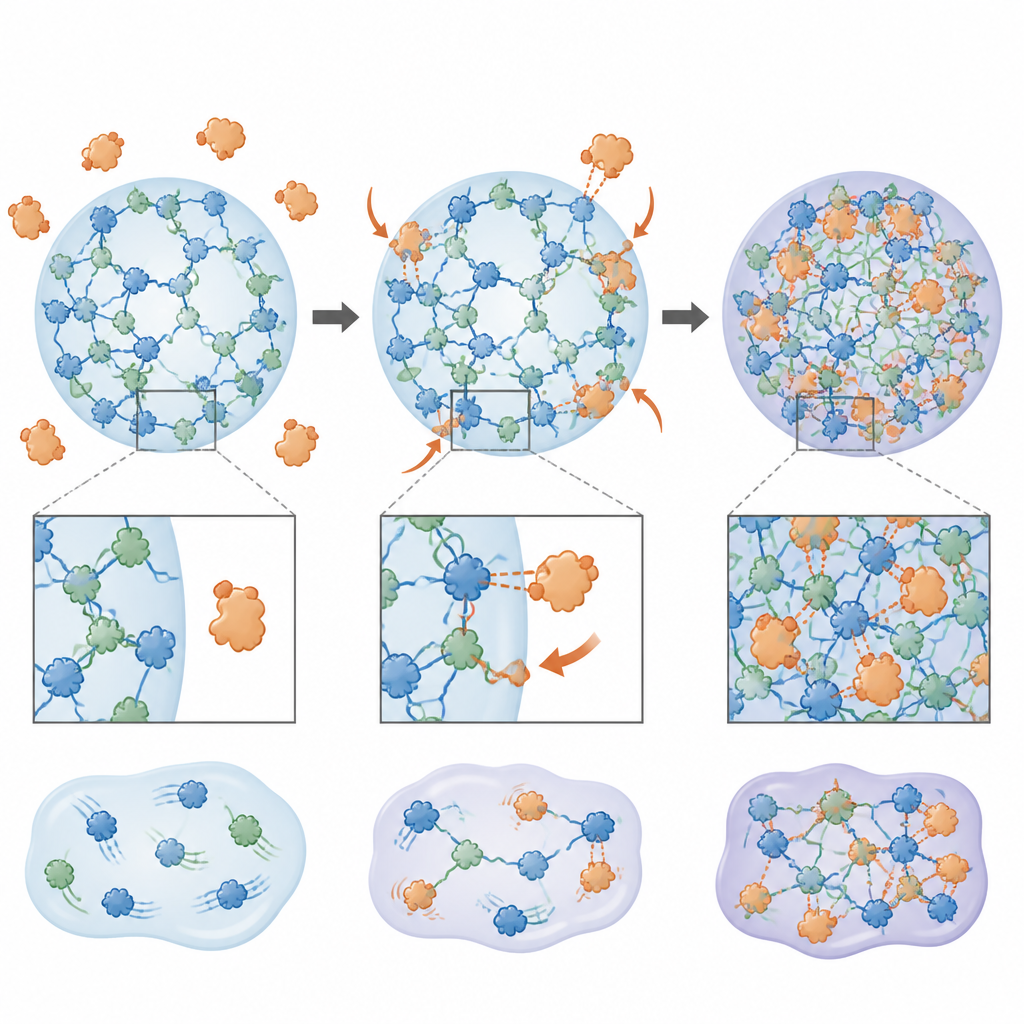
The team then set out to discover which part of Rca acts as the “entry ticket” for the pyrenoid. Green-type Rcas, including the algal version studied here, carry a floppy tail at one end called the N-terminal domain. By trimming off this tail or changing just one or two of its amino acid building blocks, the scientists produced Rca variants that could still burn ATP but could no longer revive Rubisco. Strikingly, these same tiny changes also prevented Rca from joining the Rubisco–EPYC1 droplet. When the tail alone was fused to an unrelated blue or yellow fluorescent protein, that fusion protein, which normally stayed outside, now entered the droplet both in test tubes and inside living algal chloroplasts. This shows that the tail contains “sticker” motifs that latch onto Rubisco and EPYC1 and are enough to guide other proteins into the pyrenoid.
Choosing partners with care
The researchers also compared Rca from many plants and bacteria. Most of these foreign versions could form droplets with EPYC1 alone, reflecting EPYC1’s flexible, somewhat indiscriminate binding. However, when Rubisco was added to build a more complete pyrenoid-like condensate, only Rcas that could productively work with algal Rubisco remained inside. Less compatible or unrelated Rcas were largely pushed out of the dense phase. This suggests that the combined network of Rubisco and EPYC1 acts as a filter, favoring helper proteins that make the right functional contacts and excluding weak or mismatched ones, much like a crowd that only lets in people who can interact with key hosts.
From sticky spots to smarter organelles
By tying together Rca’s activity and its ability to enter the pyrenoid, this work reveals how pre-existing, functionally important protein–protein contacts can be reused to sort proteins into specialized droplets inside cells. The same molecular “handshake” that allows Rca to repair Rubisco also serves as its pass into the Rubisco-rich compartment. Because these interactions are so delicate that even a single chemical change can break them, cells may be able to regulate who enters the pyrenoid by modifying specific amino acids, for example through phosphorylation. Understanding these sticker motifs could help scientists in the future to direct synthetic or foreign proteins into engineered pyrenoid-like structures in crop plants, potentially improving how efficiently they capture carbon dioxide.
Citation: How, J.B., Poh, C.W., Ng, Y.S. et al. Partitioning of Rubisco activase into the pyrenoidal Rubisco condensate is mediated by a functional protein-protein interaction. Nat Commun 17, 4309 (2026). https://doi.org/10.1038/s41467-026-70724-5
Keywords: pyrenoid, Rubisco activase, biomolecular condensates, photosynthesis, protein interactions