Clear Sky Science · en
Large-scale multi-omics profiling reveals environmental and evolutionary drivers of fungal phylogeographic and metabolic diversity
Why hidden fungal chemistry matters
Many of the world’s most serious food and health threats are invisible. Microscopic fungi living in soil and on crops can manufacture powerful chemicals that contaminate food, damage harvests, and even cause deadly infections. One of the most notorious culprits is Aspergillus flavus, a common mold that produces aflatoxin, a potent liver carcinogen. This study maps, at an unprecedented scale, how different environments and evolutionary histories shape the geography and chemistry of A. flavus across the globe, and what that means for future risks in a warming world.
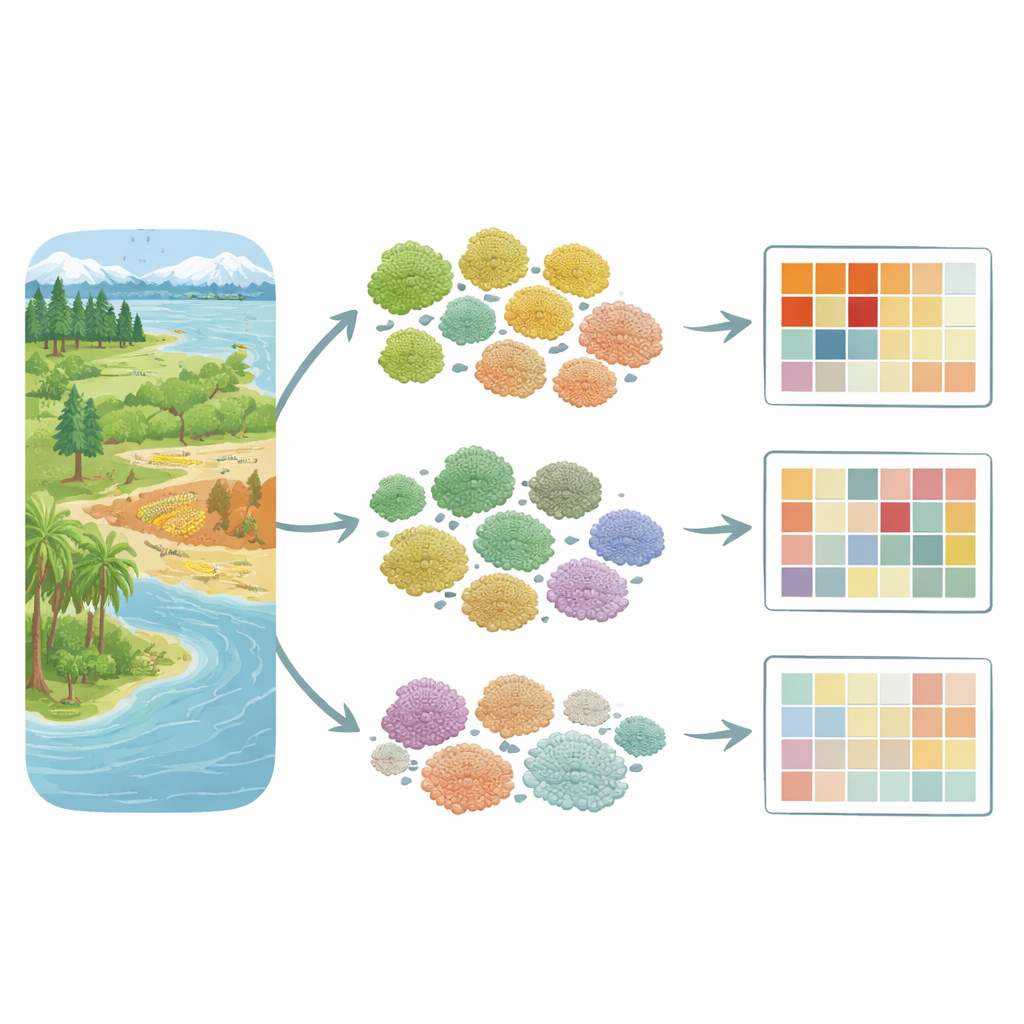
Following a mold around the world
The researchers assembled a global collection of over a thousand A. flavus strains from soils, crops, and patients across four continents, including more than 500 newly sequenced strains from many climate zones in China. Using genome sequencing, chemical profiling, and gene activity measurements, they built a detailed family tree of the fungus. This tree revealed eight major genetic subgroups, or clades, some of which were closely tied to particular regions and climates. Strains taken from clinical infections tended to cluster together, hinting that certain lineages are especially well suited to infect humans, while others are more rooted in environmental niches such as particular soils or host plants.
Hot zones, cold zones, and shifting toxin risks
By overlaying this genetic map with climate and location data, the team found clear geographic patterns in toxin production. Strains from warmer, low-latitude regions—especially in southern and central China—were far more likely to produce high levels of aflatoxin. Cooler, higher-latitude regions tended to harbor strains that made little or no aflatoxin but often produced other mycotoxins, such as cyclopiazonic acid, instead. This means that “safer” strains with respect to aflatoxin can still be chemically dangerous in other ways. The study also showed that some environmental strains from the same clades as clinical isolates carry extra copies of known virulence genes, suggesting that the boundary between harmless field fungus and human pathogen can be thin.
Inside the fungal toolkit
To understand what drives these differences, the scientists examined the fungus’s genetic toolkit for making specialized chemicals. They built a “pangenome” of more than 15,000 genes, separating a stable core shared by nearly all strains from a large, flexible set of accessory genes that vary between populations. Many of these variable genes belong to biosynthetic gene clusters—stretches of DNA that encode the enzymes needed to build specific molecules. Surprisingly, differences in these clusters only partly explained why some populations produced more aflatoxin or other toxins than others. Many strains with an apparently intact aflatoxin cluster made little toxin, while some low-aflatoxin lineages invested heavily in other, less characterized chemical families.
Regulators, metabolism, and the imprint of climate
The deeper explanation lay in how genes are controlled and how the fungus routes energy and building blocks through its metabolism. Populations living in different climates showed distinct patterns in regulatory genes that sense light, temperature, nutrients, and pH, as well as genes involved in basic energy pathways like sugar breakdown and fatty acid synthesis. Using statistical links between genetic variants, local climate and soil measurements, and metabolite profiles, the authors showed that environmental factors such as temperature, humidity, rainfall, soil pH, and bulk density consistently favored certain combinations of regulatory and metabolic genes. Knocking out selected regulatory genes in the lab caused large shifts in toxin production, often making a high-aflatoxin strain’s chemical profile resemble that of naturally low-aflatoxin populations. This indicates that climate-driven selection on regulators and core metabolism can rewire the fungus’s chemical output without major changes to its toxin-making clusters.
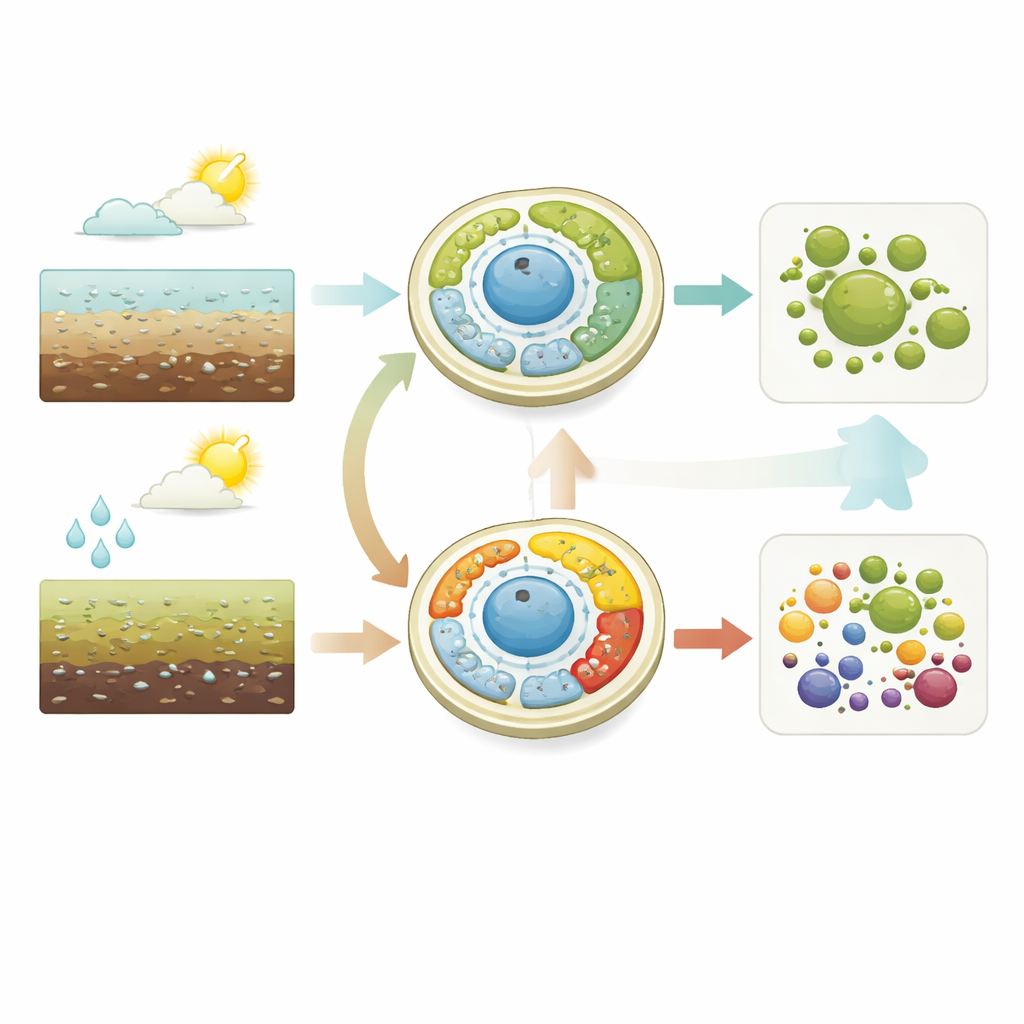
What this means for food safety and the future
Taken together, the results show that A. flavus does not simply flip between “toxic” and “non-toxic” forms. Instead, it carries a broad chemical toolkit that is tuned by local environments through changes in accessory genes, regulatory circuits, and primary metabolism. As climate zones shift with global warming, the study suggests that highly toxigenic clades favored by warmth and humidity may spread into new regions, and that non-aflatoxin strains used as biological control agents may themselves carry other, less monitored toxins. For a lay reader, the key message is that the safety of our food and the risk of fungal disease are intimately connected to climate and soil conditions—and that predicting and managing those risks will increasingly depend on understanding the hidden chemistry of fungi in their natural habitats.
Citation: Xie, H., Hu, J., Zhao, X. et al. Large-scale multi-omics profiling reveals environmental and evolutionary drivers of fungal phylogeographic and metabolic diversity. Nat Commun 17, 4121 (2026). https://doi.org/10.1038/s41467-026-70721-8
Keywords: aflatoxin, Aspergillus flavus, mycotoxins, climate change, fungal genomics