Clear Sky Science · en
Hygroscopicity-driven spontaneous sustainable direct lithium extraction
A Faster, Gentler Way to Get Lithium
Lithium powers the batteries in our phones, laptops and electric cars, yet getting it out of the ground is slow, thirsty and energy-hungry. This study describes a new way to pull lithium from solid waste left over from mining, using nothing more exotic than the air’s natural humidity. For readers concerned about clean energy, water scarcity and mining impacts, it offers a glimpse of how we might expand lithium supplies while shrinking their environmental footprint.
Why Today’s Lithium Comes at a High Cost
Modern lithium production mostly relies on two routes: evaporating salty brines in vast ponds or crushing and processing hard rock ores. Brine evaporation is cheap but can take more than a year and consumes large amounts of freshwater in already-dry regions. Hard-rock mining is faster but demands high energy use and creates extensive waste. Emerging “direct lithium extraction” methods promise cleaner separation using special membranes or chemicals, but these approaches usually need electricity, reagents and careful control, making them expensive to scale. The underlying challenge is that lithium usually appears alongside abundant salts containing sodium, potassium, magnesium and calcium, and separating this small fraction cleanly has proven difficult.
Letting Lithium’s Love of Water Do the Work
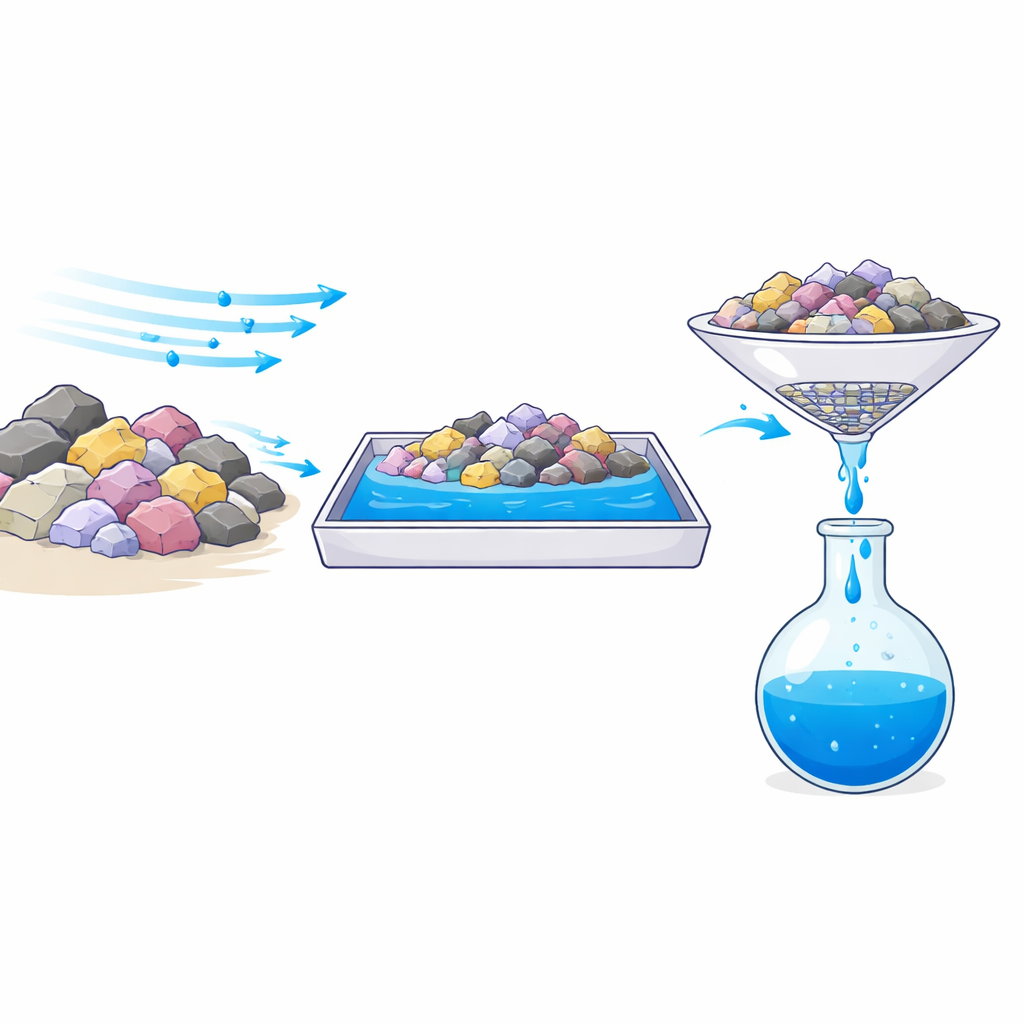
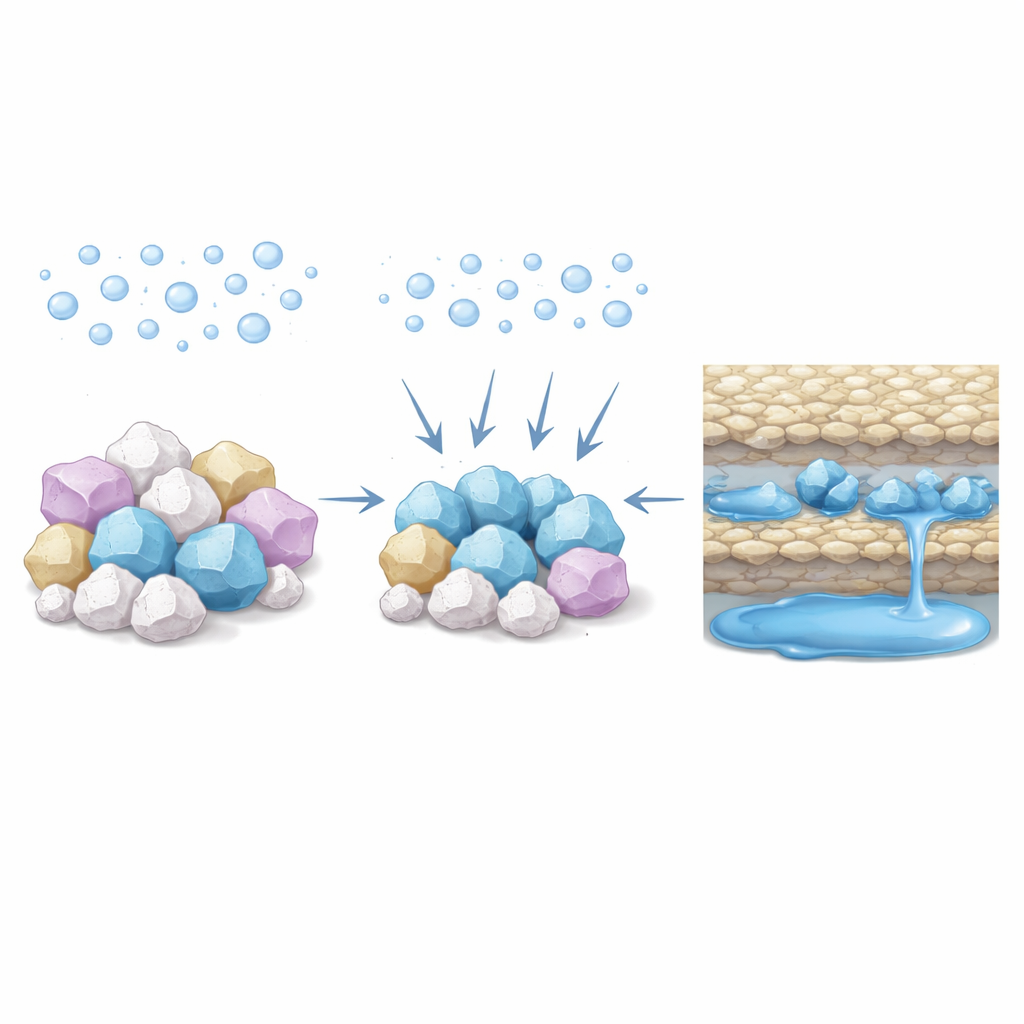
The researchers realized that lithium chloride hydrate, a lithium-containing salt common in mining slags, has a powerful tendency to pull in water from the air. When the surrounding humidity is modest—about 12% to 30%—this mineral starts to absorb tiny amounts of moisture, eventually dissolving into a liquid while neighboring salts such as table salt (sodium chloride) and common potassium, magnesium and calcium salts remain solid. By carefully holding mixtures of these minerals at controlled humidity, the team showed that only the lithium-bearing crystals liquefy, creating droplets of lithium-rich solution that can be drained away. This means that the disorder of scattered water vapor in air is harnessed to drive the lithium separation step spontaneously, without added heat, chemicals or water.
How the Controlled Humidity Process Works
To make this principle practical, the team built a humidity-controlled chamber where low-humidity air is pulled through a bed of mixed minerals or real mining slag. As the air passes by, the lithium salt greedily absorbs moisture and melts into a small volume of liquid. A gentle vacuum then draws this liquid downward through a filter, separating it from the still-solid companion salts. By tuning how fast the moist air flows and how loosely the mineral bed is packed, they can speed up moisture uptake and ensure that the lithium-rich liquid is removed before it has time to redissolve unwanted salts nearby. Under optimized conditions, they recovered up to 96% of the lithium, concentrating it to nearly 100,000 parts per million—far richer than typical industrial feed solutions—within minutes to hours instead of months.
Proving It Works Outside the Lab
Beyond carefully mixed samples, the researchers tested real slag from a brine-based lithium operation. This material contained lithium alongside several other salts and impurities, similar to what is stored in piles at actual sites. In their setup, three quick extraction cycles recovered over 80% of the lithium within about an hour, yielding solutions much more concentrated than those used in standard lithium carbonate production. They also mimicked seasonal conditions from Chile’s Atacama Desert, where many brine ponds operate, adjusting humidity, temperature and wind speed to realistic values. Even under these fluctuating natural conditions, the process consistently recovered more than 80% of the lithium in about one to three hours, showing that it can work robustly in the field.
Scaling Up with Simple Hardware
To explore real-world deployment, the team designed a simple vertical module, roughly like a hollow column filled with slag between two walls. Moist air is drawn across the packed salts, lithium-rich liquid forms and then drips down into a collector at the base. In tests, this module processed several kilograms of slag per day per meter of height and produced highly concentrated lithium solutions, outperforming many existing extraction technologies in both speed and output concentration. Because it relies on basic materials and ambient conditions, this modular design could be added to current mining sites or used in centralized facilities that condition the air more precisely.
What This Means for Cleaner Batteries
In plain terms, the study shows that we can exploit lithium’s natural thirst for water to pull it out of complex solid wastes quickly and with little added energy, water or chemicals. Instead of building ever more evaporation ponds or chemical plants, this approach lets the atmosphere do much of the separation work. While further engineering is needed to scale the technology, integrate it with existing refining steps, and test other types of lithium-bearing materials, the concept points toward more sustainable lithium supplies. That, in turn, could help ensure that the clean-energy transition does not depend on mining practices that strain water resources and ecosystems.
Citation: Chen, H., Yang, M., Zheng, S. et al. Hygroscopicity-driven spontaneous sustainable direct lithium extraction. Nat Commun 17, 4085 (2026). https://doi.org/10.1038/s41467-026-70720-9
Keywords: lithium extraction, mining waste, hygroscopic materials, battery raw materials, sustainable mining