Clear Sky Science · en
Controllable assembly of sub-1 nm nanowires for the construction of aerogels
Why airy solids matter
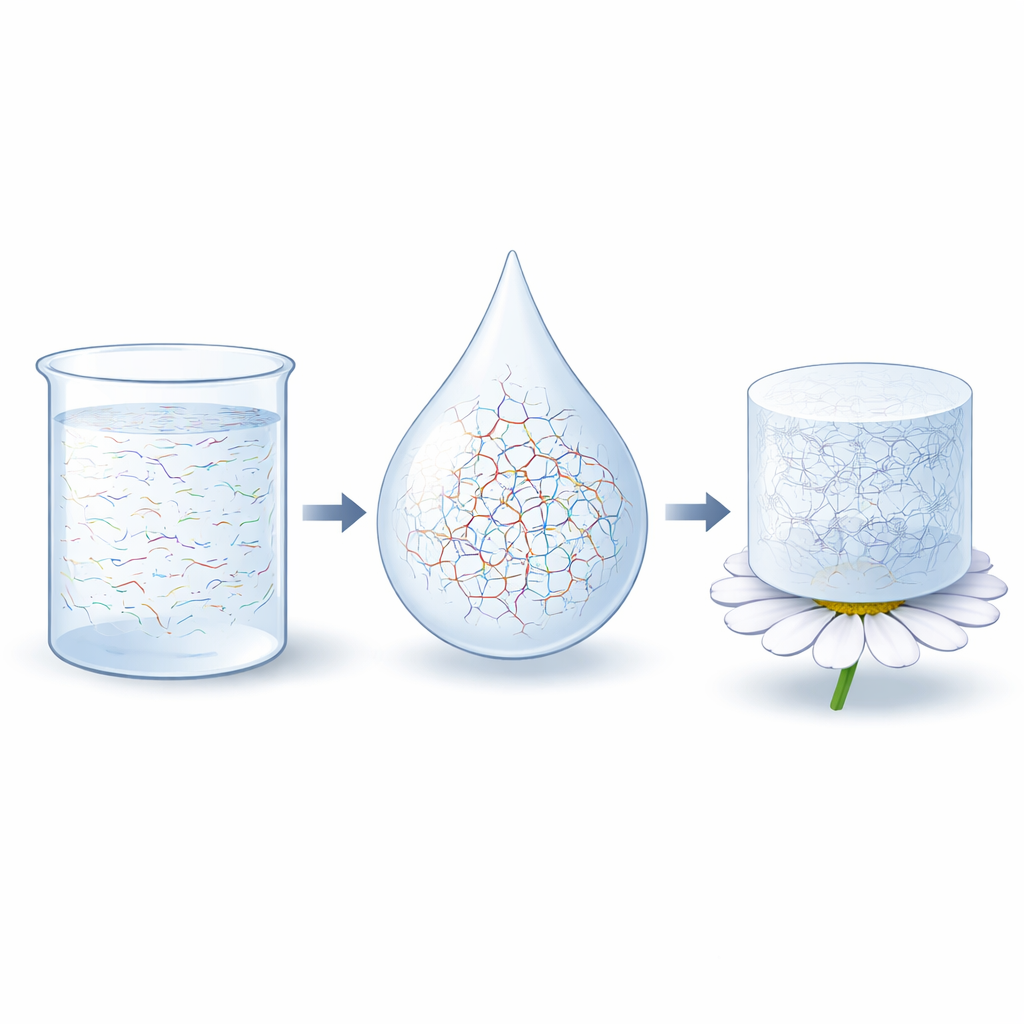
Aerogels are sometimes called “frozen smoke” because they are so light and see‑through, yet can insulate, filter, or glow with remarkable efficiency. As engineers push these materials into everything from energy‑saving windows to sensors and flexible electronics, they face a bottleneck: the tiny building blocks inside conventional aerogels can no longer deliver big jumps in performance. This paper presents a new way to build aerogels from ultra‑thin, sub‑nanometer wires, creating solids that are lighter, more porous, and mechanically tougher than many existing designs.
Building with the thinnest possible wires
Traditional aerogels rely on nanoparticles, nanofibers, or sheets that are a few to tens of nanometers thick. The authors instead use “sub‑1 nanometer nanowires” – strands so thin that their diameters approach the size of a unit cell in a crystal and are comparable to large polymer molecules. These wire‑like building blocks combine an enormous surface area with unusual flexibility and high surface energy. Earlier attempts to turn them into bulk materials produced mostly fibers and films, not three‑dimensional monoliths. A prior freeze‑casting route did make aerogels, but the growth of ice crystals squeezed the wires together, collapsing pores and wasting much of their surface area. The challenge was to assemble these fragile, hair‑thin components into a strong, open network without crushing them.
Teaching nanowires to play nicely in liquids
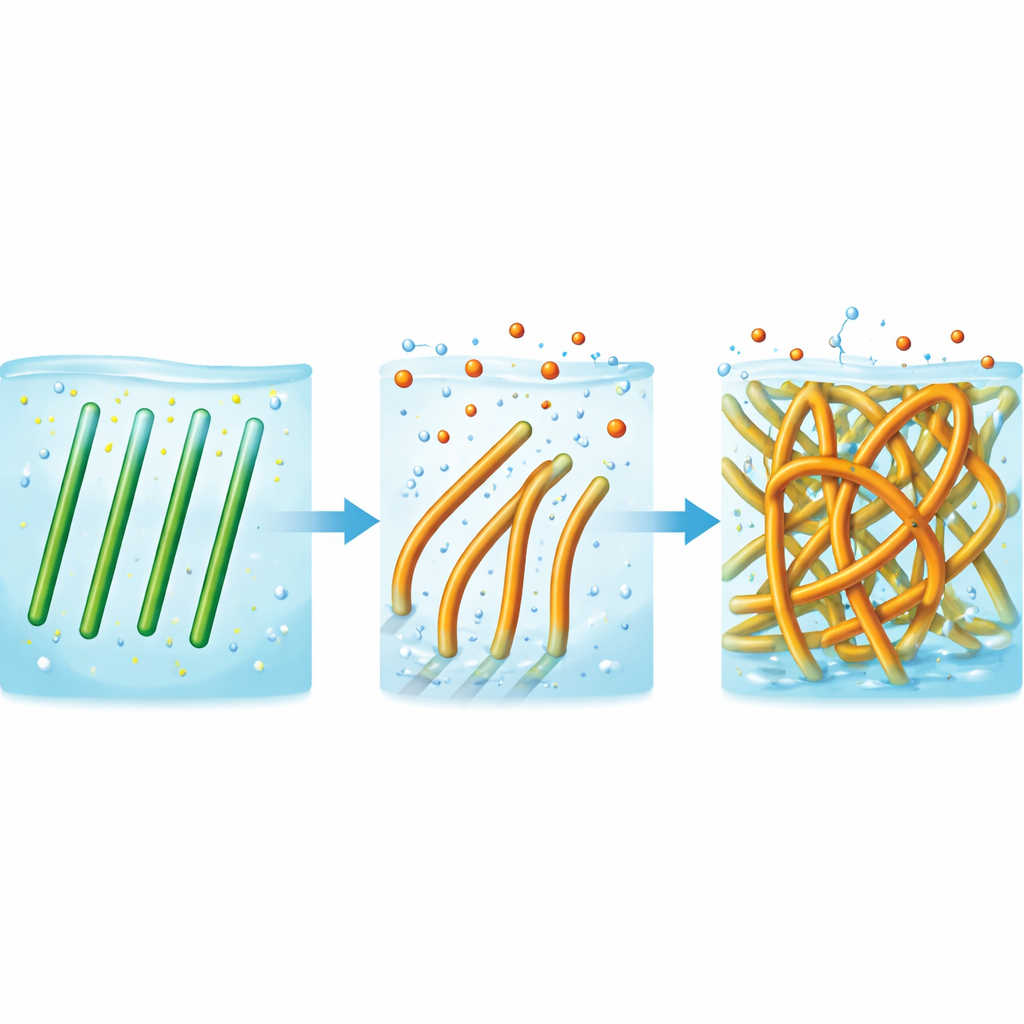
The key advance is precise control over how the nanowires interact with each other and with the surrounding liquid. The team studies gadolinium hydroxide oxide nanowires coated with oleic acid molecules. In non‑polar liquids, these coated wires disperse well, forming a clear suspension, but they quickly clump and precipitate in polar solvents such as alcohols. The researchers swap the original coating for a new molecule that ends in a hydroxyl group, using a ligand‑exchange process that keeps the overall organic content similar but changes how the wire surfaces “feel” to the solvent. Spectroscopic and thermal measurements confirm that the original ligands are almost completely replaced, while electron microscopy shows the wires changing from neatly parallel bundles to more interwoven arrangements in polar media – a sign that their mutual attractions and repulsions have been retuned.
From flowing liquid to solid gel
With the new surface chemistry, the nanowires can be dispersed in various alcohols, where the solvent’s polarity and branching subtly tune how strongly the wires attract and tangle. In different forms of butanol, the degree of bundling and crossing increases as the solvent molecules become more branched, leading to thicker, stronger gel skeletons. Adding citric acid triggers the formation of a three‑dimensional, percolating network: the acid molecules and protons act as bridges and electrostatic drivers that pull the wires together. Molecular dynamics simulations visualize this process, showing nanowires drifting closer as the interaction energies with the charged species drop. Experiments reveal that some gels strengthen over time as the network thickens, while others eventually weaken and flow again when thin strands can no longer withstand ongoing reorganization, clarifying how subtle differences in early aggregation set the mechanical fate of the gel.
Drying without collapse and adding new tricks
Once a stable wet gel is formed, the liquid inside is removed by supercritical carbon dioxide drying, a gentle process that avoids the surface tension forces that would ordinarily crush such a delicate framework. The result is a semi‑transparent aerogel made from intertwined nanowire strands just a few nanometers thick. These structures reach a very high specific surface area of about 505 square meters per gram—far above earlier sub‑nanometer‑wire aerogels and even many aerogels built from thicker nanofibers—while maintaining an ultralow density of roughly 0.024 grams per cubic centimeter. Because the fibers are much thinner than visible wavelengths of light and arranged homogeneously, related terbium‑based aerogels can glow brightly throughout their entire volume under ultraviolet illumination. The method also works for several different rare‑earth nanowires and for mixtures that emit tunable colors, underscoring its generality.
Making feather‑light solids tougher and water‑repelling
As‑made, the spidery framework is so slender that it deforms readily under load. To toughen it without sacrificing lightness, the authors coat the nanowire skeleton by chemical vapor deposition of a silica layer bearing methyl groups. This thin, rigid shell greatly boosts compressive strength and elasticity: aerogel samples can be compressed to half their height and return almost fully even after 50 cycles. At the same time, the methyl‑decorated silica makes the surface strongly water‑repellent, allowing the material to float on water and resist moisture damage. Importantly, microscopy shows that the coating preserves the overall pore structure and keeps the density low.
What this means for future materials
By learning how to tune the surface chemistry of sub‑nanometer wires, steer their behavior in different solvents, and dry their gels gently, the researchers have created a new class of ultralight, high‑surface‑area aerogels with impressive mechanical resilience and water resistance. In simple terms, they demonstrate that it is possible to take the tiniest wire‑like building blocks, coax them into forming a stable three‑dimensional web, and lock that web in place as a solid that is mostly empty space. This strategy broadens the toolkit for designing next‑generation aerogels for insulation, optics, sensing, and other technologies that benefit from materials that are simultaneously light, porous, and robust.
Citation: Du, Y., Xiu, Y., Yang, X. et al. Controllable assembly of sub-1 nm nanowires for the construction of aerogels. Nat Commun 17, 4053 (2026). https://doi.org/10.1038/s41467-026-70713-8
Keywords: aerogels, nanowires, porous materials, surface chemistry, lightweight materials