Clear Sky Science · en
Space and space-time topologies in a type-II hyperbolic lattice
Curved spaces and protected waves
Imagine a racetrack built on a surface that bends like a saddle instead of a flat floor. Waves of electricity or light can run along the edges of this strange track in special, protected ways. This article explores how to design such a curved “space” using electronic circuits, how to make energy flow along both its inner and outer rims, and how to steer that flow in time, hinting at new devices for robust signal control and light-based technologies. 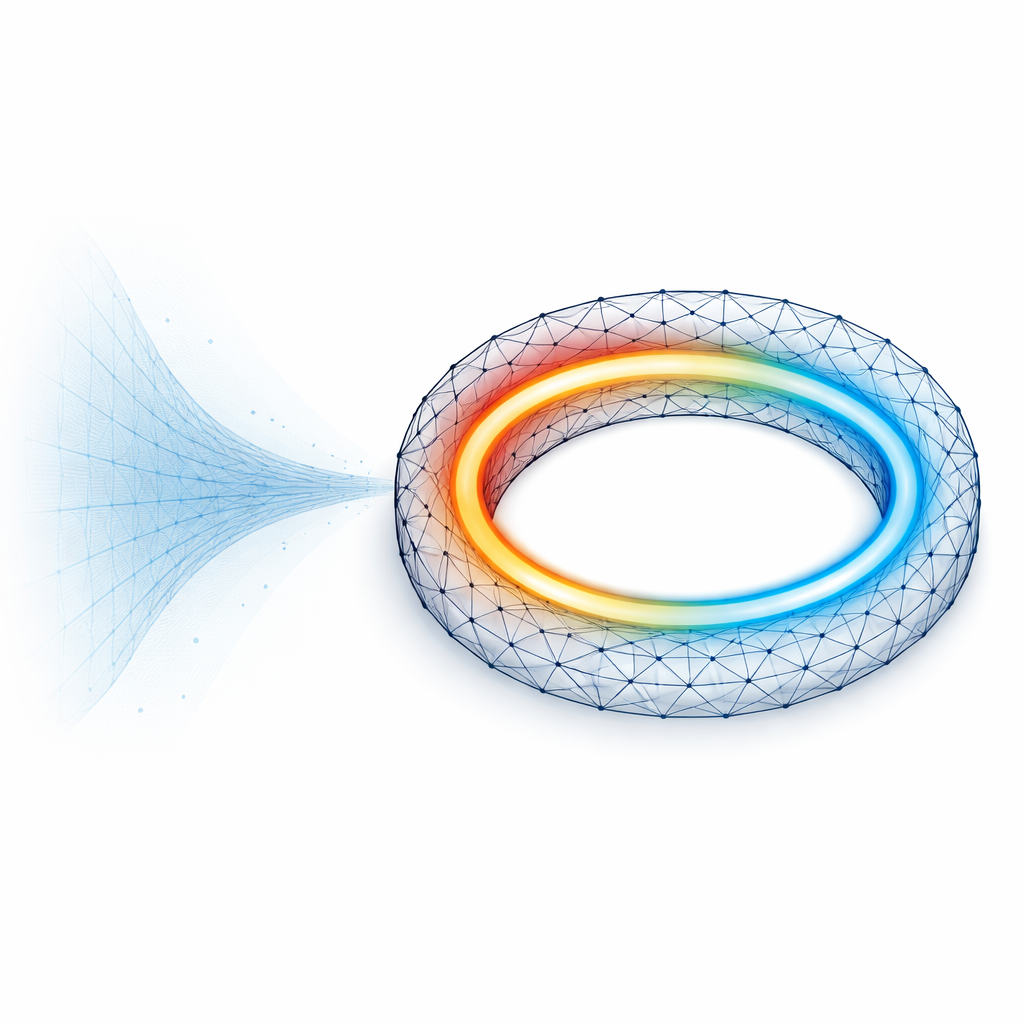
A new kind of curved lattice
In ordinary materials, atoms are arranged as if they sit on a flat sheet. Here, the authors focus on “hyperbolic” lattices, which behave as if they live on a surface with constant negative curvature, like the outside of a trumpet or a Pringles chip pushed to the extreme. Earlier work mostly used a layout with only one outer edge. This study instead uses a type-II hyperbolic lattice shaped like a ring, with both an outer boundary and an inner hole. That extra inner edge opens the door to richer behavior, because waves can live and travel along two different rims of the same structure.
Edge highways for one way travel
To explore this geometry, the team adapts a famous theoretical model that normally describes a special kind of insulator where electricity can only move along the edge. They translate this model onto a hyperbolic ring made from an array of electronic elements on a circuit board. Each lattice site is built from a small loop of capacitors and an inductor, arranged so that voltages combine into effective “spins” that mimic particles in the original model. When they probe the circuit, they find frequency ranges where the interior stays quiet but the edges respond strongly. Moreover, waves on the outer edge circulate in one direction, while waves on the inner edge circulate in the opposite direction, and both sets of edge states appear at the same energy.
Controlling traffic between the edges
Having established these two counterflowing edge highways, the researchers then open a narrow radial “bridge” between them by strengthening a few selected couplings in the ring. By tuning how strong this bridge is, they can control how much of a wave launched on one edge leaks to the other. For weak coupling, most of the energy stays on the starting edge, with only a partial transfer. As the coupling is increased toward a special operating point, the two edge modes effectively merge into almost nonmoving states, and an excitation on either edge shares itself nearly equally between both rims. The authors describe this behavior in terms of a two level model with a conserved flow difference and identify a transition between different symmetry phases as the coupling varies. 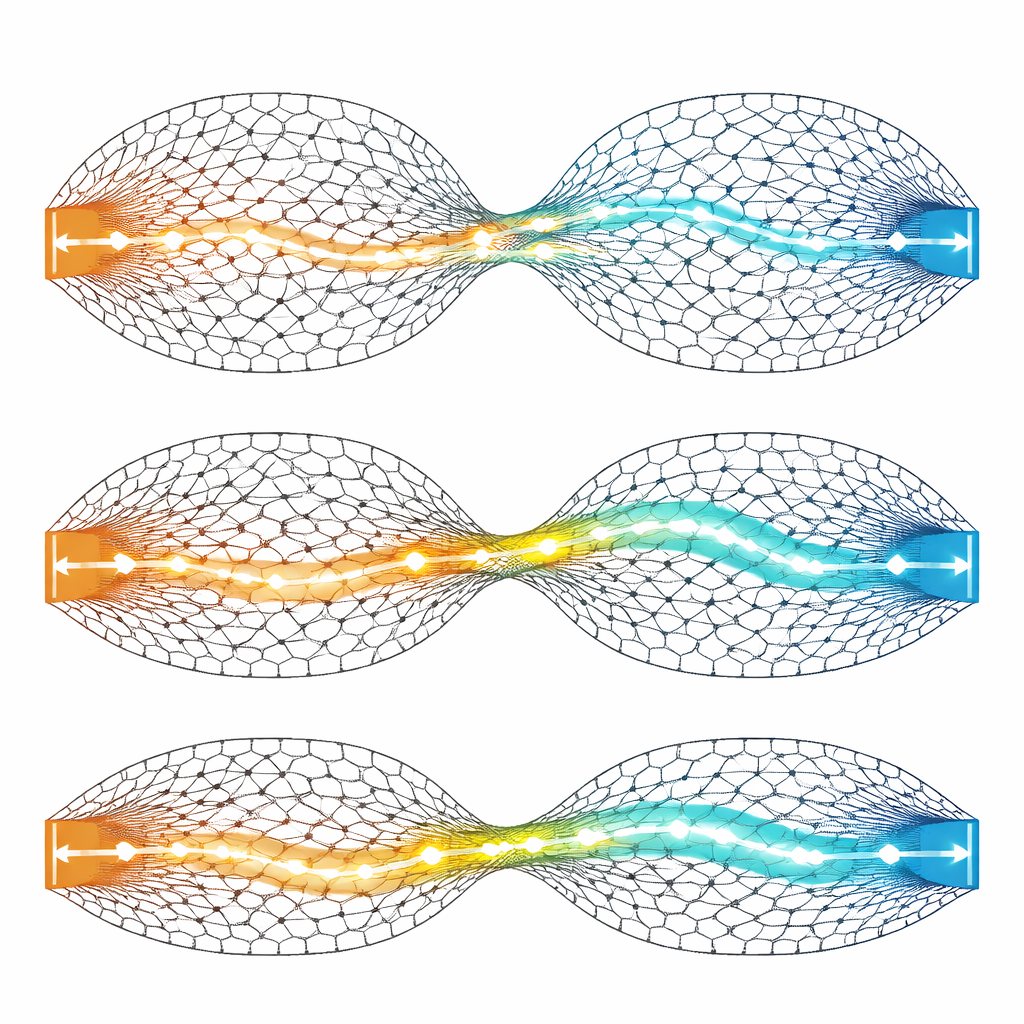
Weaving a crystal in space and time
Next, the team uses two such bridges and carefully designed gain and loss along the edges to make pulses circle around the ring in a time patterned way. Each loop around the ring acts like a step in a synthetic time lattice, while the difference in path lengths and splitting ratios at the bridges mimic a grid of ideal beam splitters. In this picture, the pulse pattern forms a crystal not just in space, but in space and time together. The authors show that this synthetic crystal carries two intertwined types of order: one tied to how waves wrap around the curved ring in space, and another tied to how they wind through the time steps set by the pulse evolution.
A string that lives in space and time
By choosing regions where the time based winding has opposite sign and joining them at a temporal boundary, the researchers predict and simulate a special “string” state in space time. This state is confined to the outer and inner edges of the hyperbolic ring and, at the same time, is trapped around a particular moment in the step by step evolution. In contrast, when only the spatial order is present, edge waves are pinned to the boundaries in space but remain spread out over time. The work shows that hyperbolic circuits provide an efficient playground to realize such exotic states, because their large ratio of edge sites to interior sites makes edge control easier. Ultimately, these ideas could inform robust lasers, frequency combs, and other devices that rely on precisely guided waves in both space and time.
Citation: Chen, J., Zhu, Z., Cheng, M. et al. Space and space-time topologies in a type-II hyperbolic lattice. Nat Commun 17, 4142 (2026). https://doi.org/10.1038/s41467-026-70706-7
Keywords: hyperbolic lattice, topological edge states, space time crystal, electric circuits, photonic topology