Clear Sky Science · en
Uniform bacterial genetic diversity along the gut
Why this matters for your gut
Your intestines are home to trillions of bacteria that help digest food, train your immune system, and even influence your risk of disease. We already knew that different stretches of the gut favor different kinds of microbes. What this study asks is a subtler question: as you move from one region of the gut to another, do the underlying bacterial "lineages" and their hidden genetic tweaks also change, or are they surprisingly similar throughout? The answer reveals something fundamental about how this inner ecosystem is organized and how it might respond to diet, drugs, or illness.
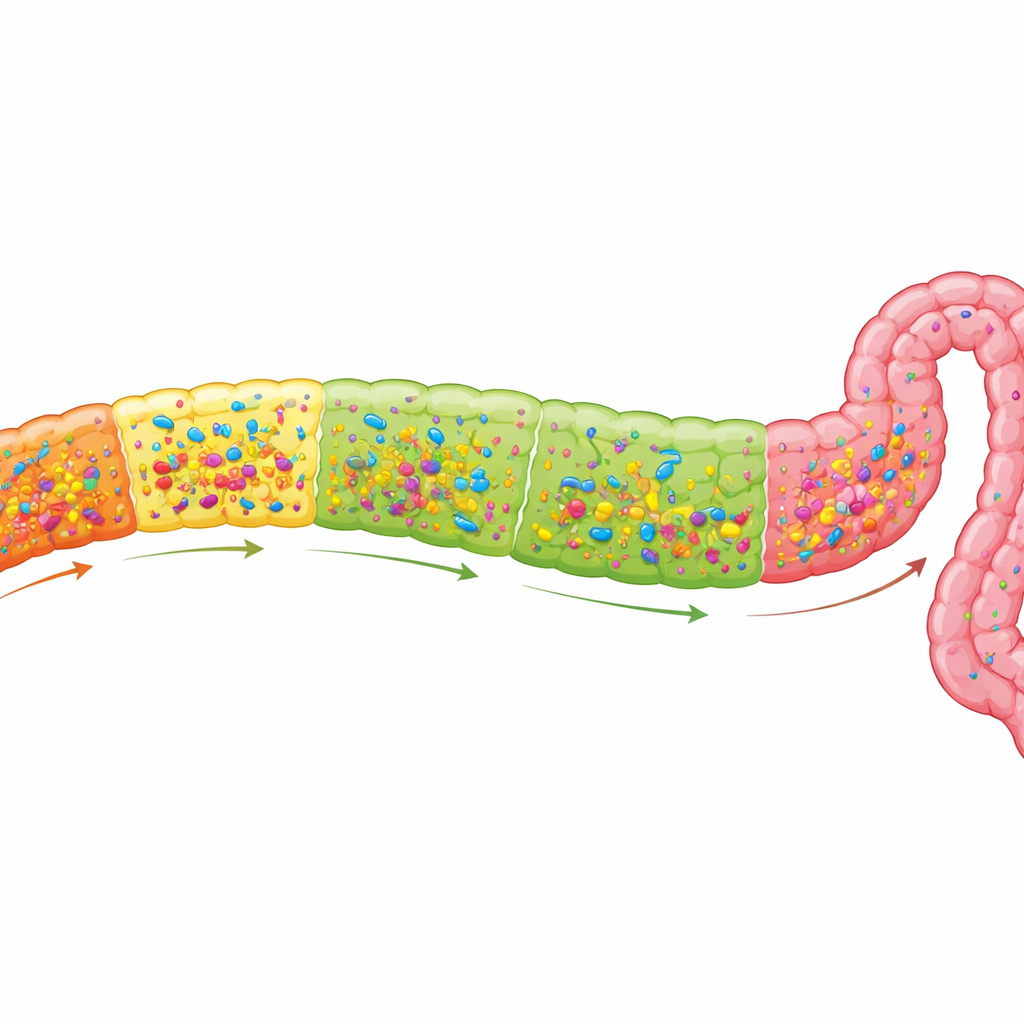
Different neighborhoods along the gut
The researchers began by confirming a now classic picture: not all parts of the gut look the same microbially. Using mice raised without any microbes and then given the same human stool sample, they measured which bacterial groups settled in each region, from the upper small intestine down to the colon. As others have found, the large intestine hosted a richer, more varied community than the small intestine, and particular families that specialize in breaking down complex carbohydrates were enriched in the colon. In contrast, other bacteria that cope well with faster flow and higher oxygen tended to dominate in the small intestine. In short, the gut still has distinct "neighborhoods" when you look at which broad types of bacteria live where.
Hidden sameness beneath visible differences
Under the surface, however, a very different pattern emerged. Within each bacterial species there can be multiple strains—think of them as different "makes" of the same model car, each with a slightly different engine under the hood. These strains carry genetic variants that affect traits like metabolism, antibiotic resistance, and ability to trigger inflammation. By sequencing all DNA in gut contents and using specialized algorithms, the team estimated how genetically diverse each species was and how common each strain was in each region. They found that while species composition changed a lot along the gut, the genetic diversity within a given species and the relative frequencies of its strains were strikingly uniform from one region to the next in the same animal.
Strains that mix instead of staying apart
One might expect that different strains of the same species would "claim" different parts of the gut to avoid competing too directly, or that local conditions would favor one strain in one region and another elsewhere. Instead, for most species that carried two or more strains, those strains coexisted at almost the same proportions in all sampled regions of a mouse’s gut. Differences between individual mice—especially those housed in different cages—were much larger than differences between regions within the same mouse. This pattern suggests that strains move quickly along the gut, aided by the constant churning and flow of its contents, and that social behaviors like mice eating each other’s droppings help equalize strain mixtures between cage-mates.
Genetic tweaks that spread everywhere
The study also tracked new genetic changes that arose over time within these gut communities. Some of these changes likely offered small advantages to the bacteria, allowing them to become more common. The researchers focused on large shifts in the frequency of individual genetic variants that are very unlikely to result from simple chance. They saw dozens of such shifts over the course of colonizing the mice, but almost all of them rose or fell together across all gut regions of a given host rather than staying confined to one spot. Only a handful of variants showed any sign of being more common in one region than another, and even then the differences were limited. This implies that when an especially beneficial mutation appears, it tends to spread along the entire gut rather than carving out a local stronghold.
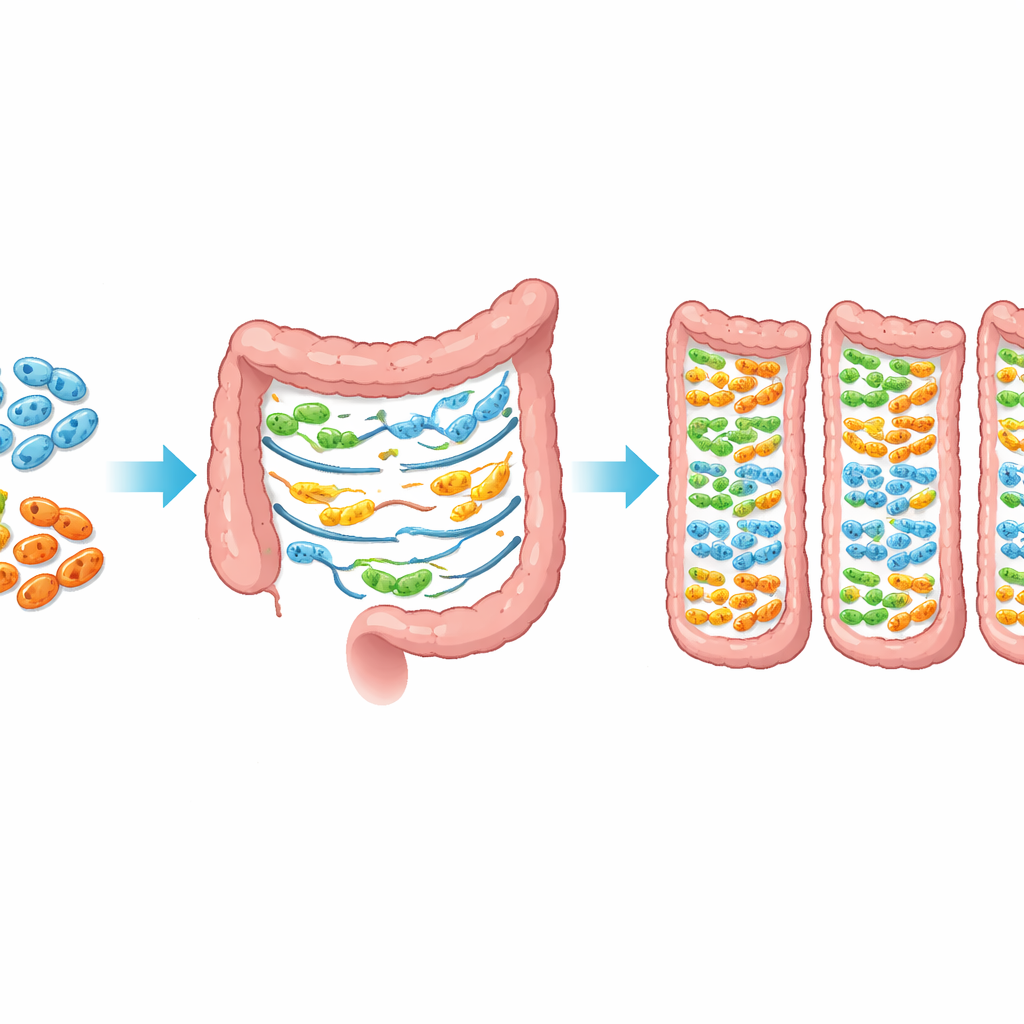
Similar patterns in mice and people
To check whether this uniformity was just a quirk of their first mouse experiment, the authors repeated key analyses in ordinary lab mice with their own natural microbiota and in healthy human volunteers who swallowed small sampling capsules that opened at different positions along the gut. In both cases, the message was the same: although the mix of species shifts from place to place, the mix of strains within a species, and the big evolutionary changes those strains undergo, are generally well mixed along the intestinal tract. Even over hours to days in humans, when strain frequencies did wobble, these swings tended to be short-lived rather than building up lasting spatial structure.
What this means for health and disease
For a non-specialist, the takeaway is that your gut’s microbial landscape is patchy in terms of which species live where, but much more uniform when it comes to the fine-grained genetic make-up within each species. This suggests that environmental differences along the gut—such as nutrients and oxygen—mostly sort microbes at the level of broad groups, not at the level of individual strains and mutations. It also points to rapid mixing as a key force: bacteria and their new adaptations are constantly being carried throughout the intestine. In healthy mammals, then, genetic diversity within gut bacteria seems to be a shared, whole-gut resource rather than a set of isolated local pockets. Understanding how this well-mixed background changes under stress or disease could be crucial for predicting when particular strains or mutations might tip the balance toward illness.
Citation: Wasney, M., Briscoe, L., Wolff, R. et al. Uniform bacterial genetic diversity along the gut. Nat Commun 17, 4100 (2026). https://doi.org/10.1038/s41467-026-70705-8
Keywords: gut microbiome, bacterial strains, genetic diversity, intestinal ecology, microbial evolution