Clear Sky Science · en
Recurring marine phosphorus spikes during major palaeozoic mass extinctions and climate change
Ancient seas and the mystery of dying oceans
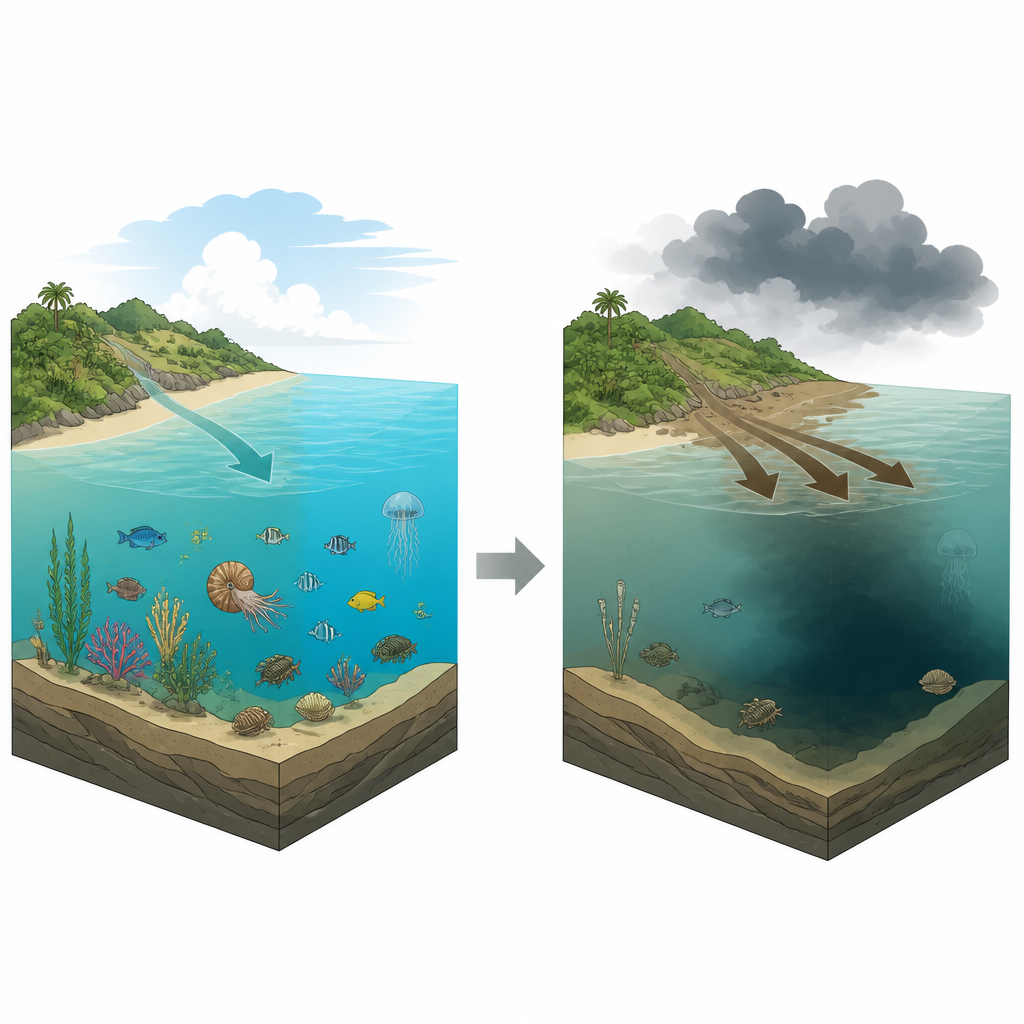
Long before dinosaurs, Earth’s oceans experienced huge die-offs that erased most marine species. Scientists have long suspected that sudden surges of the nutrient phosphorus helped drive these crises, but they lacked a direct way to test what really happened in seawater. This study develops and applies a chemical “time capsule” to ancient rocks, revealing brief but powerful phosphorus spikes that lined up with two of the earliest mass extinctions and with rapid swings in climate.
Clues hidden in ancient ocean mud and stone
The researchers focused on two mass extinctions in the early Paleozoic era: the Late Ordovician event about 445 million years ago and the Late Devonian event about 372 million years ago. Each wiped out around 80 percent of marine life and was tied to strong global cooling and changes in ocean oxygen. To probe the nutrient story, the team measured tiny amounts of phosphorus locked inside carbonate minerals, a signal called carbonate-associated phosphate, or CAP. Because seawater phosphorus is taken up into growing carbonate in proportion to its concentration, CAP acts as a chemical snapshot of nutrient levels at the time each rock layer formed.
Short nutrient bursts that reached across the globe
The team sampled seven rock sections spread across ancient continents, including sites in Canada, Estonia, South China, Western Australia, and Nevada. Despite differences in rock type and local conditions, the CAP records all showed the same pattern: modest background levels of phosphorus interrupted by sharp, short-lived spikes. During the Late Ordovician event, one clear phosphorus peak appeared just as the second and more severe extinction pulse began. During the Late Devonian event, two phosphorus peaks bracketed the main die-off interval. The consistency of these spikes across far-flung locations suggests they track changes in the global ocean rather than local quirks of sediment or later alteration.
Linking nutrients, oxygen loss, and global cooling
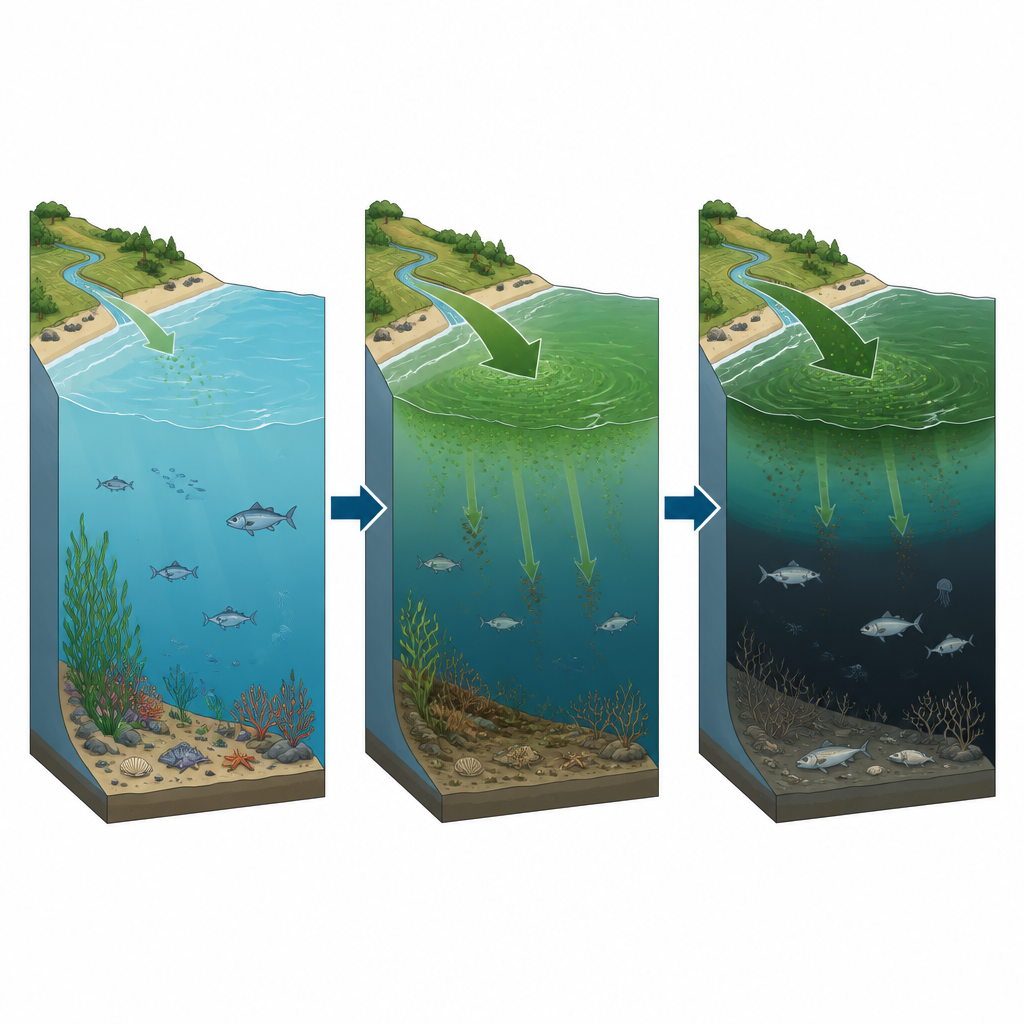
To understand what these phosphorus bursts meant for Earth’s systems, the scientists fed them into a computer model that simulates how nutrients, carbon, oxygen, and climate interact over millions of years. In the model, extra phosphorus entering the ocean fuels intense algal growth. When this organic matter sinks and decays, it consumes oxygen, expanding low-oxygen zones on the seafloor. At the same time, more organic material gets buried in sediments, which locks away carbon and gradually lowers carbon dioxide in the air. The results are more widespread ocean anoxia and global cooling of roughly a few degrees, matching independent evidence from uranium and oxygen isotopes and from organic-rich black shales in the rock record.
Different death blows in different ancient oceans
The timing of the phosphorus pulses provides a more nuanced picture of how these crises unfolded. In the Late Ordovician, the first extinction pulse occurred while phosphorus levels were still low, pointing to glacial cooling and falling sea level as the main early killers. The big phosphorus spike came later and lines up with signs of stronger oxygen loss and the second extinction pulse, when both bottom-dwelling and open-water creatures were hit hard. In the Late Devonian, by contrast, rising phosphorus and growing low-oxygen zones were already in motion during the first reef crisis and peaked just before the main extinction of reef builders, shelly animals, and free-swimming fishes. A second phosphorus surge followed, apparently prolonging poor conditions and slowing ecosystem recovery even without a fresh extinction peak.
Why this ancient story matters today
Overall, the study offers the first global, quantitative evidence that brief phosphorus surges repeatedly pushed ancient oceans toward oxygen loss, climate cooling, and ecological collapse. The results show that nutrients were powerful amplifiers rather than simple on/off switches, sometimes acting together with cooling and sea-level change, and sometimes setting the pace of recovery. By clarifying how sensitive marine life can be to relatively short-lived nutrient shocks, these ancient episodes provide a cautionary parallel for modern coastal dead zones and human-driven nutrient loading in today’s seas.
Citation: Dodd, M.S., Li, C., Zhang, Z. et al. Recurring marine phosphorus spikes during major palaeozoic mass extinctions and climate change. Nat Commun 17, 4481 (2026). https://doi.org/10.1038/s41467-026-70701-y
Keywords: phosphorus cycle, ocean anoxia, mass extinction, paleoceanography, global cooling