Clear Sky Science · en
Reversible crosslinking strategy for dynamic strain regulation in inverted perovskite solar cells
Why flexible solar materials can wear out too soon
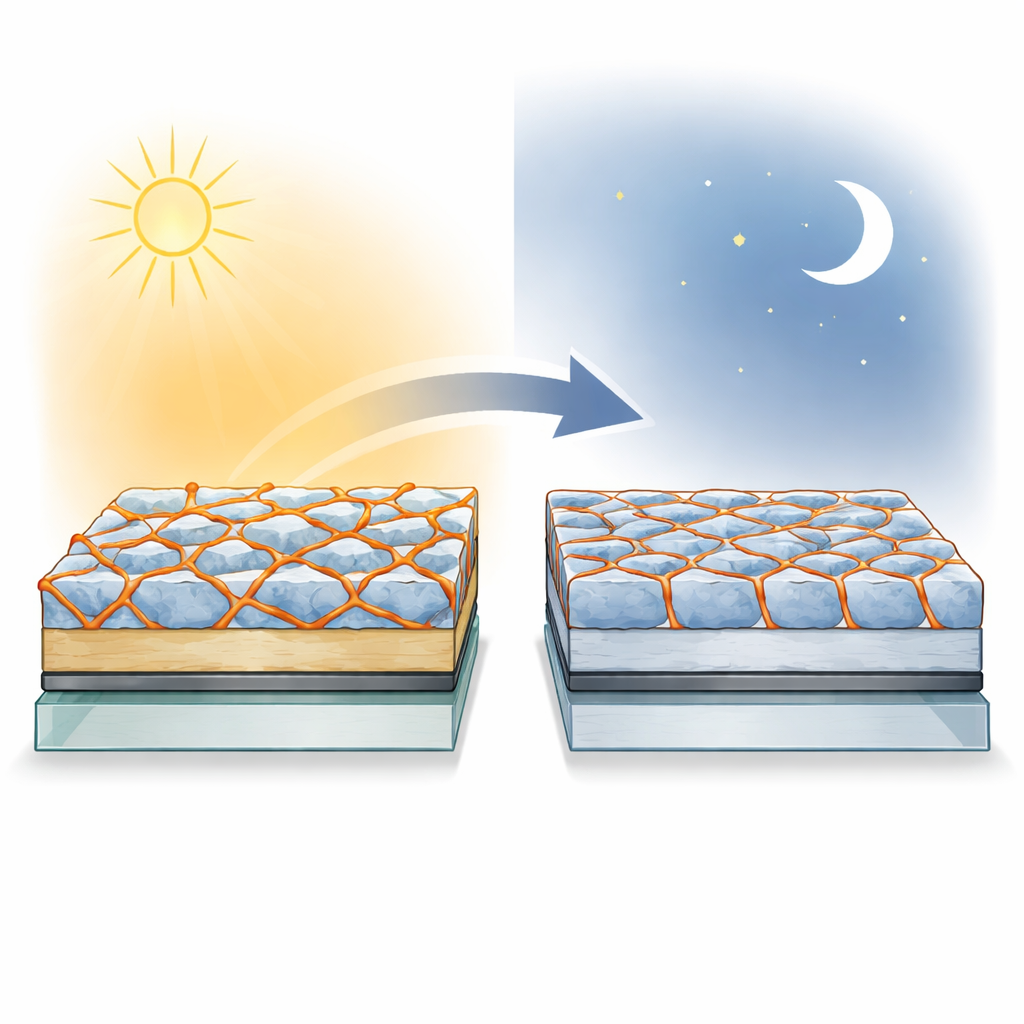
Solar panels made from perovskites promise high efficiency at low cost, but they face a subtle problem in everyday use: they repeatedly heat up in the sun and cool down at night. This daily breathing in and out makes their soft crystal structure stretch and shrink, gradually creating damage that lowers power output. The study in this article introduces a clever molecular "shock absorber" that lets perovskite solar cells cope with this constant motion and keep working efficiently for far longer than before.
A daily workout for a fragile crystal
Traditional silicon solar cells are quite rigid, but perovskites behave more like a stiff gel. Under sunlight the perovskite layer warms and expands; in the dark it cools and contracts. Over many day–night cycles, this constant straining produces tiny distortions, defects, and cracks inside the material. These imperfections act as traps for electric charges and open pathways for unwanted ion motion, both of which speed up performance loss. Past approaches tried to make the crystal tougher or to glue it to its surroundings, yet most were static fixes: they could resist expansion or contraction, but not both dynamically over thousands of cycles.
A smart additive that changes with temperature
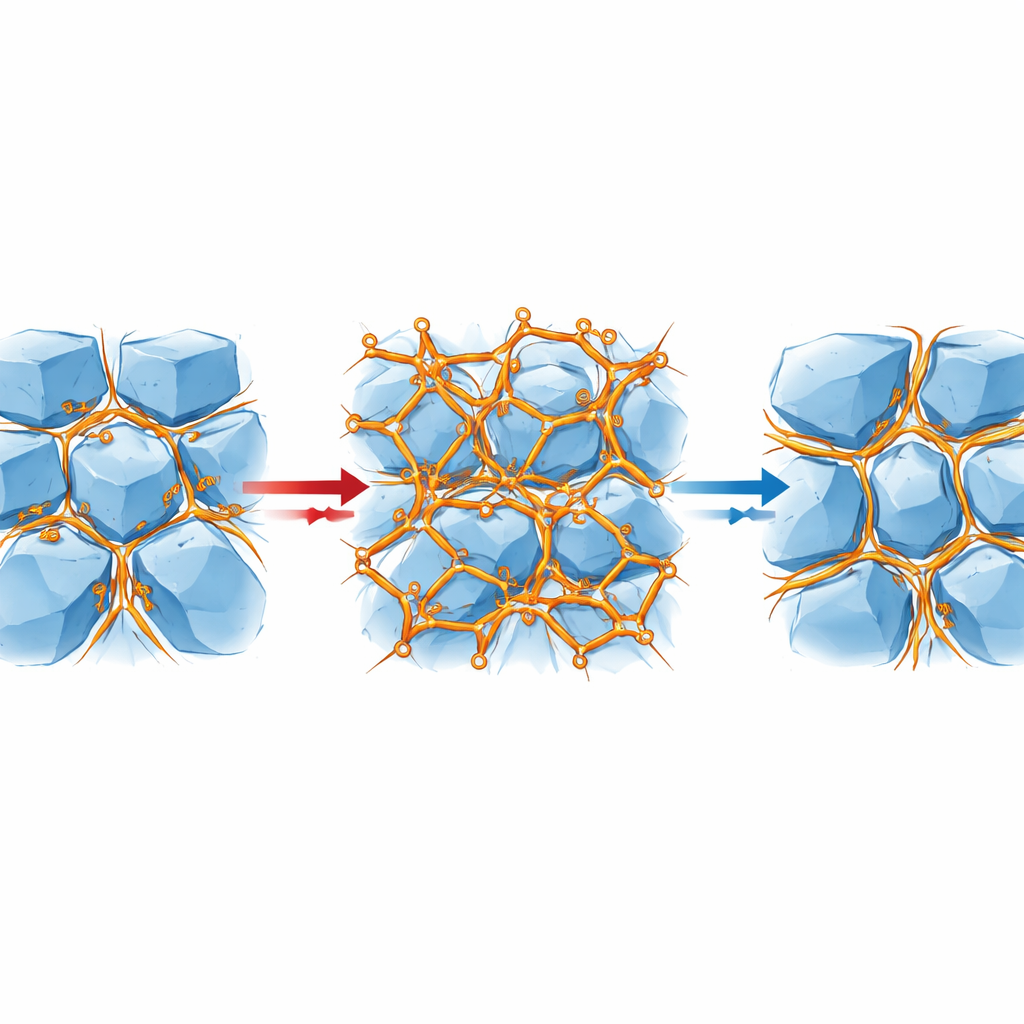
The researchers designed a small molecule called MTA that sits at the boundaries between perovskite grains, where strain tends to concentrate. MTA has two special abilities. First, it can join together into long chains during the normal heating step used to form the perovskite film, lightly stitching neighboring grains. Second, parts of the molecule form reversible links that respond to temperature. At higher temperatures, similar to daytime operation, these links open and connect chains into a robust three-dimensional network that braces the perovskite and limits how much it can expand. When the device cools to room temperature, those links close again and the network relaxes back into more flexible chains, allowing the crystal lattice to recover instead of locking in stress.
Less hidden damage during cycling
To see whether this reversible stitching truly eases the daily stress, the team tracked how the perovskite lattice changed as they switched between hot, illuminated conditions and cooler, dark ones. Films without MTA showed a steady build-up of distortion after only a few cycles, with uneven atomic spacing and bent crystal lines. In contrast, films with MTA held their spacing uniformly, indicating that strain was released each night. Electrical tests on working solar cells told the same story: standard devices developed more and deeper trap states, slower charge extraction, and faster ion migration as cycling continued. Cells containing MTA maintained almost unchanged lifetimes for charge carriers and showed little change in trap density or ion motion, confirming that the dynamic network was protecting the material from internal fatigue.
Better performance and much longer life
Importantly, this protection does not come at the expense of power output. Inverted perovskite solar cells built with MTA reached high efficiencies around 26.5%, among the best for this class of devices. More striking is their endurance: under a demanding test that alternated 12 hours of hot light exposure with 12 hours in the dark—mimicking real outdoor use—the improved cells kept about 95.7% of their initial efficiency after 1,800 hours. By comparison, similar cells without the additive lost roughly half their output in less than a third of that time, partly because stray ions migrated and reacted with the metal electrode as strain-induced defects accumulated.
Turning solar strain into an advantage
This work shows that instead of fighting thermal motion with rigid fixes, it can be smarter to build in controlled flexibility. The MTA molecules act like tiny reversible springs that stiffen during the hot part of the day and soften at night, preventing damage while letting the perovskite reset itself. For a lay reader, the key message is that clever molecular design can turn a weakness—the softness and thermal sensitivity of perovskites—into a managed behavior, pushing these promising solar cells closer to the stability needed for real-world deployment.
Citation: Li, W., Feng, B., Cui, Z. et al. Reversible crosslinking strategy for dynamic strain regulation in inverted perovskite solar cells. Nat Commun 17, 4049 (2026). https://doi.org/10.1038/s41467-026-70697-5
Keywords: perovskite solar cells, material stability, dynamic polymers, strain engineering, renewable energy