Clear Sky Science · en
Coenzyme-functionalized photo-redox catalysis for low-energy click labeling
Lighting Up Biology with Gentle Green Light
Many modern biomedical tools rely on shining light into cells to control or map what proteins are doing. The problem is that most current methods need high‑energy blue or ultraviolet light, which can damage delicate biological molecules and trigger unwanted side reactions. This paper describes a new way to use lower‑energy green light, together with a vitamin‑based helper, to label proteins quickly and precisely. The work could make it easier to study how proteins interact in living systems and to build highly targeted diagnostics with far less collateral damage.
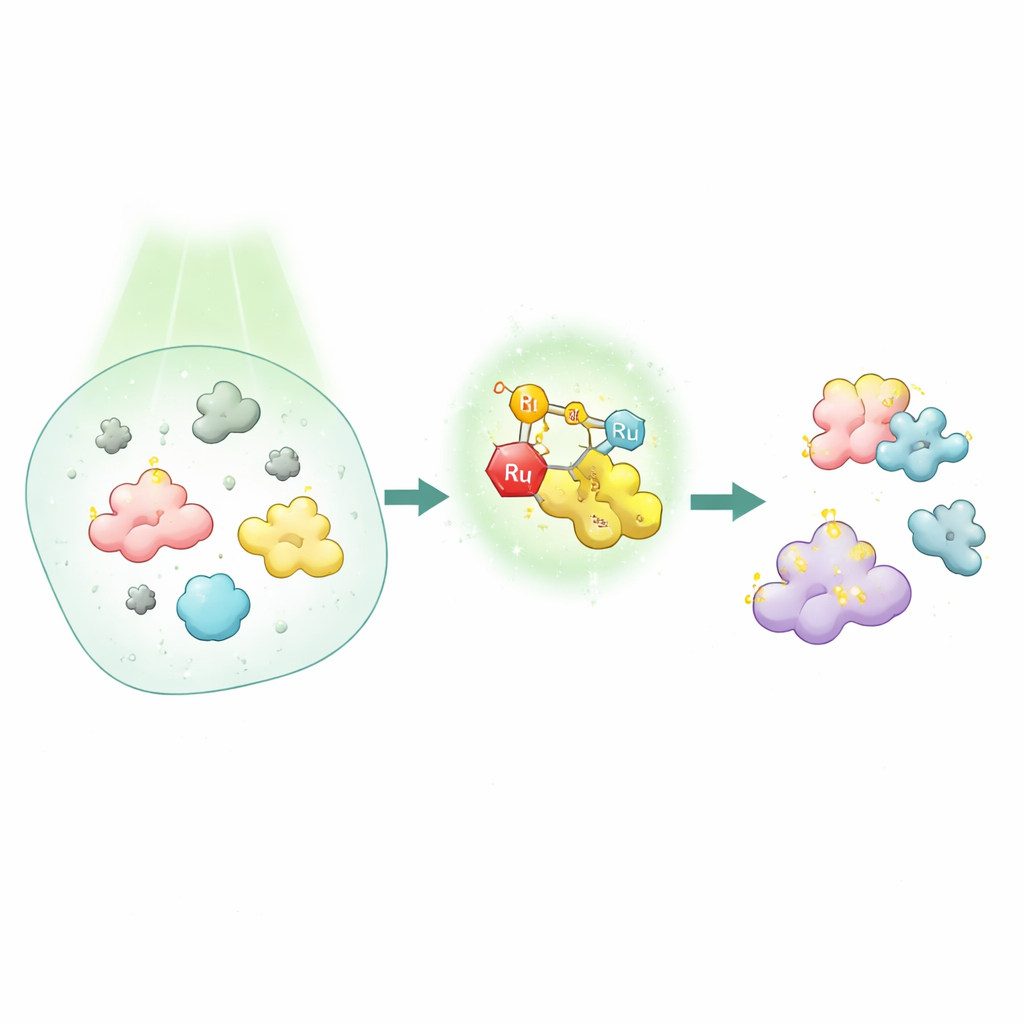
Why Softer Light Matters
Light‑driven chemistry has become a powerful tool in biology because it can be turned on and off in specific places and at specific times. But high‑energy light, which is good at driving tough chemical reactions, is also harsh on cells. It can create many different reactive species that attack a wide range of targets, including DNA and sensitive amino acids in proteins. Lower‑energy green light is gentler and penetrates tissue better, but it usually cannot push electrons hard enough to start the key chemical steps needed for labeling. The central challenge addressed in this study is how to design a light‑absorbing catalyst that soaks up green light while still having the “electrical power” to activate very specific chemical partners attached to proteins.
Building a Smarter Light-Activated Catalyst
The researchers designed a family of ruthenium‑based molecules that act as tiny solar‑powered switches. By chemically “charging up” the surrounding ligands—rings that hold the metal in place—they made the complexes both more eager to accept electrons and able to absorb green light. One version of the complex, when placed in water, spontaneously converts into a new form that carries a built‑in site for transferring protons (hydrogen atoms). When this system is exposed to green light, it can strongly oxidize phenol‑containing molecules, the same type of building blocks that plants use to form lignans in nature. In the presence of oxygen and a coenzyme related to vitamin B2 (riboflavin), the complex undergoes further transformation into a third, carbonyl‑containing form that becomes the true workhorse catalyst in the reaction cycle.
Borrowing a Trick from Nature’s Coenzymes
In living organisms, coenzymes like riboflavin help shuttle electrons and protons during photosynthesis and many other reactions. The authors harness this natural helper role by pairing their ruthenium complex with a modified riboflavin derivative. Under green light, the coenzyme participates in a proton‑coupled electron transfer sequence, in which electron and proton motion are tightly linked. This sequence allows the catalyst to move charge internally between its ligands and to recover its active form after each cycle, all while using low‑energy photons. The net effect is a smooth flow of electrons from carefully chosen phenol partners to oxygen, generating highly controlled radical intermediates that couple to form “click‑like” neolignan linkers without over‑oxidizing the surrounding biomolecules.
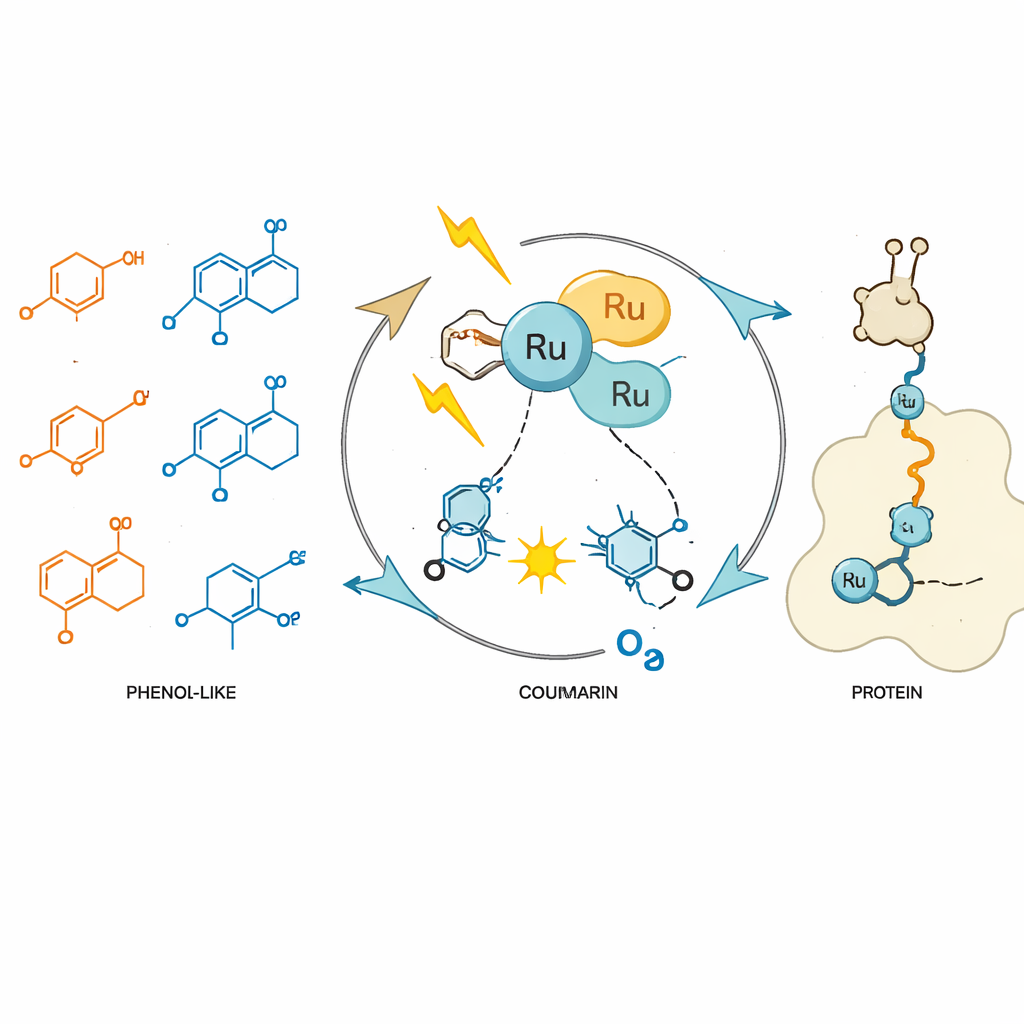
Clicking Molecules onto Proteins with Precision
To turn this chemistry into a practical labeling tool, the team designed two small phenolic partners. One is first attached to specific lysine residues on proteins using standard NHS chemistry, serving as a “handle.” The second is a coumarin‑based phenol that, under green light in the presence of the ruthenium–coenzyme catalyst, cross‑couples with the attached handle to form a rigid neolignan bridge. This reaction proceeds within seconds in serum‑like conditions and in cell culture media, delivering very high yields. Tests with amino acids showed that other sensitive residues such as tyrosine, tryptophan, histidine and cysteine are largely untouched, underscoring the selectivity. The authors further demonstrate that the scheme can be extended to biotin‑tagged versions of the coumarin partner, enabling strong streptavidin‑based detection of labeled bovine serum albumin and precise mapping of modification sites by mass spectrometry.
What This Means for Future Biological Tools
Overall, the study shows that by cleverly combining a metal complex with a natural coenzyme, it is possible to run demanding labeling reactions using gentle green light rather than damaging high‑energy light. The key innovation is a catalyst that evolves in situ and uses tightly synchronized electron and proton motions to reach very high oxidizing power while staying compatible with complex biological fluids. For non‑specialists, the takeaway is that this platform offers a fast, accurate way to “snap” reporter groups or affinity tags onto chosen spots on proteins in environments close to those in the body, with minimal side reactions. This opens the door to safer, more precise mapping of protein interactions in cells and could help in the development of next‑generation imaging agents and targeted therapeutics.
Citation: Xiao, K., Zhang, NY., Zhou, KT. et al. Coenzyme-functionalized photo-redox catalysis for low-energy click labeling. Nat Commun 17, 3925 (2026). https://doi.org/10.1038/s41467-026-70696-6
Keywords: photoredox catalysis, protein labeling, green light, coenzyme riboflavin, click chemistry