Clear Sky Science · en
Sustained hydrogen peroxide production via MXene-functionalized supramolecular docking
Turning Sunlight, Air, and Water into a Useful Chemical
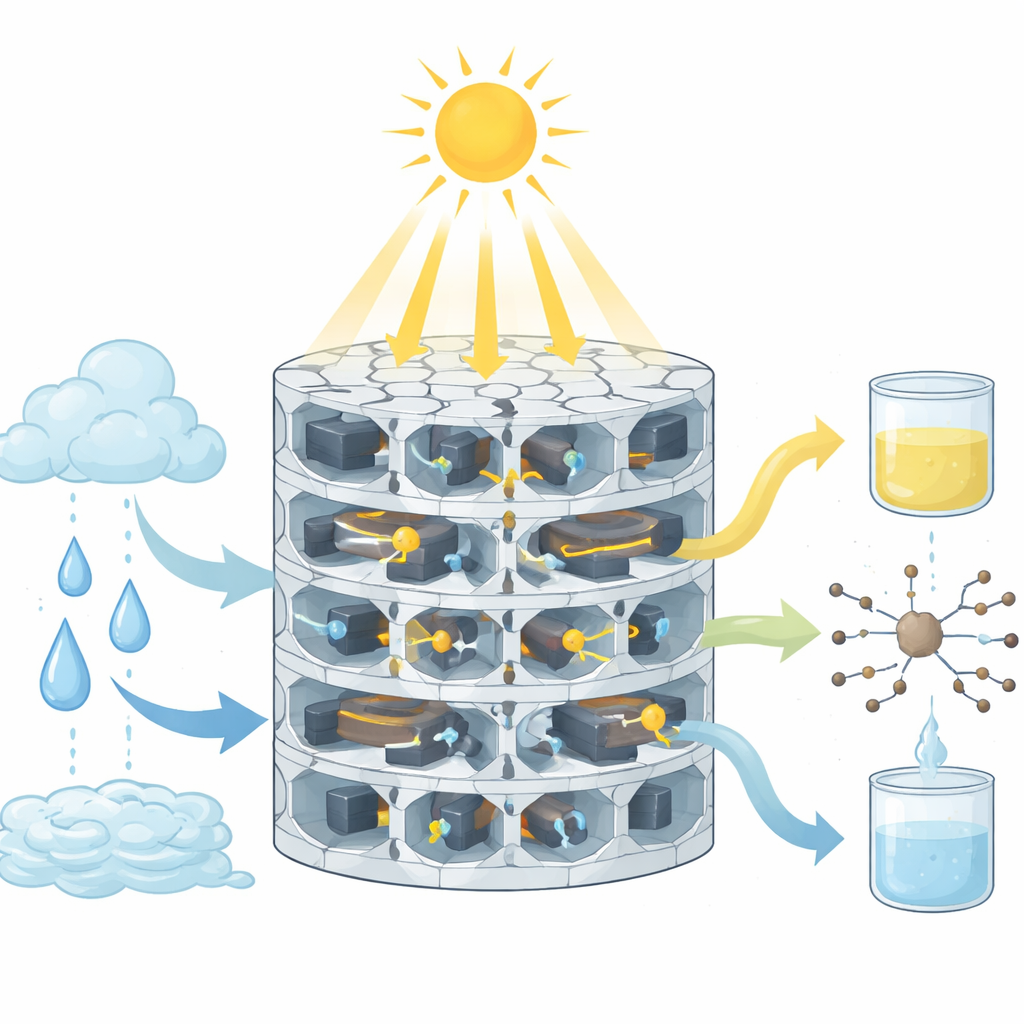
Hydrogen peroxide is a familiar ingredient in medicine cabinets and cleaning products, but it is also a powerful tool for disinfecting water, treating pollution, and even storing energy as a liquid fuel. Today, most hydrogen peroxide is made in large factories using an energy‑hungry, multi‑step process that creates a lot of waste. This study explores a very different approach: using sunlight, ordinary air, and water to make hydrogen peroxide continuously in a simple reactor, potentially close to where it is needed.
A New Way to Build a Light-Driven Factory
At the heart of this work is a carefully engineered solid material that behaves like a tiny chemical factory. The researchers combined two components: an ordered organic framework full of uniform pores, and thin metallic layers known as MXenes that heat up and move charges efficiently when light hits them. These pieces are linked together by a web of hydrogen bonds and stacked in an orderly fashion, creating a supramolecular structure with many channels and docking spots where gas and water molecules can temporarily settle. This architecture is inspired by how natural enzymes capture oxygen and water in precisely shaped pockets to drive reactions in living cells.
Guiding Oxygen to the Right Spots
To steer oxygen molecules exactly where they are most useful, the team subtly altered the framework’s chemistry. They replaced certain carbon atoms with more electronegative bromine atoms, which reshapes how electrons are distributed across the aromatic rings that line the pores. Computer simulations and spectroscopic measurements show that this tuning creates preferred docking sites where oxygen is more strongly attracted than nitrogen from the air. At the same time, the stacked layers and hydrogen-bonded bridges form straight, low‑resistance pathways for electrical charges to move, allowing light‑excited electrons and holes to quickly travel to these active regions instead of wasting their energy as heat or light.
Using More of the Sun’s Light and Heat
The MXene sheets play a second crucial role: they absorb not only visible light but also near‑infrared wavelengths that make up more than half of the sun’s energy. When illuminated, these metallic layers generate hot electrons and convert light into gentle heating within the framework. Measurements with thermal microscopes and surface probes reveal that the catalyst warms up by just a few tens of degrees, boosting the speed of the chemical steps without overheating the material or breaking down the hydrogen peroxide that is being formed. This combined light and heat effect lets the system use a broader slice of the solar spectrum than many previous photocatalysts.
Two Reaction Paths Working Together
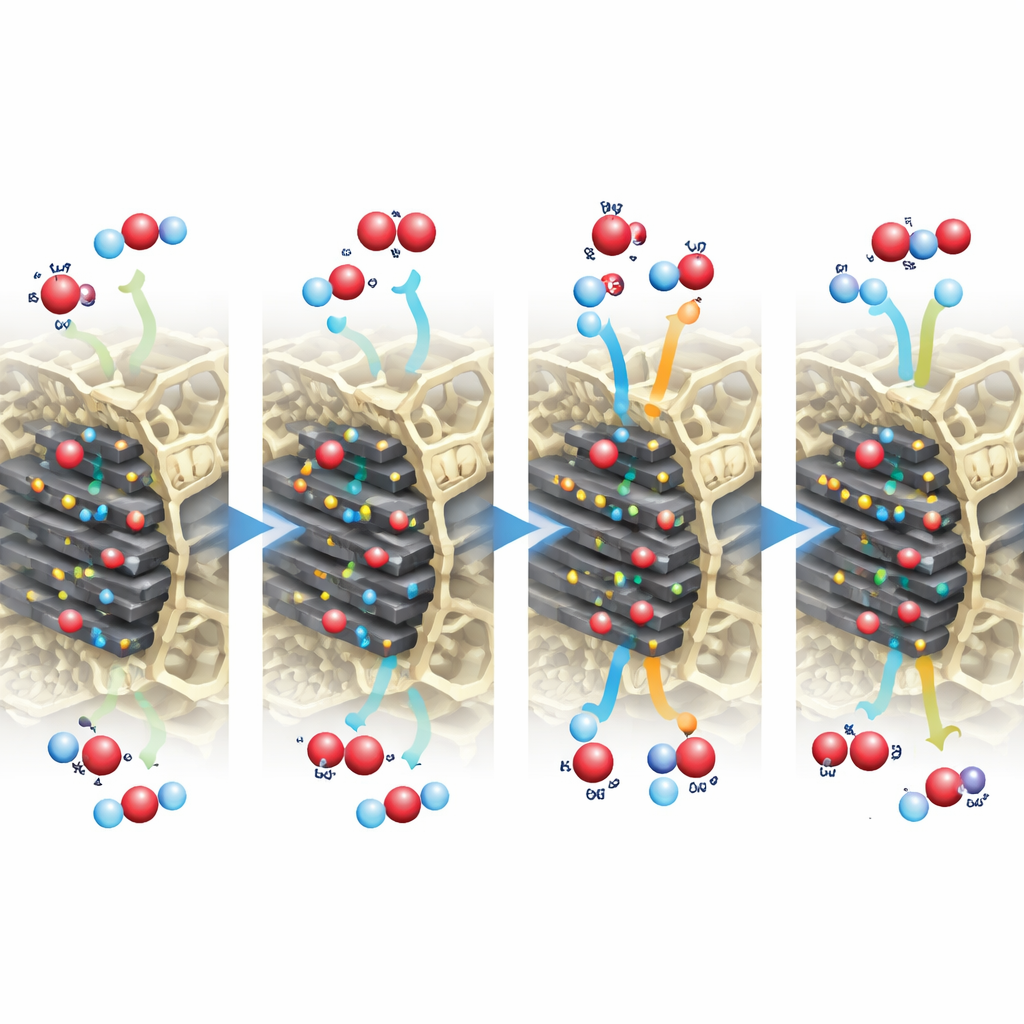
Once oxygen and water are docked inside the pores, the material drives two complementary reaction routes. On one side, oxygen is partially reduced: it picks up electrons and protons to form hydrogen peroxide through short‑lived intermediates that the team detected using magnetic resonance and infrared techniques. On the other side, water is oxidized: it donates electrons and releases oxygen gas. That newly formed oxygen can be captured again by nearby sites, feeding back into the cycle. Calculations of reaction energies, together with electrochemical tests, show that the engineered aromatic sites in the framework lower the barriers for both routes, allowing them to proceed efficiently under mild conditions without extra chemicals, gas bubbling, or pH adjustment.
From Lab Demonstration to Real-World Use
Because the framework is robust and the MXene layers are stabilized by their molecular surroundings, the catalyst keeps working for a remarkably long time. In a flowing reactor, the system produced hydrogen peroxide steadily for more than 1,000 hours, far outlasting most previous designs. The output is a dilute solution, at levels appropriate for on‑site applications like water disinfection, food preservation, and small‑scale green chemistry, avoiding the need to ship and concentrate hazardous oxidants. Tests in fresh water, simulated seawater, and real seawater all showed strong performance, and the hydrogen peroxide generated in place was able to break down common dye and phenolic pollutants efficiently.
Why This Matters for Everyday Life
This study demonstrates that by carefully arranging molecular building blocks and metallic units, it is possible to turn simple sunlight, air, and water into a steady stream of hydrogen peroxide without large plants or harsh operating conditions. For non‑specialists, the key outcome is a blueprint for compact, solar‑driven units that could one day provide safer cleaning and disinfection, local water treatment, and low‑carbon chemical production in many different settings. Instead of a centralized, energy‑intensive industry, hydrogen peroxide could be made where and when it is needed, using a material that mimics the elegance and efficiency of natural enzymes.
Citation: Sun, J., Zhang, Y., Lu, W. et al. Sustained hydrogen peroxide production via MXene-functionalized supramolecular docking. Nat Commun 17, 3993 (2026). https://doi.org/10.1038/s41467-026-70693-9
Keywords: hydrogen peroxide, photocatalysis, covalent organic frameworks, MXene, solar chemistry