Clear Sky Science · en
Theoretical morphospace reveals mixed optimisation of the avian wing planform for flight style
Why Bird Wing Shape Still Matters
From hovering hummingbirds to soaring albatrosses, birds showcase an astonishing variety of ways to stay aloft. But how much of this variety is dictated by the exact outline of the wing, and how much by other factors such as muscle power or inherited family traits? This study tackles that puzzle by building a virtual map of all possible bird wing shapes and asking which shapes would, in theory, fly best for different lifestyles.
Exploring a Map of Possible Wings
The researchers assembled images of 1,139 modern bird wings spread to their full extent, spanning 36 of the 41 living bird orders. They traced each wing’s outer edge and used a mathematical method to describe its outline with a small set of shape parameters. These parameters were then varied systematically to generate a “theoretical morphospace” – a grid of hundreds of possible wing outlines that not only covered all shapes seen in real birds but also pushed beyond them into forms that do not currently exist in nature. 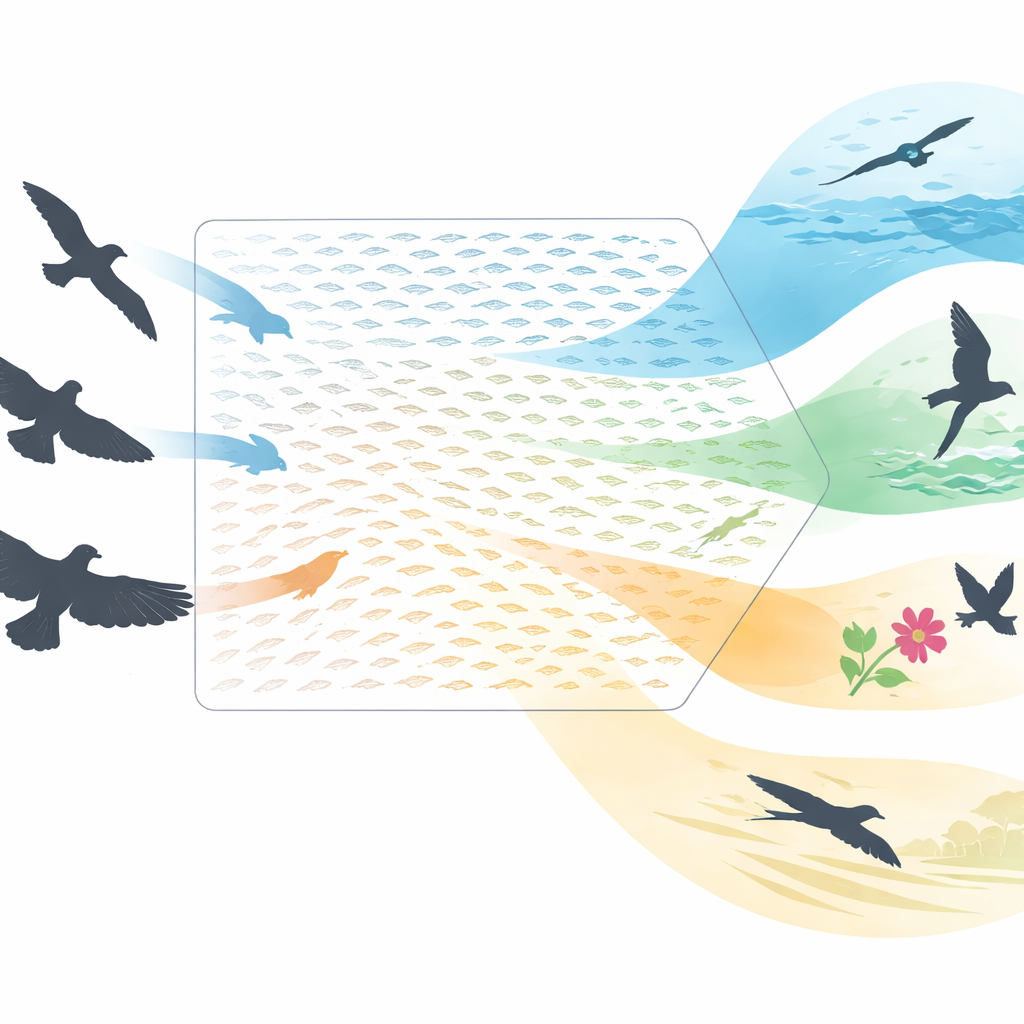
Testing How Well Shapes Should Fly
On this theoretical grid, the authors calculated how each wing outline should perform under simple, widely used measures of flight. They examined four key traits: how long and narrow the wing is (linked to energy-efficient travel), how the wing’s area is distributed from base to tip (linked to tight turning), how easily the wing can shift into an unstable state needed for sudden maneuvers (linked to agility), and how pointed or rounded the tip is (linked to the balance between lift and drag). They also combined these traits to represent seven broad flight niches such as marine soaring, long-distance migration, hovering, diving, and rapid take-off. The result was a set of smooth “performance landscapes” showing where, in the space of all possible wings, theory predicts the best shapes for each flying style should lie.
Where Real Birds Land in Shape Space
Next, the real bird wings were plotted back onto these performance maps. For some demanding flight modes, such as hovering, wing-assisted diving, and aerial hunting, many species cluster very close to the predicted sweet spots. Hummingbirds, penguins, swifts and other agile flyers turn out to have wing shapes that strongly resemble the theoretical optima for their tasks, often matching more than 80–90 percent of the ideal. In contrast, birds that rely on low-energy gliding over long distances, such as albatrosses and migratory shorebirds, come surprisingly short of the shapes that would minimize flight costs on paper. Even the longest-winged living albatrosses fall well shy of the theoretical best shapes, which appear to push the limits of what a bird can manage while still being able to take off, land and reproduce.
Why Many Birds Are Not Perfect Fliers
Perhaps the most unexpected finding is that a huge number of species, especially perching birds such as songbirds and many land birds, are clearly not optimized for any one of the tested flight measures. Instead they occupy a broad plateau of “good enough” shapes, particularly for basic maneuverability. The study finds that wing shape shows only a weak imprint of ancestry overall: related groups often evolve similar outlines because they face similar flight demands, not simply because they share history. Yet for many everyday flyers, other factors – including how they flap, how their bodies are built, and non-flight roles for wings such as display – appear to matter as much or more than precise outline. 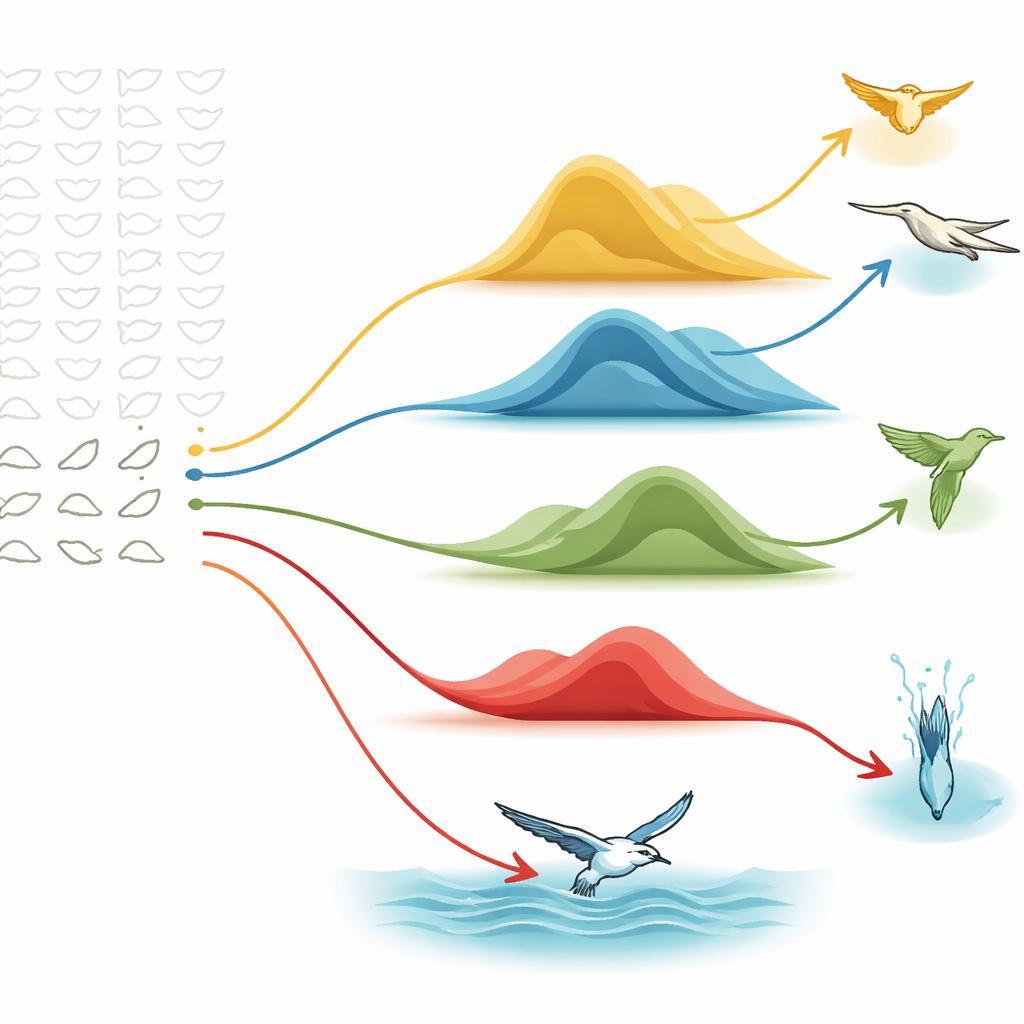
What This Means for Understanding Bird Flight
In plain terms, this work shows that wing shape still plays a vital role in how birds fly, but not in a simple one-size-fits-all way. Extreme specialists such as hoverers, divers and aerial hunters are pushed by physics toward very particular wing outlines, and many have evolved shapes close to those theoretical ideals. By contrast, gliders and generalists often fall far from perfection because they must juggle flying with other demands like take-off, landing and life on the ground. Overall, the study argues that agility-related demands are a major force shaping bird wings, while basic maneuverability sets more of a minimum standard than a pinnacle. Wing shape is thus one important piece – but not the only piece – of the complex puzzle that determines how birds move through the air.
Citation: Walters, B., Liu, Y., Rayfield, E.J. et al. Theoretical morphospace reveals mixed optimisation of the avian wing planform for flight style. Nat Commun 17, 3902 (2026). https://doi.org/10.1038/s41467-026-70692-w
Keywords: bird wings, flight performance, wing shape, aerodynamics, evolution