Clear Sky Science · en
A hydro-topological strategy enables self-regulating biofilms for sustainable wastewater treatment
Cleaner Water for Growing Cities
As cities grow and water supplies tighten, getting more cleaning power out of wastewater treatment plants has become a global priority. A widely used technology, the moving bed biofilm reactor, relies on tiny plastic pieces that host communities of microbes which remove pollutants. But over time these carriers tend to clog with excessive growth, wasting energy and limiting how much water can be treated. This paper presents a new carrier design that lets the biofilm effectively "groom itself," keeping treatment fast and stable even under cold and demanding conditions.
Why Today’s Microbe Filters Get Stuck
Most existing plastic carriers follow a simple logic: more surface area means more microbes, and more microbes should mean better cleaning. In practice, packing in more sheltered space often leads to uncontrolled growth. Thick, clogged biofilms slow the movement of water and oxygen, favor less helpful species, and increase the energy needed to keep carriers moving. The authors show that this long-standing design focus has unintentionally undermined the promise of these systems for sustainable and low-carbon water treatment.
A New Shape That Guides Microbial Growth
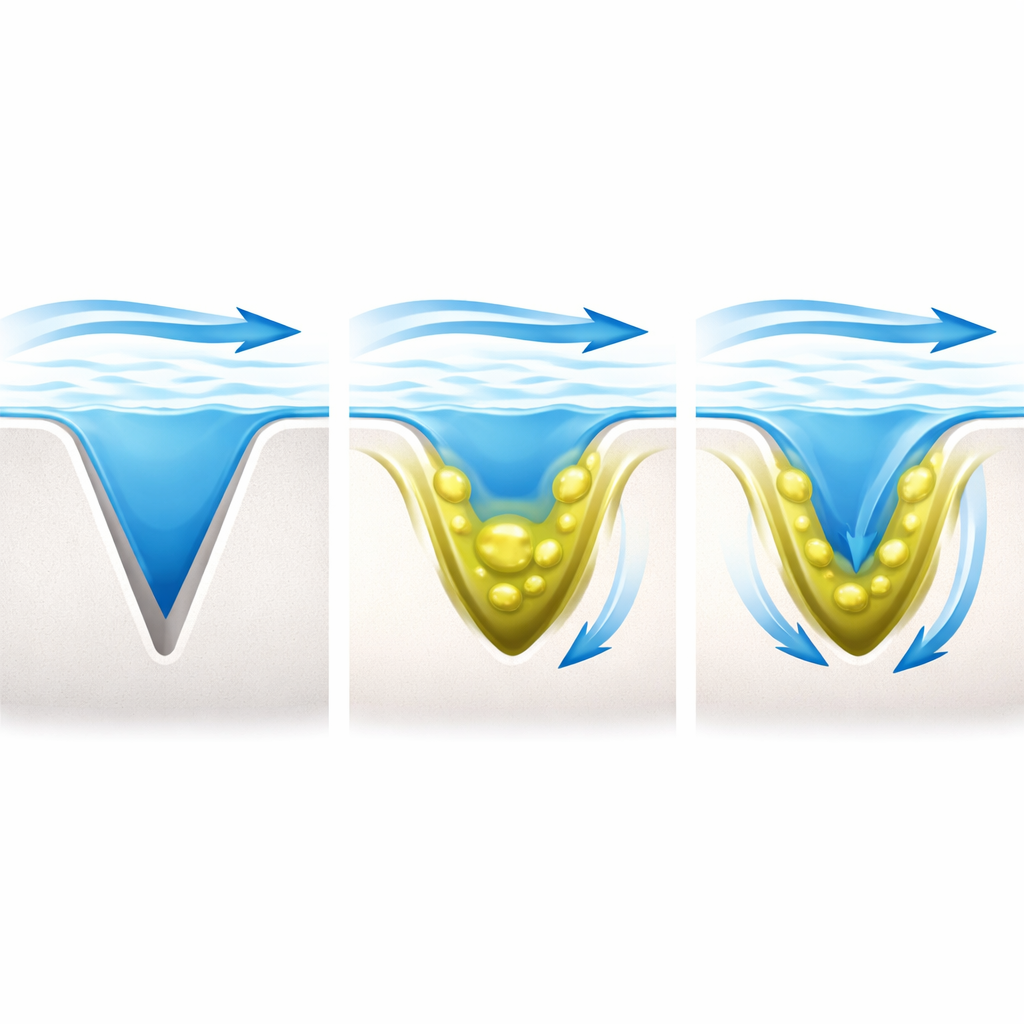
To escape the clogging trap, the researchers created a thin square plastic carrier etched with thousands of small V-shaped grooves. This layout is not just extra surface; it is engineered to manage how water forces act on the biofilm. The open V-grooves encourage the film to grow outward into the flowing water, while their depth limits how thick the biofilm can become. The sloping sides protect the core biofilm from being stripped away, and the repeating pattern of grooves creates many tiny, stable habitats for microbial communities. Together, these features form what the authors call a “hydro-topological” strategy: using shape and flow to keep the biofilm at an ideal thickness and activity level.

Proving Stable Cleaning in the Real World
The team tested their V-carrier in a laboratory-scale treatment plant that handled real municipal wastewater continuously for more than 500 days. Throughout start-up, seasonal warming, and a cold spell down to about 9 °C, the system removed ammonium and other nitrogen compounds to very low levels with little performance drift. Importantly, this high treatment level was maintained while the biofilm stayed relatively thin and uniform, around half a millimeter, in both oxygen-rich and low-oxygen zones. Compared with conventional tube-shaped carriers, the V-carrier supported a much higher cleaning rate per gram of biomass, even though it contained substantially less biomass overall.
How Water Flow Helps Microbes Help Themselves
Detailed comparisons with several common carrier shapes revealed why the V-grooves worked so well. In closed or narrow tubes, biofilms tend to grow inward, gradually choking flow; hydraulic shear—the scouring force of moving water—drops, and inorganic deposits build up. In contrast, the open V-grooves keep the biofilm surface directly exposed to flowing water. This constant but moderated shear gently removes excess outer layers and waste products while leaving a productive inner layer behind. Microscopy showed internal voids and zones of cell death inside the film, evidence of ongoing self-renewal and material export. At the same time, the microbial community flexibly restructured with temperature, swapping in more cold-tolerant nitrifying species as the reactor cooled, yet retaining overall function.
Rethinking “More Is Better” in Wastewater Treatment
By carefully pairing geometry with water flow, the V-carrier turns the plastic support from a passive surface into an active regulator of the microbial ecosystem. The reactor achieved over three times the nitrification rate of a standard carrier while holding roughly 40% less biomass, and it did so without the chronic clogging and extra energy demand that plague many plants. To a lay reader, the key message is that smarter shapes and controlled forces can make microbe-based treatment both cleaner and more efficient, helping cities meet strict discharge limits and climate goals without endlessly building bigger or more energy-hungry facilities.
Citation: Fang, Y., Zhang, Z., Xue, B. et al. A hydro-topological strategy enables self-regulating biofilms for sustainable wastewater treatment. Nat Commun 17, 3878 (2026). https://doi.org/10.1038/s41467-026-70682-y
Keywords: wastewater treatment, biofilms, moving bed biofilm reactor, nitrogen removal, water sustainability