Clear Sky Science · en
Experimental mechanician for plate lattice metamaterial discovery
Why smarter materials matter
From running shoes to aircraft, engineers are always hunting for materials that are both strong and light. A newer class of “lattice” materials built from repeating 3D patterns can outperform solid metal or plastic, but tuning their intricate geometry has usually meant slow trial and error. This article introduces an automated lab system that behaves like a tireless engineer: it designs, 3D‑prints, tests, and learns from hundreds of tiny lattices on its own to discover structures that carry heavy loads while staying feather‑light.
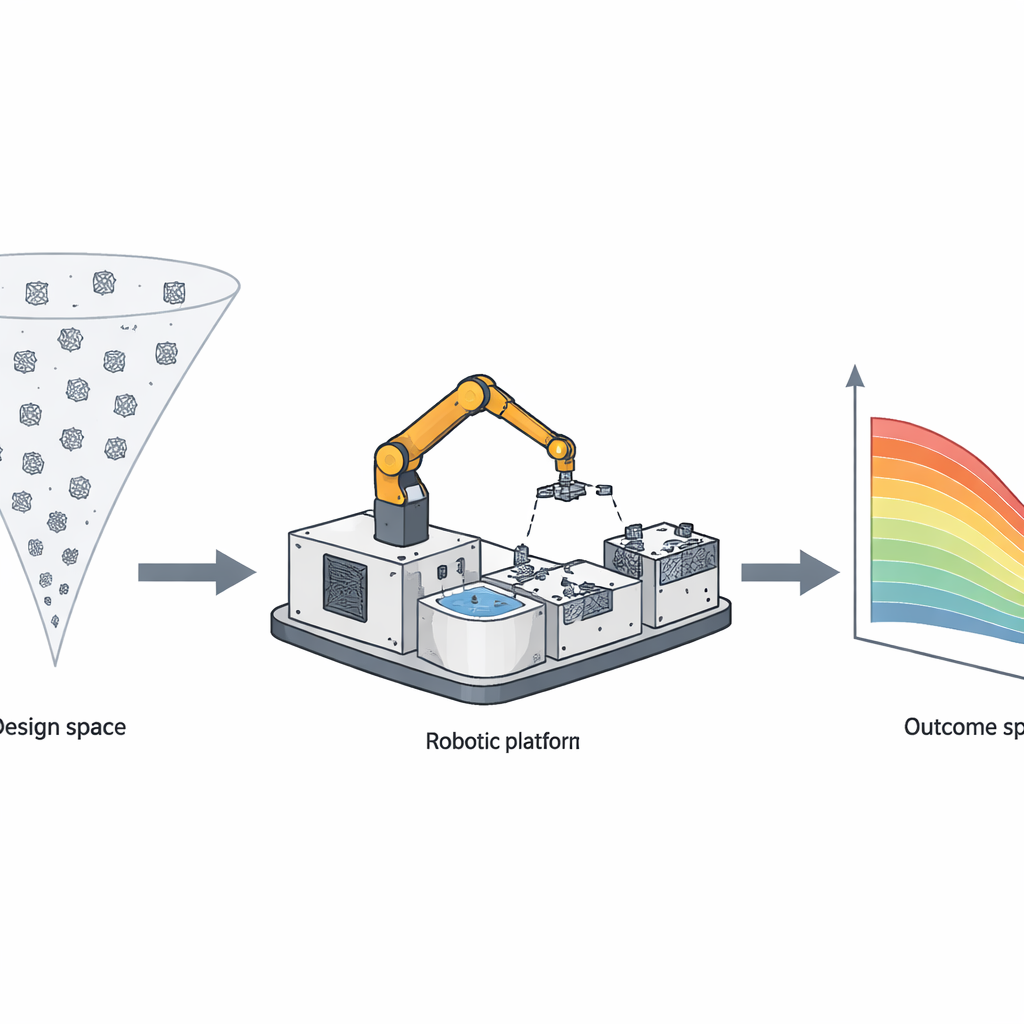
A robot that runs its own experiments
The heart of the work is a system the authors call an experimental mechanician, or ExMech. It occupies a dedicated lab space and links nine workstations: several 3D printers, cleaning and drying stations, weighing and testing machines, and a robotic arm that shuttles samples between them. Software written in Python coordinates everything. In each cycle, the system automatically designs digital models of lattice samples, prints them in photosensitive resin, cleans and dries them, weighs them to determine how porous they are, and then crushes and shears them in dedicated testers to measure how much force they can withstand before failing.
A learning loop instead of blind trial and error
What makes ExMech more than a production line is the way it thinks about what to test next. After each batch of measurements, a machine‑learning model called Gaussian Process Regression is updated to predict how design choices will affect three goals at once: compressive strength, shear strength, and lightness. An “active learning” procedure then searches through thousands of possible combinations of plate thickness, hole size, and strut diameter and chooses the ones most likely to improve the balance among these goals. This approach focuses experiments near the best trade‑offs, rather than spreading effort across poor designs.
Finding the best trade‑offs
The team applies ExMech to a family of so‑called plate–truss hybrid lattices, which combine solid plates with slender rods. These hybrids can, in theory, surpass traditional rod‑only lattices in strength for the same weight, but the design space is huge. Instead of the more than 55,000 mechanical tests that a fine grid search would require, ExMech homes in on the best “Pareto front” of solutions in only 150 tests—about a 370‑fold reduction in workload. Along this front, one cannot improve any of the three goals without sacrificing at least one other. Within this set, some designs raise both compressive and shear strength by about 15% over the starting designs without adding weight; others more than double both strengths while increasing weight by only about 13%.
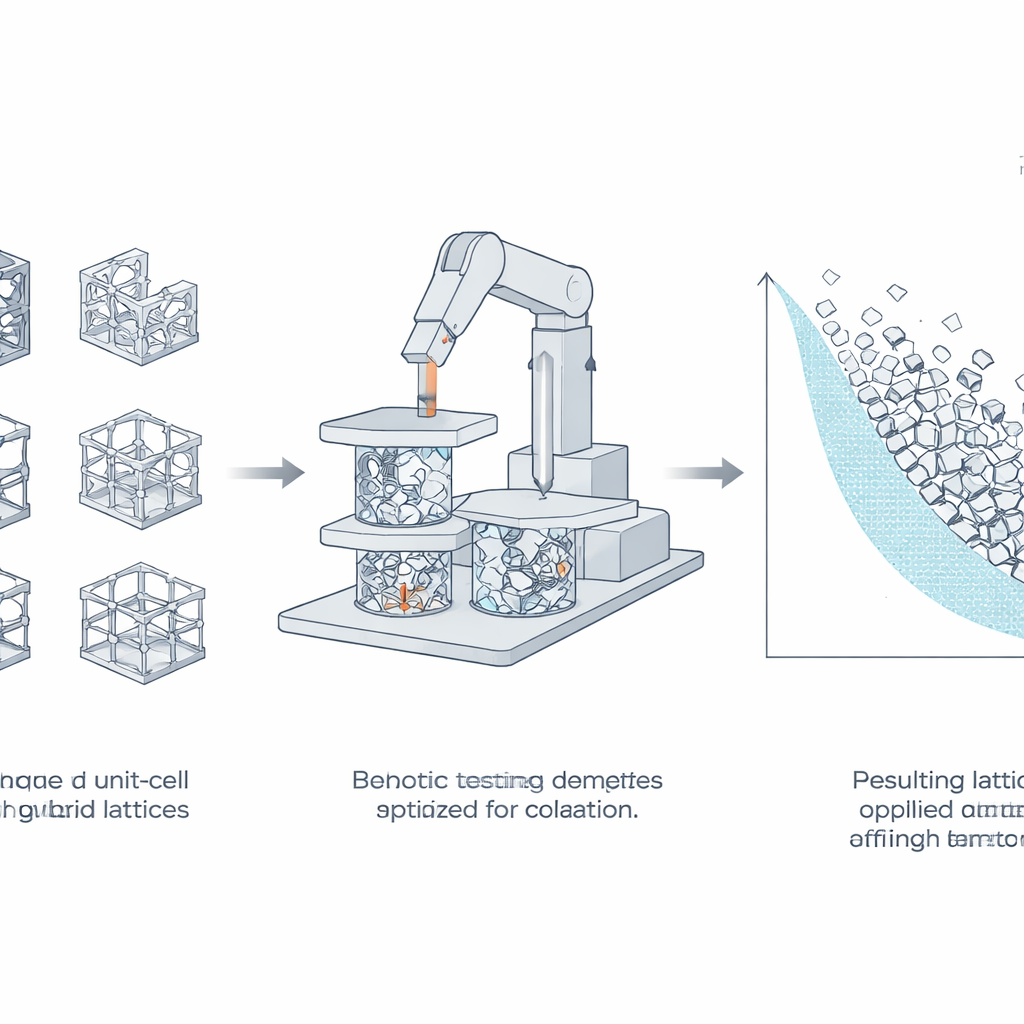
Peeking inside how the lattices work
Because the system records every variable and outcome, the researchers can dissect why certain lattices perform well. They use a technique called SHAP, widely used in explainable AI, to gauge how strongly each geometric variable influences each property. The analysis shows that plate thickness and strut diameter generally boost strength, while larger holes reduce strength but lighten the material. However, the relationships are strongly nonlinear: similar hole sizes can have very different effects depending on plate and strut dimensions. Mechanical tests and video observations reveal that low‑density lattices tend to fail by gentle buckling and gradual collapse, while denser ones fail more abruptly by brittle fracture. The team identifies a key “strut‑plate synergy”: rods brace the plates against sideways spreading, and plates help engage more rods in carrying load, so performance drops sharply if either element is made too weak.
From lab samples to real‑world soles
To show practical impact, the authors use two of the discovered lattices to build 3D‑printed shoe midsoles with higher porosity than typical commercial foams, making them very light. One midsole design favors shear resistance, the other compression resistance. When tested under combined vertical and sideways loading at a tilted angle, the two designs fail in distinct ways—one by more symmetric buckling, the other by sliding along diagonal bands—illustrating how the mapped trade‑off surface can guide designers to choose structures tailored for specific loading patterns.
What this means going forward
In simple terms, this study shows that a robot‑driven, AI‑guided lab can rapidly discover new lightweight yet strong building blocks for future products. By automatically exploring how tiny changes in geometry alter strength and weight, ExMech uncovers subtle reinforcement effects in plate–truss lattices and turns an overwhelming design space into a navigable map. The same self‑optimizing approach could accelerate the development of many other “metamaterials,” helping engineers design safer, lighter, and more efficient structures from footwear to aerospace components.
Citation: Hu, S., Li, H., Lu, W. et al. Experimental mechanician for plate lattice metamaterial discovery. Nat Commun 17, 3933 (2026). https://doi.org/10.1038/s41467-026-70675-x
Keywords: mechanical metamaterials, lattice structures, self-driving laboratories, multi-objective optimization, 3D-printed midsoles