Clear Sky Science · en
Resonant and non-resonant driving of linearly-polarized excitons in Cd3P2 magic-size clusters
Why tiny light-absorbing clusters matter
Modern technologies from solar cells to quantum computers all rely on how precisely we can control the way light interacts with matter. This study shows how extremely small semiconductor clusters, just a couple of nanometers across, can be driven by laser light in a remarkably clean and controllable way. By doing so at room temperature, the work brings ideas once limited to ultracold, highly specialized systems closer to everyday devices and solution-processed materials.
Small clusters that behave like simple atoms
Most solids absorb light over a broad, messy range of colors, which makes it hard to cleanly manipulate any single optical transition. The authors instead use so‑called magic-size clusters of cadmium phosphide (Cd3P2), whose atoms arrange in highly precise structures less than 2 nanometers wide. In this extreme confinement regime, electrons and holes are squeezed into discrete energy levels, much like in isolated atoms or small molecules. As a result, these clusters show sharp, well-separated absorption and emission peaks near visible energies, giving researchers a nearly ideal two-level system in a liquid solution.
Light that “pushes” and “splits” energy levels
With this simple optical transition in hand, the team explores two ways to drive it using ultrafast laser pulses. When the laser color is tuned slightly below the natural absorption color, it does not directly excite the clusters but instead shifts their energy levels through a phenomenon related to the optical Stark effect. In transient absorption measurements, this appears as a blue-tinged, derivative-like signal: part of the original peak weakens while a nearby region strengthens, as if the absorption line were nudged to higher energy. This kind of non‑resonant driving had been seen before in other materials, but the clean transition in magic-size clusters allows it to be measured and modeled with unusual clarity. 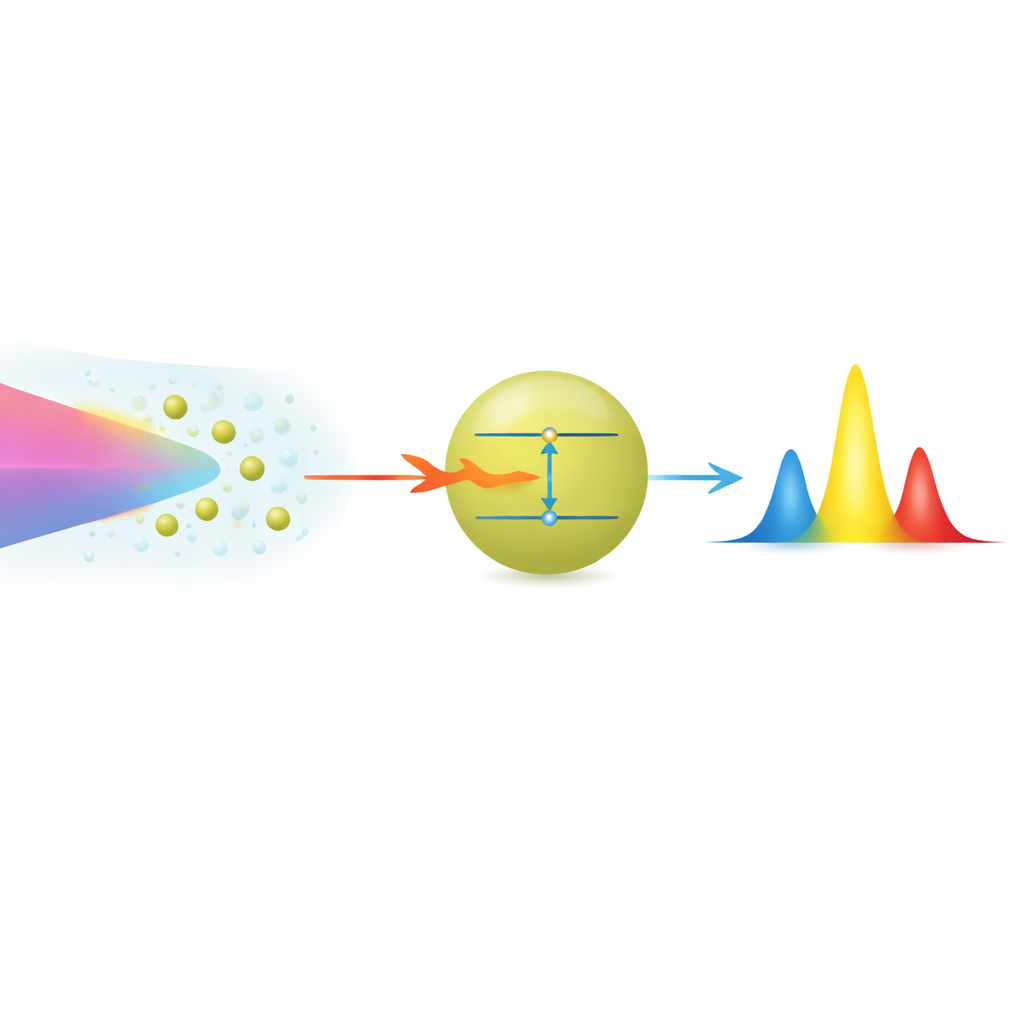
Hitting the sweet spot: resonant control
The most striking behavior emerges when the laser is tuned exactly to the clusters’ main exciton transition. In this resonant case, light and matter strongly mix to form new “dressed” states that are part light and part electronic excitation. Instead of a single absorption feature, the spectrum briefly shows a central dip flanked by two side features — a Mollow-like pattern previously famous in atom and quantum dot experiments at cryogenic temperatures. By carefully separating this fleeting coherent signal from longer-lived excited populations using global fitting of the time-resolved data, the authors verify that the sidebands move farther apart in direct proportion to the strength of the laser’s electric field, a hallmark of true resonant Rabi splitting.
Linearly polarized excitons as a built-in filter
A key ingredient in these experiments is that the band-edge exciton transition in Cd3P2 magic-size clusters is strongly linearly polarized. The researchers demonstrate this by using polarization-resolved photoluminescence and pump–probe measurements. When pump and probe pulses share the same linear polarization, the transient signal is about three times stronger than when they are crossed, yielding an anisotropy close to the theoretical maximum for a perfectly aligned dipole. This built-in directionality lets them use cross-polarized geometries to suppress stray light from the driving pulse, making the delicate coherent features around time zero stand out even in room-temperature, solution-based samples.
Measuring the strength of light–matter coupling
Because the clusters behave so cleanly, the authors can translate how much the absorption peak shifts or splits into a quantitative measure of how strongly the exciton couples to light. Under non-resonant driving, the energy shift scales with laser intensity, while under resonant driving, the Rabi splitting scales with the electric field amplitude. Both routes independently point to a transition dipole moment exceeding 20 Debye—remarkably large for such tiny objects, and comparable to or larger than that of much bigger semiconductor quantum dots. This indicates that the extreme confinement in magic-size clusters concentrates oscillator strength into the band-edge exciton, enabling strong optical responses with modest pulse energies. 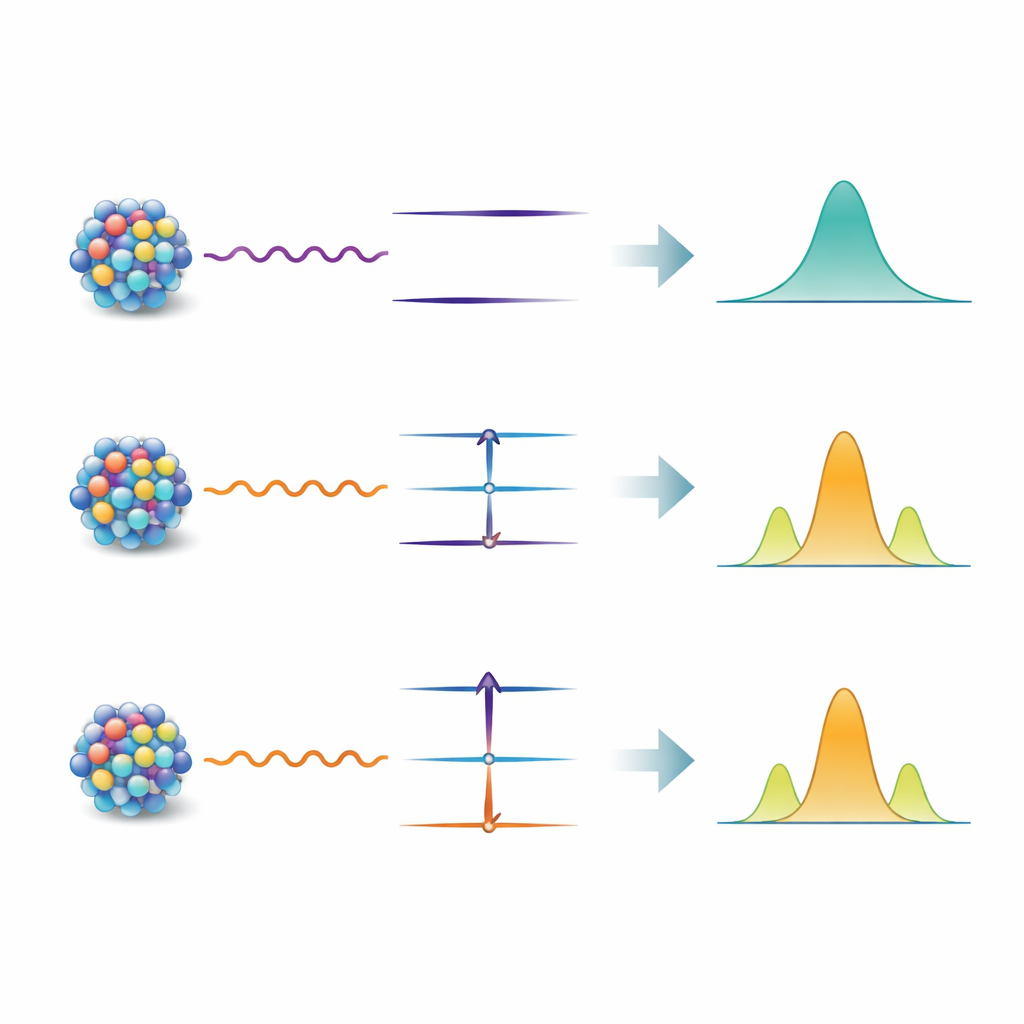
What this means for future photonics
In accessible terms, this work shows that a beaker of carefully crafted nanoclusters can mimic the clean, controllable behavior of single atoms under strong laser driving, and can do so at room temperature. By revealing both non-resonant level shifting and resonant Mollow-like splitting in the same system, and by quantifying the unusually large light–matter coupling, the study positions Cd3P2 magic-size clusters as a promising platform for future experiments on quantum interference, gain without population inversion, and ultrafast optical control. In the long term, such capabilities could help bridge fundamental quantum optics and practical optoelectronic devices made from solution-processed materials.
Citation: Liu, Y., Li, Y., Yang, Y. et al. Resonant and non-resonant driving of linearly-polarized excitons in Cd3P2 magic-size clusters. Nat Commun 17, 4022 (2026). https://doi.org/10.1038/s41467-026-70674-y
Keywords: coherent light–matter interaction, magic-size clusters, exciton dynamics, optical Stark effect, Rabi splitting