Clear Sky Science · en
The COP1-ADA2b module mediates light regulation of DNA double-strand break repair in Arabidopsis
Why light and DNA repair matter for plants
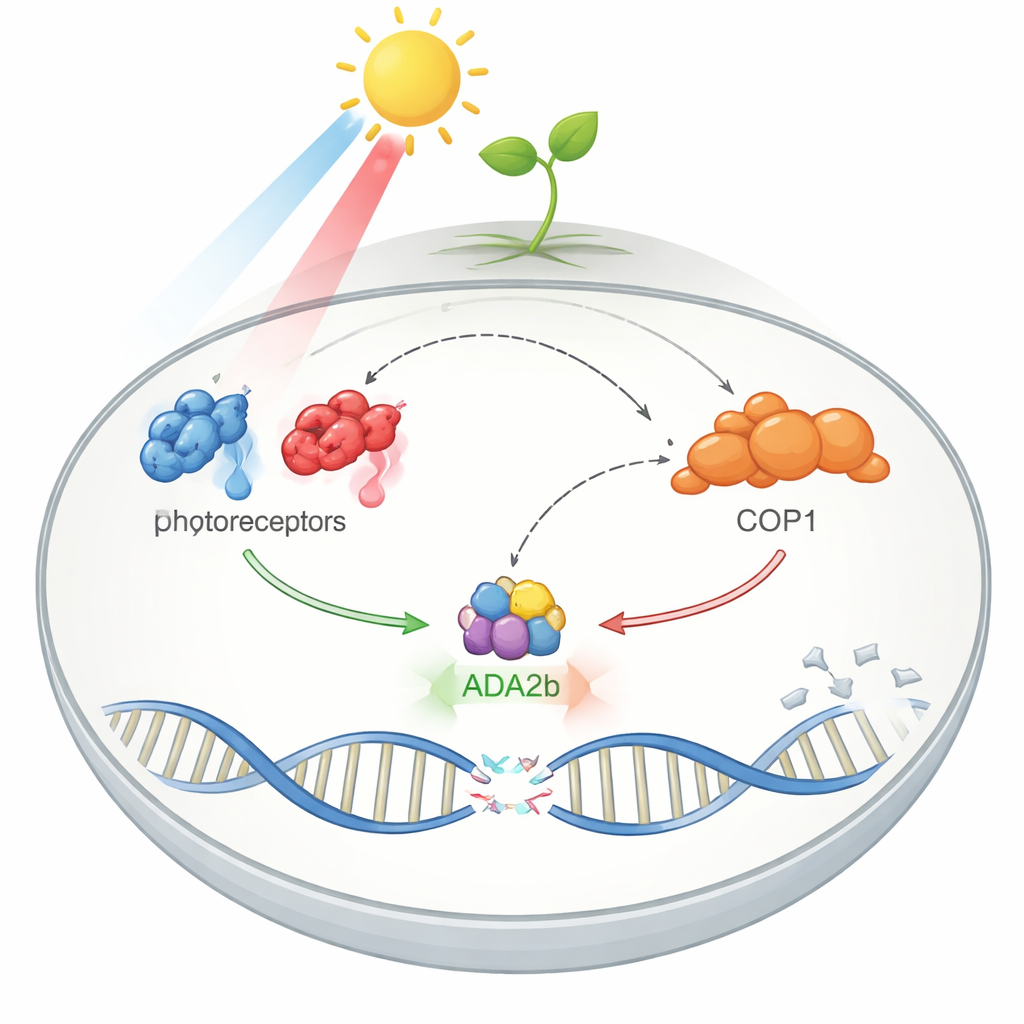
Plants can’t run away from sunlight, yet the same light that powers photosynthesis also damages their DNA. When the DNA double helix breaks, the cell must repair it quickly but carefully: too little repair leads to mutations, while too much or misdirected repair can scramble the genome. This study in the model plant Arabidopsis uncovers how light-sensing proteins and a central growth regulator work together as a molecular "brake and accelerator" to fine‑tune DNA repair according to changing light conditions.
A dangerous kind of DNA injury
The researchers focus on DNA double‑strand breaks, where both strands of the DNA helix snap. These are among the most lethal forms of damage because they can cause chromosome breakage and large‑scale rearrangements. Plants repair such breaks mainly through two pathways: a quick but error‑prone method that simply rejoins loose ends, and a slower, more accurate method that copies information from an intact template. In Arabidopsis, a protein called ADA2b helps recruit a protein complex named SMC5/6 to the broken DNA, steering the cell toward the more accurate repair route. Earlier work had shown that blue‑light receptors called cryptochromes enhance ADA2b’s action and promote repair, but it was unknown whether any component of the light‑response machinery actively holds repair back.
A molecular tug‑of‑war over ADA2b
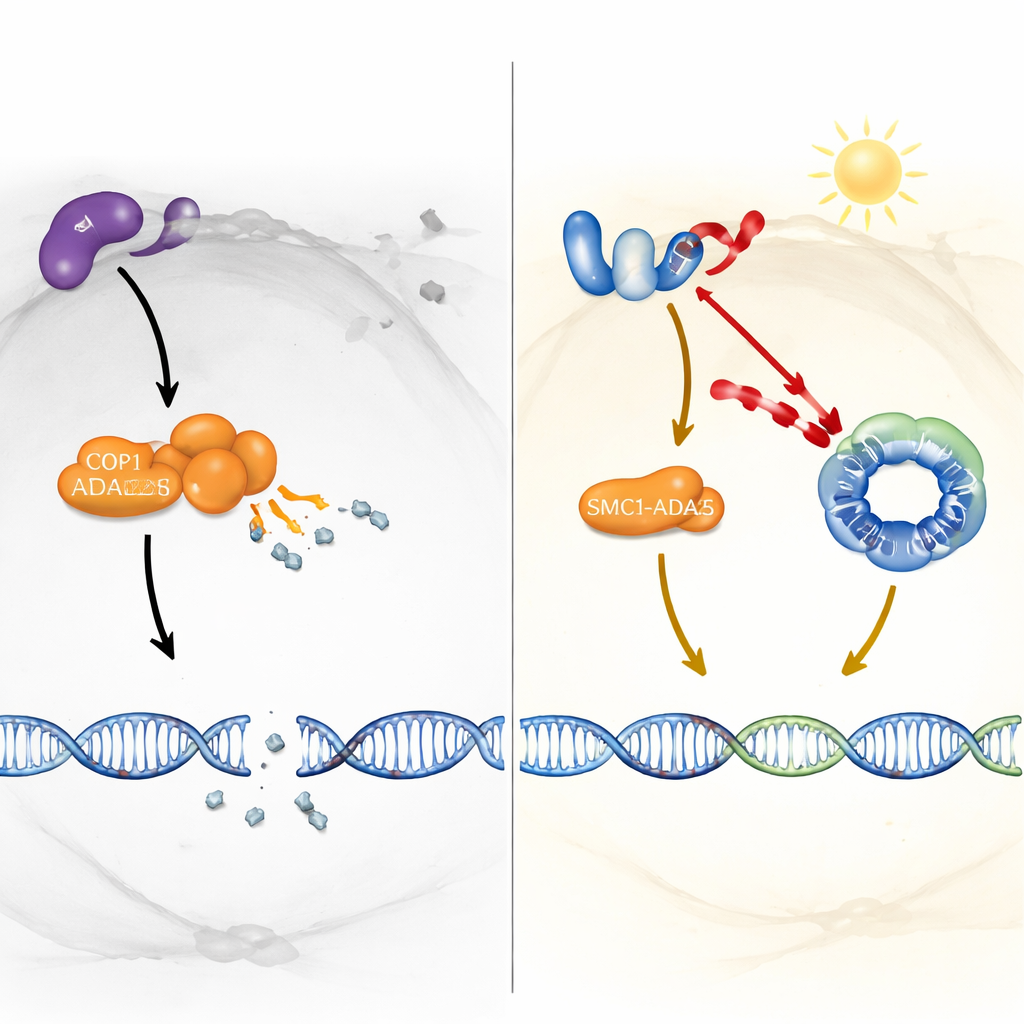
This study identifies the E3 ubiquitin ligase COP1 as a key negative regulator of ADA2b in the dark. COP1 is already famous in plant biology as a master repressor of light‑driven development. Here, biochemical and imaging experiments in yeast, tobacco, and Arabidopsis show that COP1 physically binds the C‑terminal part of ADA2b inside the nucleus. Once bound, COP1 tags ADA2b with ubiquitin, a small protein that marks it for destruction by the cell’s 26S proteasome. In seedlings kept in darkness, ADA2b is heavily ubiquitinated and rapidly degraded, whereas light exposure sharply reduces both its interaction with COP1 and its ubiquitination, allowing ADA2b protein to accumulate.
Light sensors tip the balance toward repair
The team then asked how different colors of light control this balance. They confirmed that blue, red and far‑red light all increase ADA2b levels, and showed that this rise depends on the corresponding photoreceptors: cryptochromes for blue light, and phytochromes phyA and phyB for red and far‑red light. In mutants lacking these photoreceptors, ADA2b accumulation after light exposure is blunted and DNA damage builds up. Further tests reveal that activated cryptochromes and phyB can weaken the COP1–ADA2b interaction, likely by competing for COP1 binding surfaces. Under continuous blue or red light, seedlings missing cryptochromes or phyA/phyB degrade ADA2b faster than normal plants, consistent with the idea that light receptors normally shield ADA2b from COP1‑driven destruction.
When the brake is broken
To explore the consequences for whole plants, the authors studied a partial‑loss mutant of COP1, called cop1‑4. In the dark or under dim light, cop1‑4 seedlings have longer roots, larger root meristems, and less endogenous DNA damage than wild type, suggesting that their cells experience fewer unrepaired breaks. When exposed to ultraviolet radiation or chemicals that induce DNA double‑strand breaks, cop1‑4 plants retain more fresh weight and show fewer DNA damage markers, indicating enhanced resistance. Crucially, combining cop1‑4 with mutations in ADA2b abolishes this protection: DNA damage again accumulates and growth suffers. Microscopy of tagged proteins shows why: in cop1‑4 seedlings, ADA2b persists even in darkness and is able to recruit more SMC5 to break sites, whereas in plants lacking ADA2b this recruitment fails.
A light‑regulated safety dial for plant genomes
Taken together, the findings reveal a COP1–ADA2b module that links light perception to DNA repair. In darkness, active COP1 acts as a brake by destroying ADA2b, limiting the recruitment of the SMC5/6 complex and constraining high‑fidelity repair. When seedlings emerge into the light, cryptochromes and phytochromes are activated; they inhibit COP1 and allow ADA2b to build up and guide SMC5/6 to broken DNA, improving repair accuracy. The authors propose that this antagonistic system functions like a tunable dial, letting plants balance genome protection with growth demands as light conditions change—prioritizing rapid, error‑tolerant growth in the dark and more meticulous repair once sunlight, and the DNA damage it brings, becomes a daily reality.
Citation: Chen, L., Diao, L., Ruan, J. et al. The COP1-ADA2b module mediates light regulation of DNA double-strand break repair in Arabidopsis. Nat Commun 17, 3876 (2026). https://doi.org/10.1038/s41467-026-70673-z
Keywords: plant DNA repair, light signaling, Arabidopsis, COP1, photoreceptors