Clear Sky Science · en
Saccades orchestrate intraocular glucose dynamics to shape visual responses in birds
How Quick Eye Flicks Keep Bird Vision Sharp
Birds are famous for their razor-sharp vision, yet their eyes lack the fine network of blood vessels that nourishes our own retinas. This raises a puzzle: how do bird eyes power such demanding visual work without the usual plumbing? This study in pigeons reveals an unexpected answer — each rapid eye flick, or saccade, doesn’t just shift where a bird is looking; it also helps pump sugar-rich fluid inside the eye, quietly fueling the machinery of sight.
A Retina That Works Without Blood Vessels
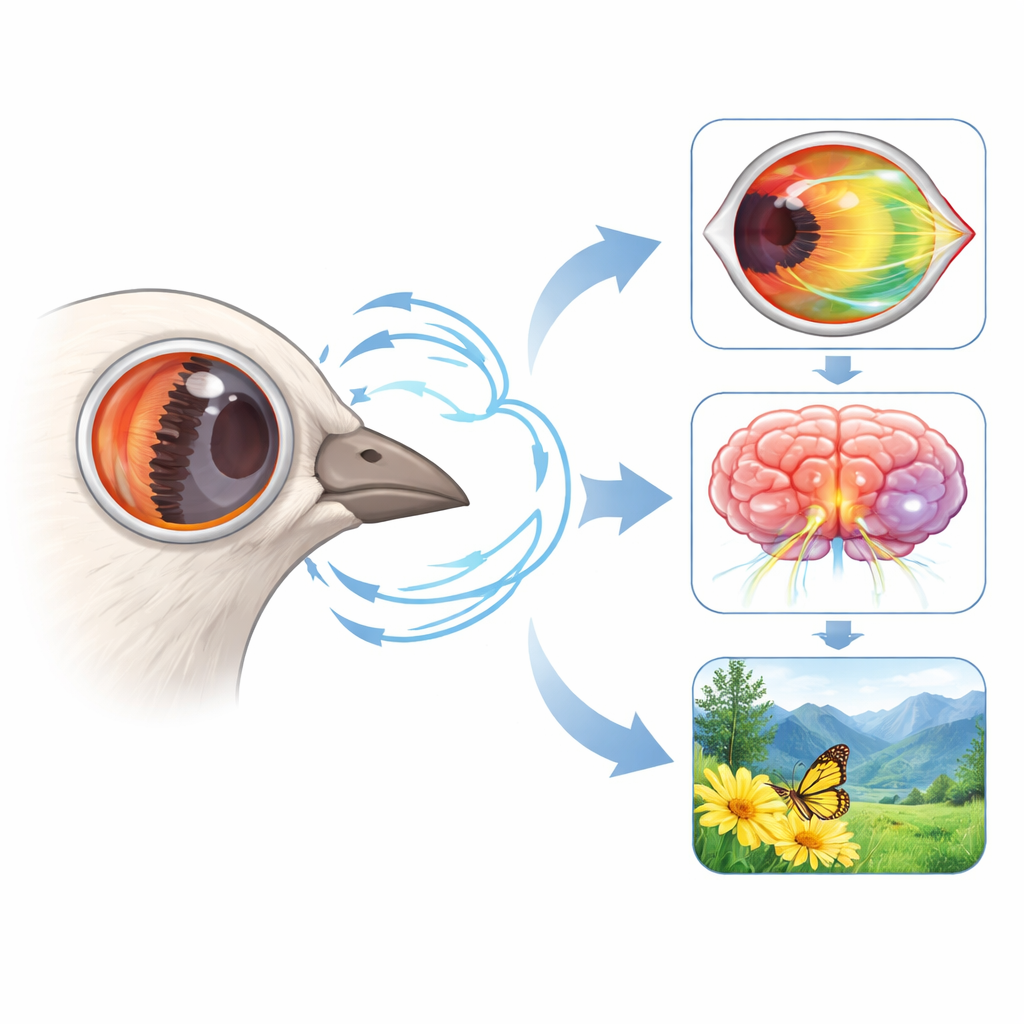
In most mammals, tiny blood vessels spread across the retina to bring oxygen and glucose, the brain’s main fuel. Birds, by contrast, have thick, energy-hungry retinas but no such vessels. Instead, they possess a dark, comb-shaped structure called the pecten that sticks into the eye’s internal fluid. The authors wondered whether birds might use their distinctive eye movements to move nutrients from this structure to the retina. Pigeons, like many other birds, make frequent saccades that are accompanied by brief twisting oscillations of the eyeball. The team suspected that these motions might act like an internal stirrer, boosting the spread of glucose from the pecten toward the light-sensing tissue.
Eye Movements That Stir Up Fuel
To test this idea, the researchers recorded eye movements and continuously monitored glucose levels inside the eyes of awake, head-fixed pigeons viewing different scenes. When screens switched from dark to bright, or from a plain gray field to lively social videos, the birds increased their saccades and accompanying oscillations. A few minutes later, the glucose level inside the eye rose as well. When the visual scenes became less engaging, both the rate of saccades and the intraocular glucose level dropped. Careful timing analyses showed that changes in glucose consistently lagged behind changes in eye-movement activity by about three to four minutes, suggesting that repeated saccades gradually pump extra fuel toward the retina.
From Eye Motion to Brain Signals
The team then asked how this mechanically driven fuel supply affects visual processing in the brain. They recorded from neurons in three key regions that receive direct input from the retina while presenting brief moving grating patterns. Even though responses were measured during steady fixation, each neuron’s response strength depended on what the eyes had been doing beforehand. After several minutes of more frequent saccades, neurons tended to respond more strongly to the same visual pattern, matching the time course of the glucose rise. On much shorter time scales of a few seconds, responses were weaker immediately after a saccade and grew stronger as more time elapsed, consistent with nutrients diffusing outward from the pecten across the retina after each movement.
Proving the Role of Glucose and Saccades
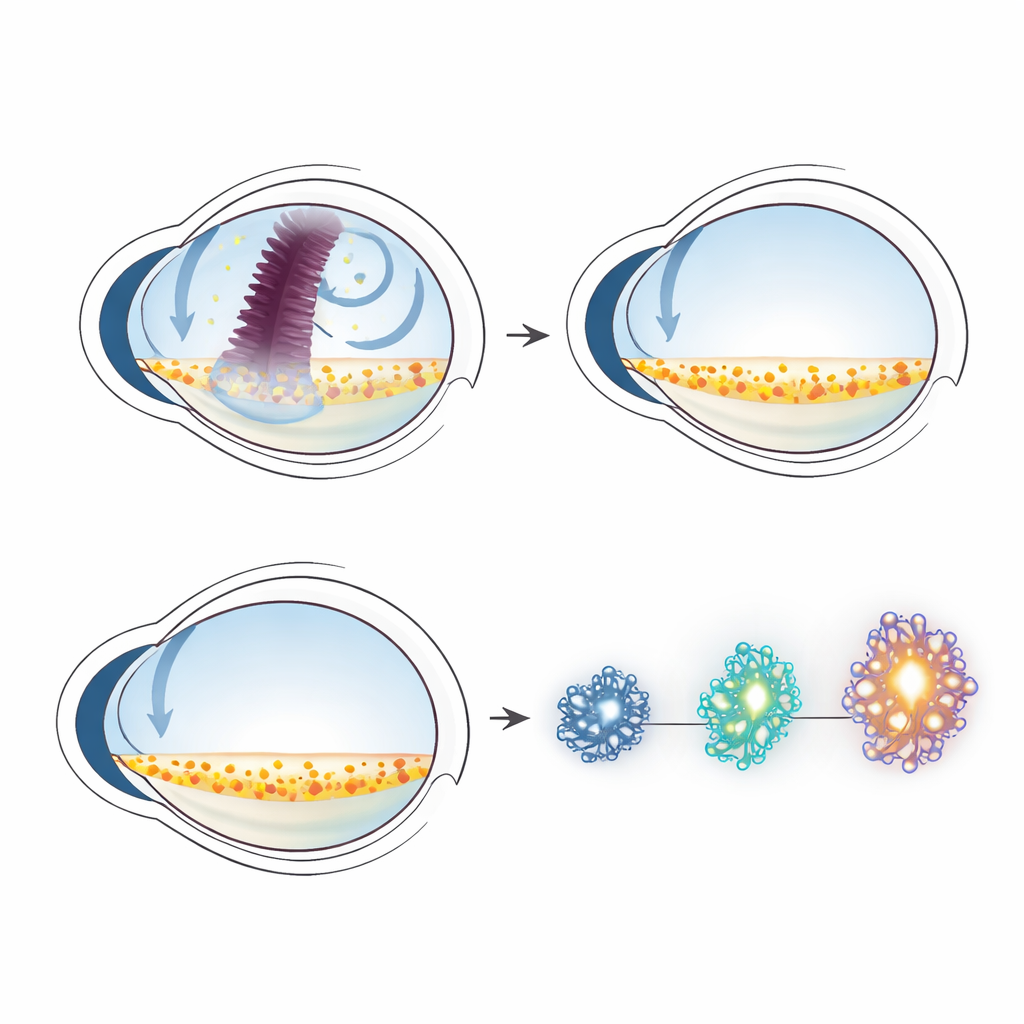
Correlation alone is not enough to show cause and effect, so the authors directly altered glucose levels and eye movements. When they injected extra usable glucose into the eye, neurons in visual brain areas fired more vigorously to the same stimulus within seconds, without any change in how often the birds moved their eyes. Blocking a major glucose transporter had the opposite effect, lowering local glucose and weakening visual responses. In a separate set of experiments, they silenced a brainstem region that generates the characteristic avian saccadic oscillations. Saccades nearly vanished, intraocular glucose fell, and visual responses in all three brain regions declined, again with a delay of about three minutes. Together, these manipulations show that saccades help maintain retinal fuel levels, and that this fuel in turn controls how strongly visual signals are transmitted.
Why This Hidden Pump Matters
This work reveals that in birds, eye movements serve a double duty. They not only redirect gaze to interesting parts of the world, but also act as tiny internal pumps that keep glucose flowing from the pecten to the retina. Over seconds, individual saccades briefly enhance local nutrient delivery; over minutes, a history of frequent saccades raises overall retinal sensitivity. In the absence of retinal blood vessels, this movement-driven fuel system appears to be a key adaptation that allows birds to sustain high-acuity vision. The study suggests that how an animal looks at the world is tightly intertwined with how it powers the very cells that make seeing possible.
Citation: Xu, X., Xiao, T., Chen, Y. et al. Saccades orchestrate intraocular glucose dynamics to shape visual responses in birds. Nat Commun 17, 4173 (2026). https://doi.org/10.1038/s41467-026-70672-0
Keywords: avian vision, saccadic eye movements, retinal metabolism, glucose transport, pecten oculi