Clear Sky Science · en
Submicrowatt-driven near-infrared luminescence from perovskite-fluoride quantum-cutting heterostructures for gas sensing
Lighting Up Invisible Fingerprints
Every breath of air around us is a complex mix of gases, many of which are invisible, odorless, and hard to track. Yet their subtle "fingerprints" in near‑infrared light can reveal pollution, industrial leaks, and even the make‑up of distant planets. This paper reports a new kind of tiny glowing particle that can turn very weak everyday light into a rich spread of near‑infrared colors, enabling sensitive, multi‑gas detection with far less power than today’s specialized lasers require.
Why Hidden Colors Matter
Near‑infrared light—just beyond what our eyes can see—interacts with molecules in ways that are highly specific. Each gas absorbs certain narrow colors, much like a barcode. Current sensing systems typically use single‑color infrared lasers tuned to one gas at a time, which makes them expensive and limited in the number of gases they can monitor. The authors aim to build a light source that covers a broad swath of near‑infrared colors at once, so that many gases can be detected simultaneously, while also working under very low power so it can be practical for compact instruments and remote sensing.
Building a Light‑Converting Nano Lantern
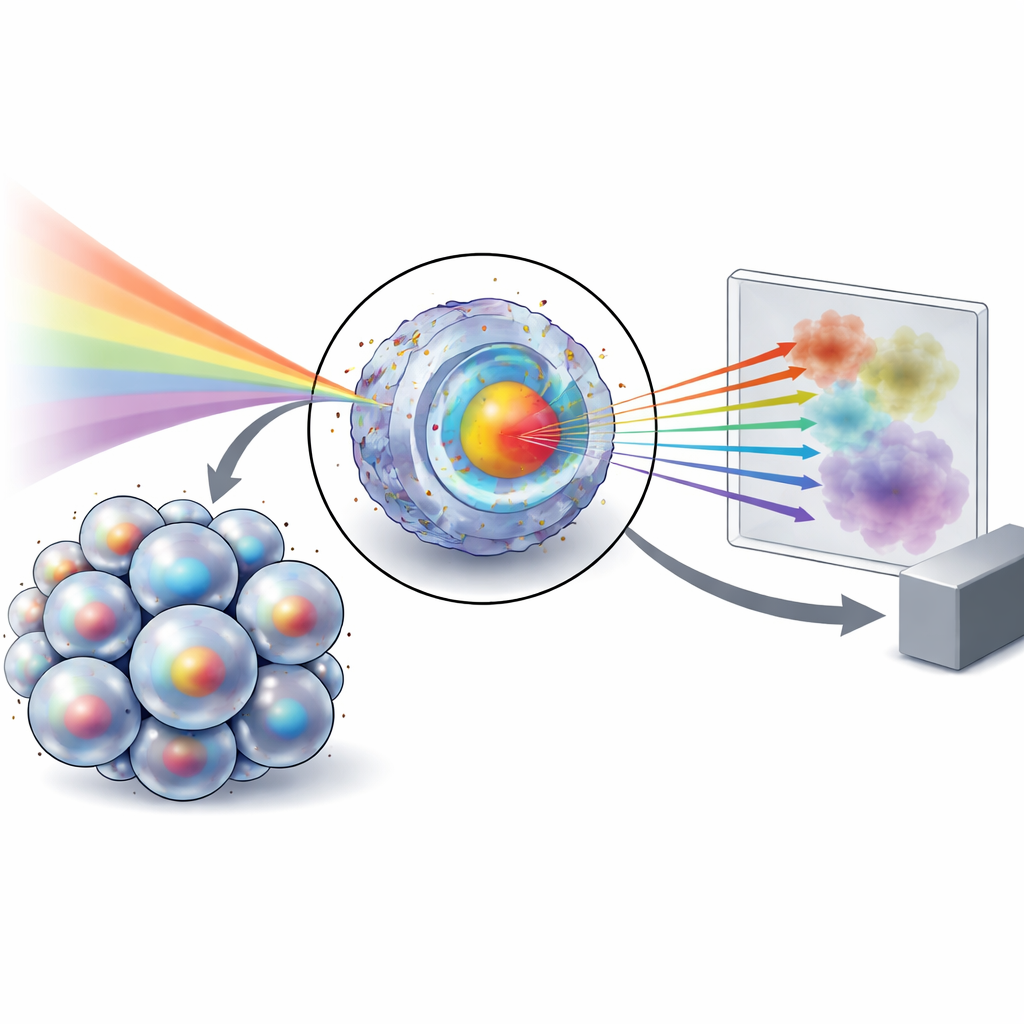
The team’s solution is a carefully layered nanoparticle—thousands of times smaller than the width of a human hair—that behaves like a tiny lantern for invisible light. At its heart sits a perovskite core, a semiconductor crystal known for soaking up ultraviolet and visible light extremely well. Surrounding this is a shell made of a fluoride material that can host a high density of special metal ions called lanthanides, which are excellent near‑infrared emitters. The researchers dope both the core and shell with ytterbium ions, which act as go‑betweens, and add other lanthanides such as erbium, holmium, and thulium in different layers to produce emission at several distinct near‑infrared wavelengths.
How Energy Flows Through the Layers
When weak ultraviolet or visible light hits the perovskite core, it does more than simply glow once and fade. Instead, a process known as "quantum cutting" allows one high‑energy photon to be converted into two lower‑energy quanta that excite ytterbium ions. These excited ytterbium ions then hand off their energy across the boundary between core and shell to ytterbium ions in the fluoride layer, which in turn pass it to the outer lanthanide ions. This cascading hand‑off channels energy efficiently from a broad range of incoming colors into several narrow near‑infrared outputs. The authors map this pathway in detail, showing that the core‑to‑ytterbium‑to‑lanthanide route dominates and that energy transfer along it can reach efficiencies above seventy percent.
From Single Dots to Multi‑Color Glow
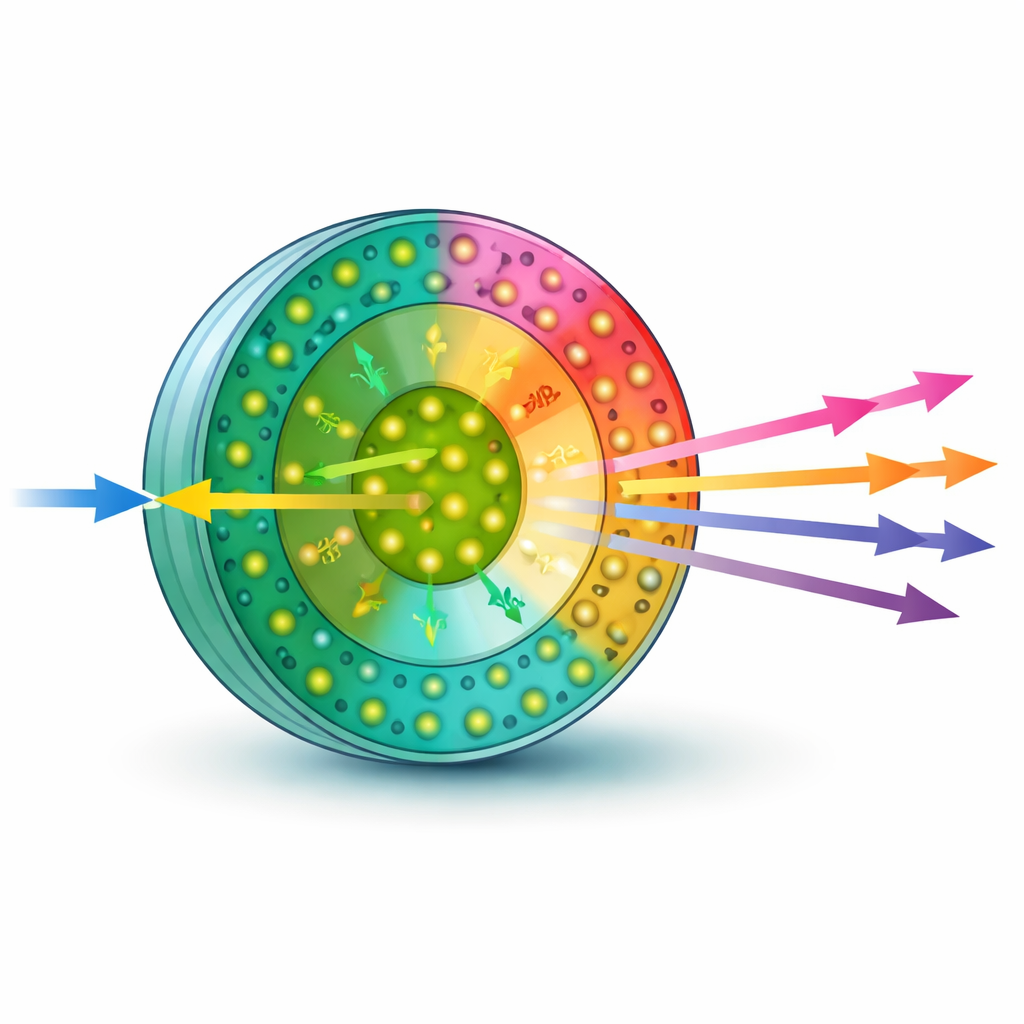
By stacking multiple active shells on a single nanoparticle, the researchers combine several near‑infrared colors into one source, spanning roughly 900 to 2200 nanometers. They fine‑tune the composition of each layer to control which colors appear and how strong they are, even using an additional helper ion (cerium) to steer energy into specific emission channels. Remarkably, these particles can be driven not by a powerful laser, but by extremely weak light—down to about fifty microwatts per square centimeter—hundreds of times lower than what similar materials previously needed. Under simple white‑light illumination, a single batch of particles produces a smooth, strong glow covering much of the near‑infrared region.
Turning Glow into a Multi‑Gas Meter
To turn this nano lantern into a gas sensor, the team passes its near‑infrared glow through a small gas chamber and records how the spectrum changes. Different gases nibble away at different parts of the glow, leaving telltale dips at their characteristic wavelengths. In tests with six common marker gases—including ammonia, ethanol, formaldehyde, hydrogen sulfide, ethene, and toluene—the system could track how much each gas was present down to tens of parts per million. The researchers then feed these spectral changes into a machine‑learning model that learns to recognize mixtures. Their random‑forest algorithm correctly identifies both gas types and concentrations with about 98 percent accuracy, and can even sort out simulated “planetary atmospheres” made from complex gas blends.
What This Means for Everyday and Distant Worlds
In essence, this work shows how smartly designed nanoparticles can turn weak, easily supplied light into a bright, finely structured near‑infrared source that covers many gas fingerprints at once. For a non‑expert, the key takeaway is that instead of needing a separate, expensive laser for each gas, one compact glow source can serve many at once, and do so with very little power. That opens doors for portable environmental sensors, industrial safety monitors, and even instruments aimed at reading the atmospheres of distant planets in search of subtle chemical clues.
Citation: Wang, Y., Zhou, D., Wang, R. et al. Submicrowatt-driven near-infrared luminescence from perovskite-fluoride quantum-cutting heterostructures for gas sensing. Nat Commun 17, 4101 (2026). https://doi.org/10.1038/s41467-026-70670-2
Keywords: near infrared gas sensing, luminescent nanoparticles, perovskite materials, spectroscopy, machine learning sensing