Clear Sky Science · en
Design of miniprotein inhibitors targeting complement C9 to block membrane attack complex assembly
Stopping Friendly Fire in the Blood
Our immune system carries powerful weapons that can punch holes in cells to kill invading microbes. But when this firepower misfires and attacks our own red blood cells, it can trigger life-threatening anemia and organ damage. This study explores a new way to place a last‑second brake on that process using tiny custom‑built proteins that block the final step of the attack, with the goal of treating both slow‑burn autoimmune disease and sudden, destructive bouts of hemolysis.
The Body’s Punch-Through Defense
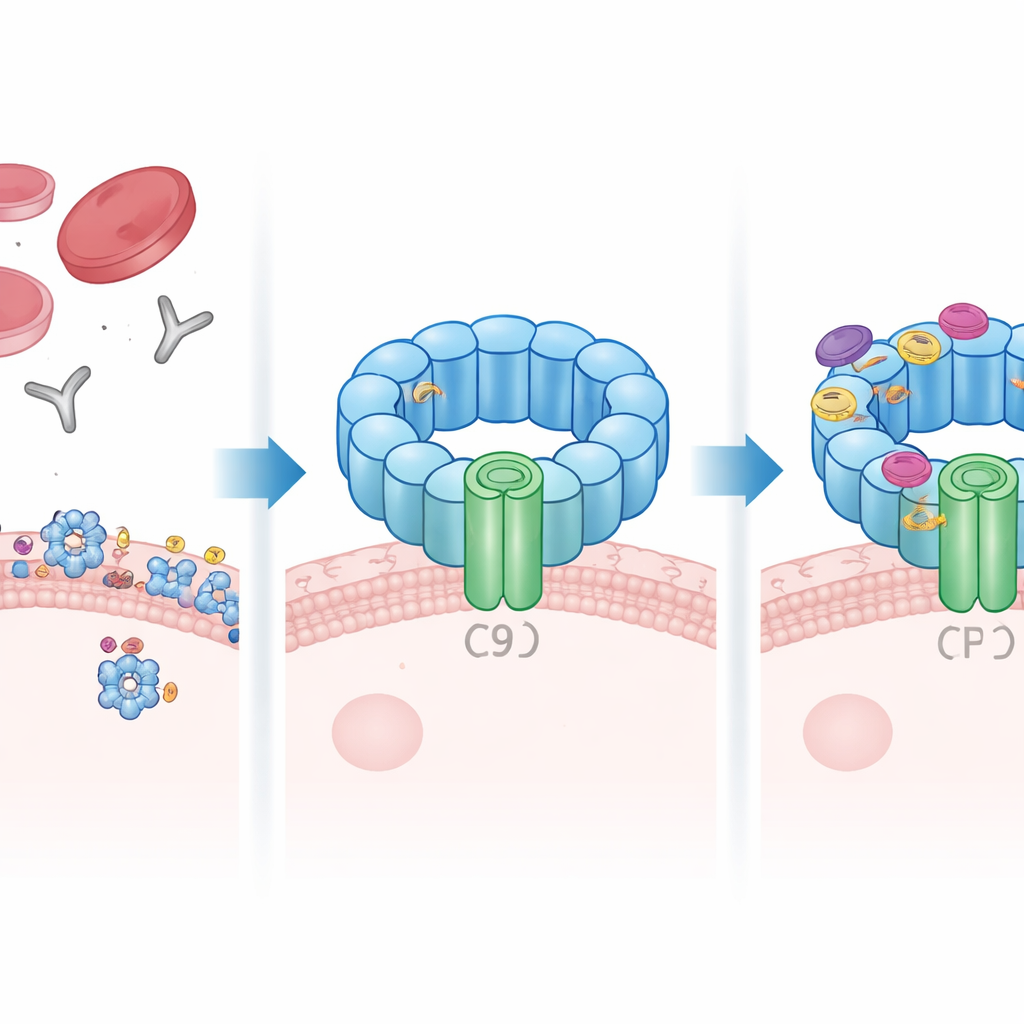
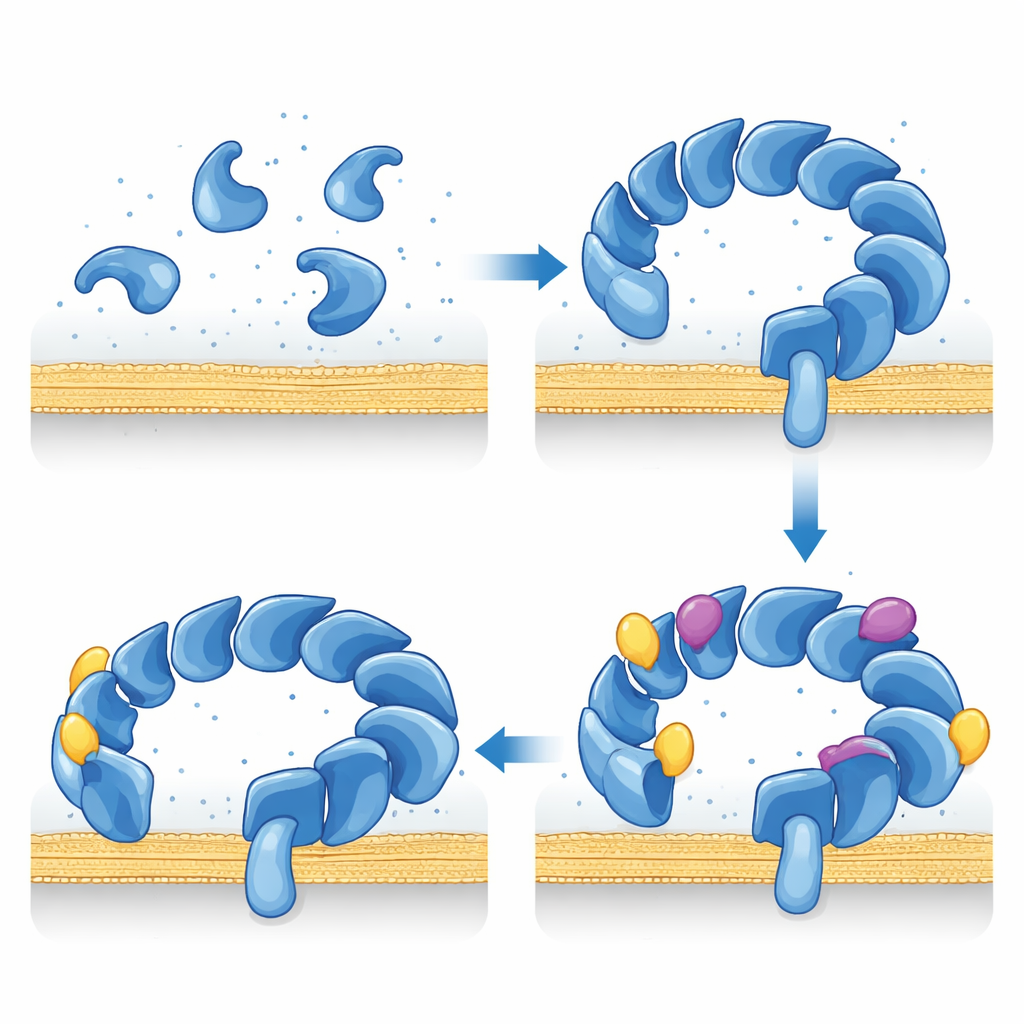
A key part of immunity, called the complement system, ends in the assembly of a protein ring known as the membrane attack complex on the surface of a target cell. This ring behaves like a microscopic drill, opening a pore that lets the cell’s contents leak out. The protein C9 is the final building block: once the first C9 unit inserts into the membrane, additional copies rapidly join to complete the pore. Errors in this process, or insufficient natural protection, underlie conditions such as paroxysmal nocturnal hemoglobinuria and severe transfusion reactions, where red blood cells are destroyed inside the bloodstream. Doctors can already block an earlier complement step using drugs like eculizumab, but that approach also dampens useful immune signals and does not always work in time during very rapid attacks.
Designing Tiny Custom Blockers
Instead of targeting an upstream switch, the authors set out to stop C9 itself from inserting into cell membranes. C9 presents a broad, flat interaction surface that has been difficult for traditional antibody discovery methods to hit with high precision. To overcome this, the team used modern deep‑learning tools to design mini‑proteins from scratch that would fit tightly onto carefully chosen patches of the C9 surface. They started from the known structure of mouse C9, defined several key “hotspot” regions where blocking should prevent pore formation, and then used AI models to generate thousands of small protein scaffolds whose shapes and sequences were predicted to bind those sites stably.
From Hundreds of Candidates to Potent Inhibitors
Out of many computer‑designed candidates, 103 mini‑proteins were produced in bacteria and tested directly in a functional blood test that measures red blood cell lysis. Only a handful showed strong protection, with one candidate, named Binder‑47, giving the best performance. Further modeling suggested that Binder‑47 should also recognize human C9, and indeed it blocked complement‑driven hemolysis in both mouse and human serum. To strengthen its effect, the researchers returned to the computer: they fed the predicted Binder‑47–C9 complex into an AI “partial diffusion” procedure that fine‑tunes the protein’s shape while preserving the basic binding mode. This second design round yielded several improved variants, two of which—P9 and P57—showed markedly higher potency and tighter binding, with affinities in the low‑nanomolar to sub‑nanomolar range.
Seeing the Fit and Proving Specificity
To confirm that design and reality matched, the team crystallized one of the optimized mini‑proteins and solved its three‑dimensional structure at atomic detail. The experimentally observed fold closely overlaid with the design model, demonstrating that the AI‑generated sequence indeed adopts the intended shape. Additional biochemical tests showed that these mini‑proteins bind specifically to C9 and not to other complement components, and that altering a few interface residues sharply reduced both binding and protection from hemolysis. Thermal stability experiments revealed that the mini‑proteins remain folded and active after brief heating to near‑boiling temperatures, in contrast to the antibody drug eculizumab, which lost activity. The small proteins also expressed at high levels and stayed soluble, key advantages for manufacturing.
Putting the Brake on Runaway Hemolysis
How well do these tiny blockers perform compared with existing therapies? In standard lab assays using human serum, P9 and P57 inhibited complement‑mediated hemolysis at concentrations similar to eculizumab and clearly outperformed two commercial anti‑C9 antibodies. In mouse serum, P57 remained active where eculizumab—which targets a human protein—had no effect. The team then turned to live‑animal studies: when human serum was injected into mice to provoke intravascular hemolysis, pre‑treatment with either the mini‑proteins or eculizumab prevented red blood cell destruction. However, when the inhibitors were given only after complement activation had already started, the C9 mini‑proteins retained strong protective power even eight minutes later, while eculizumab’s benefit dropped off after just a few minutes. This supports the idea that blocking the final pore‑forming step can act as a true last‑minute intervention.
What This Could Mean for Patients
Together, the work demonstrates that AI‑designed mini‑proteins can precisely target a difficult immune protein and halt the formation of destructive membrane pores. By focusing on C9, these inhibitors may preserve more of the upstream immune signaling than current drugs, while offering a wider window to intervene in sudden hemolytic crises such as severe transfusion reactions or cold‑induced hemolysis. At the same time, the authors note that long‑term C9 blockade could raise infection risks and alter how immune complexes are cleared, so careful testing of safety, dosing, and immunogenicity will be essential. Still, the study provides both a promising new class of complement therapeutics and a blueprint for using deep learning to craft highly specific mini‑protein drugs against other challenging targets.
Citation: Li, M., Wang, N., Fu, X. et al. Design of miniprotein inhibitors targeting complement C9 to block membrane attack complex assembly. Nat Commun 17, 3827 (2026). https://doi.org/10.1038/s41467-026-70667-x
Keywords: complement system, membrane attack complex, C9 inhibitor, de novo protein design, hemolysis