Clear Sky Science · en
Shape-optimized metasurface beamformer for high-efficiency full-duplex optical wireless communications across an ultra-wide field-of-view
Why future wireless needs better light beams
As our phones and gadgets demand ever faster connections, engineers are looking beyond radio waves to light itself. Optical wireless communication sends data through narrow beams of infrared light in open air, offering huge capacity with low interference. This study shows how a new kind of ultra-thin optical device can aim such light beams efficiently across a very wide viewing area, enabling smooth, low‑delay video links even when sender and receiver sit at sharp angles to each other. 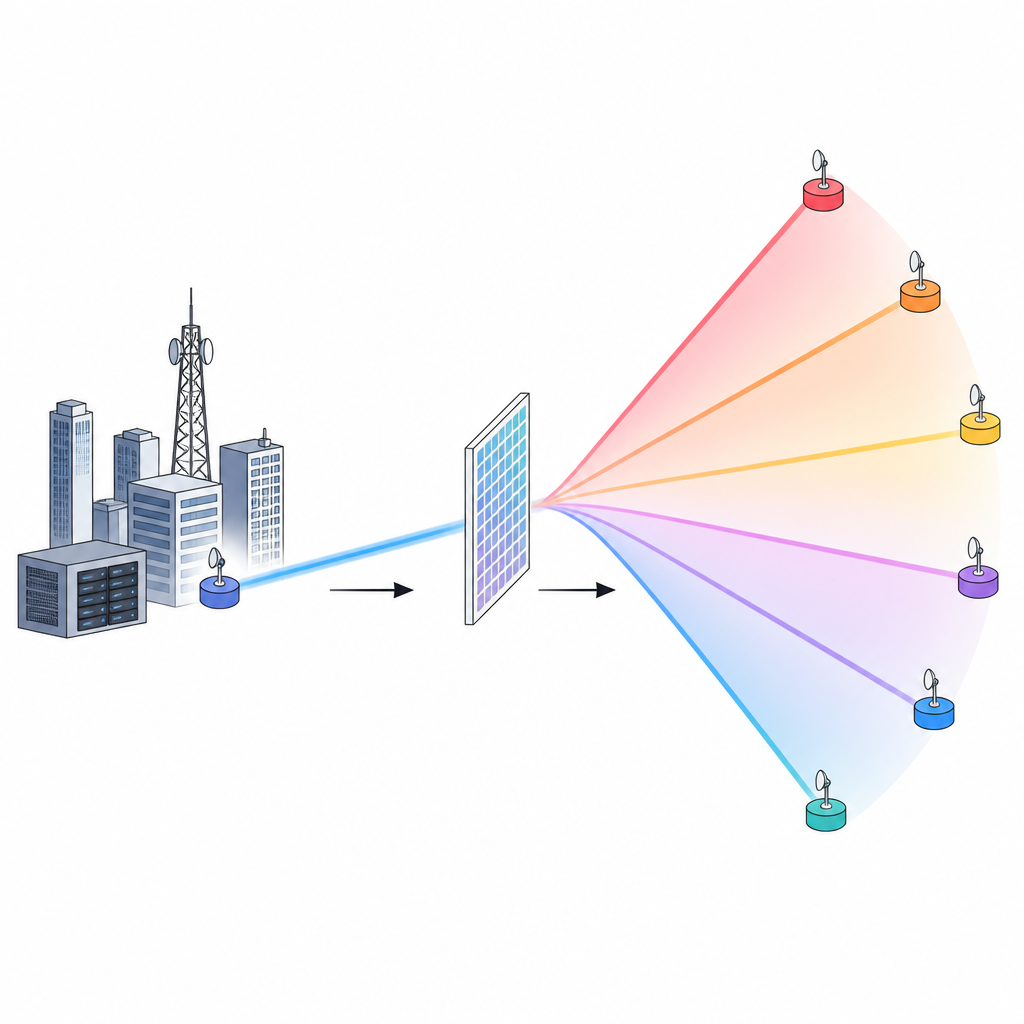
From spreading light to sharp laser-like links
Light based wireless links can be built in two basic ways. One uses spreading beams, like a lamp filling a room, which naturally cover many users but waste most of their power before it ever hits a receiver. The other uses narrow, laser-like beams that carry data over long distances with far less loss, but then you must steer those beams precisely to each device. Traditional steering tools, such as rotating mirrors or liquid crystal panels, struggle when the beam must bend to very large angles, and their efficiency drops, limiting speed and range. This bottleneck is a key barrier to using light links widely in future 6G networks.
Flat optics that bend light at extreme angles
The researchers turn to metasurfaces, extremely thin patterned films that can reshape light using tiny structures smaller than the wavelength. Conventional metasurfaces use simple shapes like cylinders, which work well for modest deflections but lose much of the light at steep angles. The team developed a new “shape optimized metasurface,” where the tiny patterns are freeform rather than regular blocks. Using a two step computer design method, they search for patterns that both steer light strongly and remain simple enough to manufacture reliably with standard chip‑making tools. The result is a family of flat optical tiles that can bend infrared beams by up to 80 degrees while still sending more than 80 percent of the energy into the desired direction, and that work similarly well no matter how the light is polarized.
Testing fast two way links over wide angles
To see what this means for real communication, the team compared their new metasurface with a regular design. They measured how much light reaches the target direction and how many data errors appear when sending digital signals. At very large angles the new surface delivered more than three times the useful beam power of the regular one, in both forward and backward directions, confirming that it can act as a highly efficient two way “beamformer.” Using it as the key optical element, they built a full‑duplex video link that connects a 5G base station to a core network while phones talk to the base station by radio. At a 60 degree bend and a distance of two meters, the optimized surface supported smooth, low‑delay high definition video calls, whereas the regular metasurface produced choppy, delayed images under the same power.
Pushing distance, speed, and coverage
The group then stressed the system in more demanding scenarios. They demonstrated a 200 meter outdoor optical link bent by 60 degrees that still maintained error free data transmission at suitable power levels, and carried real time video between two mobile devices. Next, they used nine closely spaced light colors on the same beam to create a “multi lane” channel. Over 20 meters and a 60 degree bend, this dense wavelength multiplexing achieved an overall rate of 225 gigabits per second, with all colors showing similar reliability. Finally, they designed a concept in which many such metasurface tiles are arranged in a two dimensional array and fed by a bundle of fibers, so that each tile sends its own beam in a different direction. In simulation this produces an almost fully covered half‑sphere of possible links, supporting many users around a hub at once. 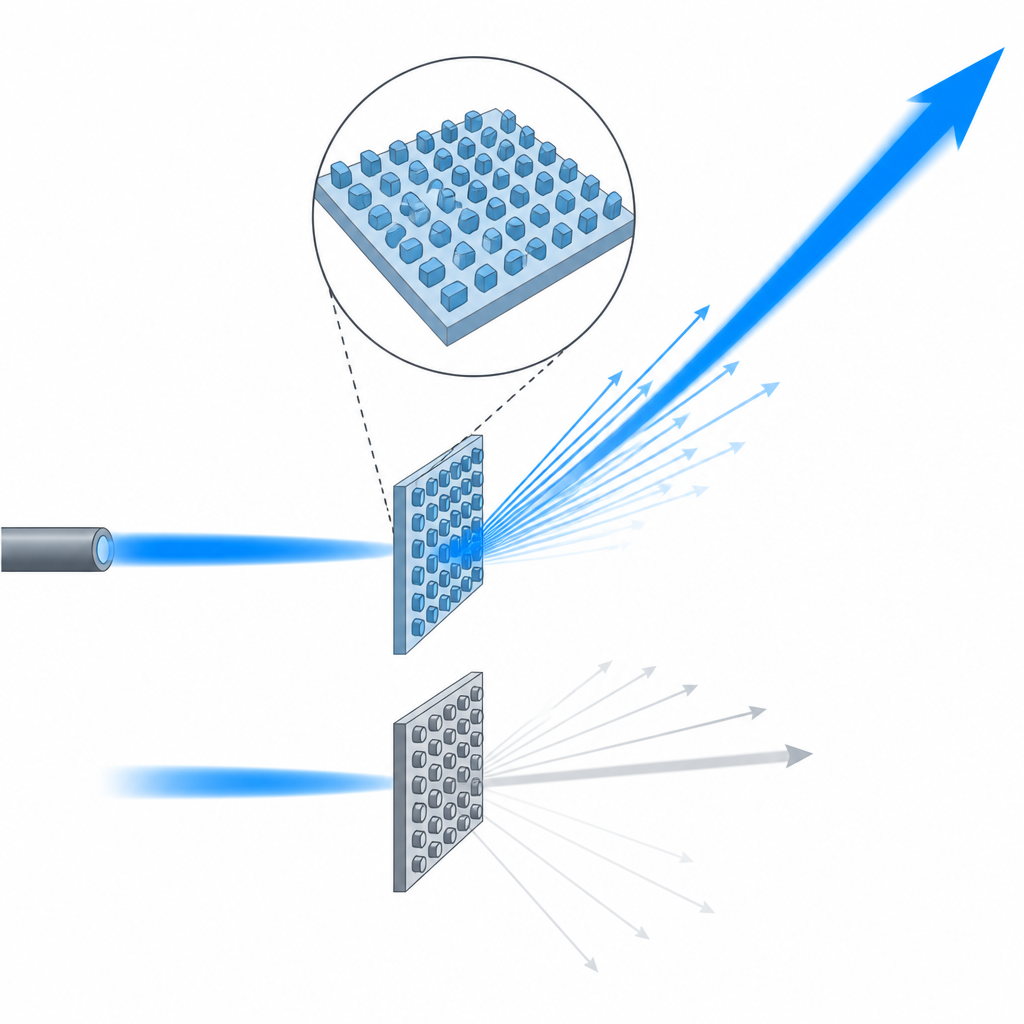
What this means for everyday connections
In plain terms, the work shows how a fingernail thin patterned film can efficiently steer light beams over almost any direction, turning optical wireless from a fragile straight line link into a flexible, wide angle option. By carefully shaping the tiny features so they are both effective and manufacturable, the authors combine high efficiency, long reach, high data rates, and compatibility with mobile radio networks. Such metasurface beamformers could one day sit in compact boxes on rooftops, drones, or lampposts, quietly bending light to route data between base stations and users, easing the load on crowded radio channels and helping power future generations of wireless communication.
Citation: Yuan, Z., Chen, J., Wang, Y. et al. Shape-optimized metasurface beamformer for high-efficiency full-duplex optical wireless communications across an ultra-wide field-of-view. Nat Commun 17, 4250 (2026). https://doi.org/10.1038/s41467-026-70665-z
Keywords: optical wireless communication, metasurface beamforming, free-space optics, 6G networks, beam steering